


Vitamin K2 (Menaquinone-7) supplementation does not affect vitamin K-dependent coagulation factors activity in healthy individuals
- PMID: 34115006
- PMCID: PMC8202544
- DOI: 10.1097/MD.0000000000026221
Vitamin K2 (Menaquinone-7) supplementation does not affect vitamin K-dependent coagulation factors activity in healthy individuals
Abstract
Background: Vitamin K has long been regarded as a procoagulant drug by physicians, and concerns have been raised with regard to its effects on hemostasis. Although many studies have shown that vitamin K supplementation is safe for thrombotic events, the effect of vitamin K supplementation on the activities of vitamin K dependent procoagulation factors in healthy individuals is not available.
Objectives: This study aimed to investigate whether vitamin K2 supplementation at recommended doses affects the activity of vitamin K dependent procoagulation factors in healthy individuals without any anticoagulation treatment.
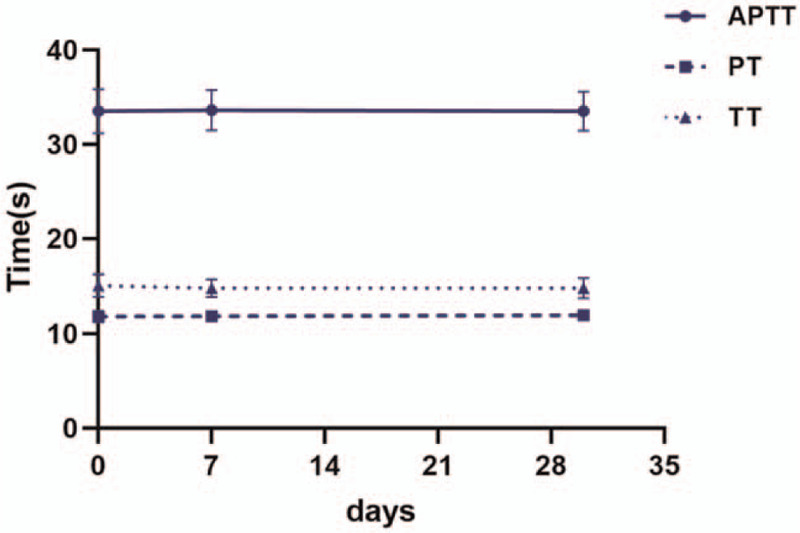
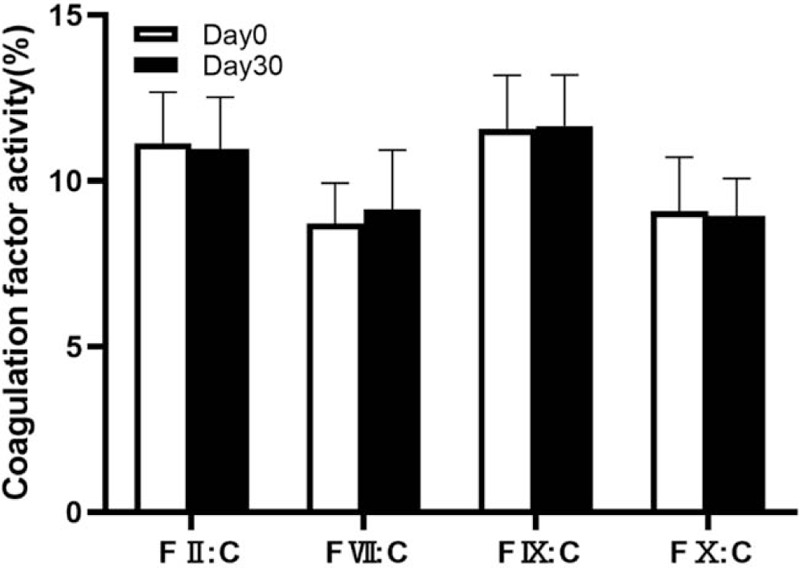
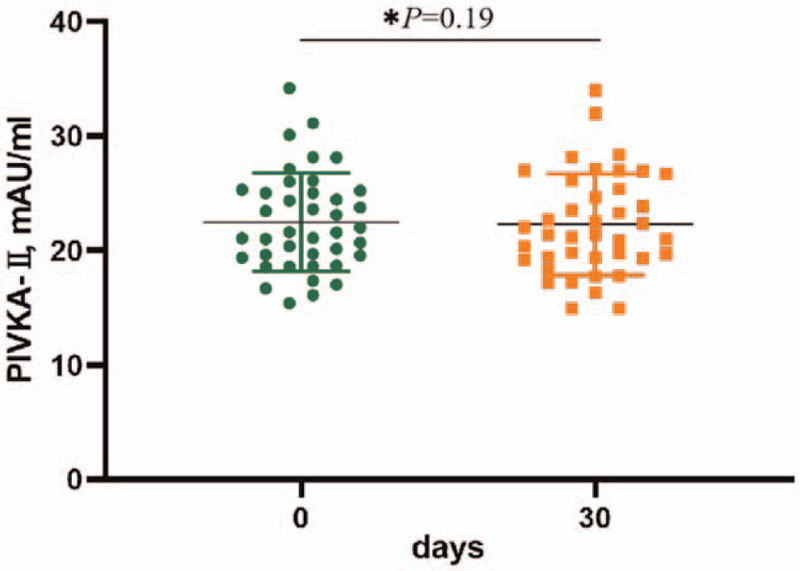
Design: Forty healthy volunteers between 25 and 40 years of age were recruited. Menaquinone-7 (MK-7) was administrated at 90 μg for 30 days. Prothrombin time (PT), activated partial thromboplastin time (APTT), thrombin time (TT), and blood coagulation factors II, VII, IX, and X activities and Protein induced by vitamin K absence or antagonist-II (PIVKA-II) were measured on days 0 and 30 after MK-7 administration.
Results: PT, APTT, and TT showed no significant differences on day 30 when compared with baseline. The activities of coagulation factors II, VII, IX, and X on day 30 showed no significant differences with those at baseline. PIVKA-II levels were unchanged after 30 days of MK-7 supplementation.
Conclusions: MK-7 supplementation at recommended dosage does not affect vitamin K-dependent coagulation factors' coagulation activity, and does not enhance the carboxylation of prothrombin in healthy individuals. This indicated that MK-7 administration does not alter hemostatic balance in healthy populations without anticoagulation treatment.
Copyright © 2021 the Author(s). Published by Wolters Kluwer Health, Inc.
Conflict of interest statement
The authors have no conflicts of interests to disclose.
Figures
References
-
- Schurgers LJ, Teunissen KJ, Hamulyak K, et al. . Vitamin K-containing dietary supplements: comparison of synthetic vitamin K1 and natto-derived menaquinone-7. BLOOD 2007;109:3279–83. - PubMed
-
- Cockayne S, Adamson J, Lanham-New S, et al. . Vitamin K and the prevention of fractures: systematic review and meta-analysis of randomized controlled trials. Arch Intern Med 2006;166:1256–61. - PubMed
-
- Knapen MH, Drummen NE, Smit E, Vermeer C. Three-year low-dose menaquinone-7 supplementation helps decrease bone loss in healthy postmenopausal women. Osteoporos Int 2013;24:2499–507. - PubMed
-
- Geleijnse JM, Vermeer C, Grobbee DE, et al. . Dietary intake of menaquinone is associated with a reduced risk of coronary heart disease: the Rotterdam Study. J NUTR 2004;134:3100–5. - PubMed
-
- Theuwissen E, Cranenburg EC, Knapen MH, et al. . Low-dose menaquinone-7 supplementation improved extra-hepatic vitamin K status, but had no effect on thrombin generation in healthy subjects. Br J Nutr 2012;108:1652–7. - PubMed
MeSH terms
Substances
LinkOut - more resources
Full Text Sources
Medical
