Comparison of Symptoms and RNA Levels in Children and Adults With SARS-CoV-2 Infection in the Community Setting
- PMID: 34115094
- PMCID: PMC8491103
- DOI: 10.1001/jamapediatrics.2021.2025
Comparison of Symptoms and RNA Levels in Children and Adults With SARS-CoV-2 Infection in the Community Setting
Abstract
Importance: The association between COVID-19 symptoms and SARS-CoV-2 viral levels in children living in the community is not well understood.
Objective: To characterize symptoms of pediatric COVID-19 in the community and analyze the association between symptoms and SARS-CoV-2 RNA levels, as approximated by cycle threshold (Ct) values, in children and adults.
Design, setting, and participants: This cross-sectional study used a respiratory virus surveillance platform in persons of all ages to detect community COVID-19 cases from March 23 to November 9, 2020. A population-based convenience sample of children younger than 18 years and adults in King County, Washington, who enrolled online for home self-collection of upper respiratory samples for SARS-CoV-2 testing were included.
Exposures: Detection of SARS-CoV-2 RNA by reverse transcription-polymerase chain reaction (RT-PCR) from participant-collected samples.
Main outcomes and measures: RT-PCR-confirmed SARS-CoV-2 infection, with Ct values stratified by age and symptoms.
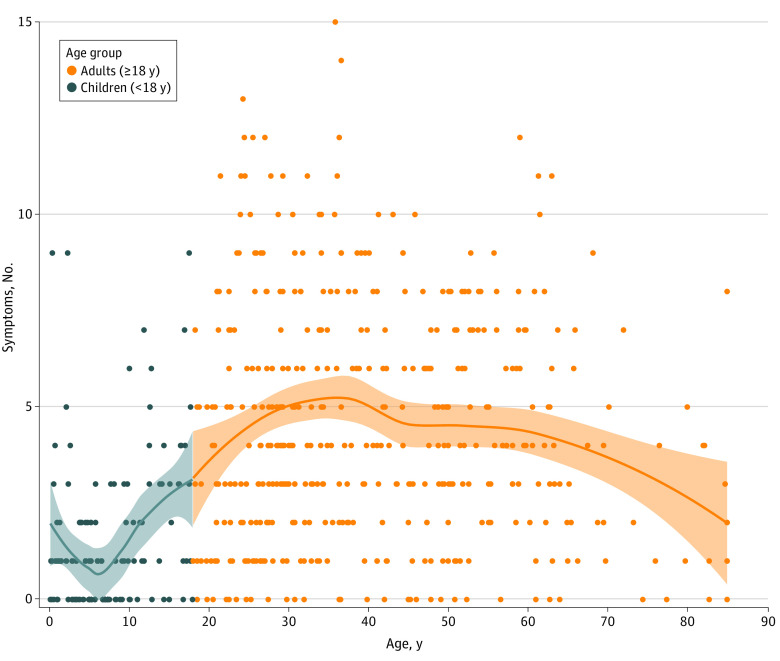
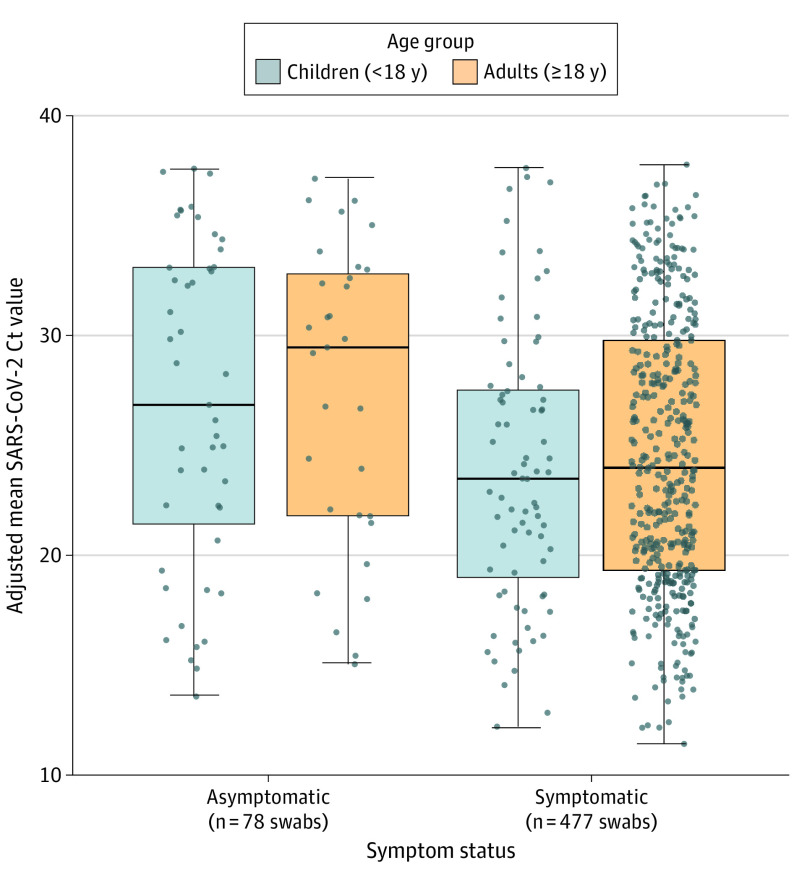
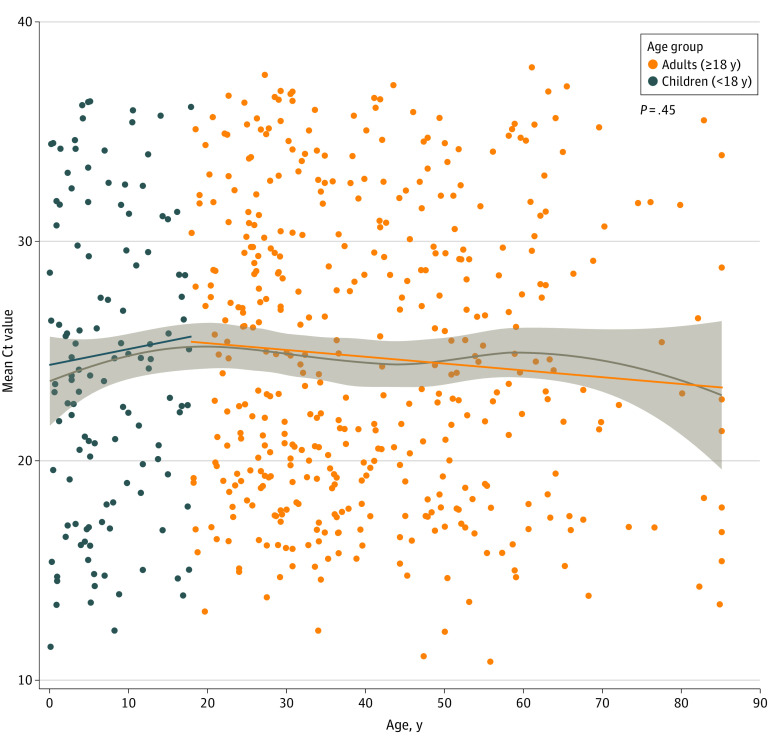
Results: Among 555 SARS-CoV-2-positive participants (mean [SD] age, 33.7 [20.1] years; 320 were female [57.7%]), 47 of 123 children (38.2%) were asymptomatic compared with 31 of 432 adults (7.2%). When symptomatic, fewer symptoms were reported in children compared with adults (mean [SD], 1.6 [2.0] vs 4.5 [3.1]). Symptomatic individuals had lower Ct values (which corresponded to higher viral RNA levels) than asymptomatic individuals (adjusted estimate for children, -3.0; 95% CI, -5.5 to -0.6; P = .02; adjusted estimate for adults, -2.9; 95% CI, -5.2 to -0.6; P = .01). The difference in mean Ct values was neither statistically significant between symptomatic children and symptomatic adults (adjusted estimate, -0.7; 95% CI, -2.2 to 0.9; P = .41) nor between asymptomatic children and asymptomatic adults (adjusted estimate, -0.6; 95% CI, -4.0 to 2.8; P = .74).
Conclusions and relevance: In this community-based cross-sectional study, SARS-CoV-2 RNA levels, as determined by Ct values, were significantly higher in symptomatic individuals than in asymptomatic individuals and no significant age-related differences were found. Further research is needed to understand the role of SARS-CoV-2 RNA levels and viral transmission.
Conflict of interest statement
Figures
Comment in
-
Implications of SARS-CoV-2 Viral Load in Children: Getting Back to School and Normal.JAMA Pediatr. 2021 Oct 1;175(10):e212022. doi: 10.1001/jamapediatrics.2021.2022. Epub 2021 Oct 4. JAMA Pediatr. 2021. PMID: 34115097 No abstract available.
-
Factors and Challenges in Understanding SARS-CoV-2 RNA Levels, Symptoms, and Transmissibility.JAMA Pediatr. 2021 Dec 1;175(12):1292-1293. doi: 10.1001/jamapediatrics.2021.3573. JAMA Pediatr. 2021. PMID: 34542579 No abstract available.
-
Factors and Challenges in Understanding SARS-CoV-2 RNA Levels, Symptoms, and Transmissibility.JAMA Pediatr. 2021 Dec 1;175(12):1293. doi: 10.1001/jamapediatrics.2021.3576. JAMA Pediatr. 2021. PMID: 34542581 No abstract available.
References
Publication types
MeSH terms
Substances
Grants and funding
LinkOut - more resources
Full Text Sources
Medical
Miscellaneous