. 2021 Aug 2;376(1830):20200213.
doi: 10.1098/rstb.2020.0213. Epub 2021 Jun 14.

A songbird adjusts its heart rate and body temperature in response to season and fluctuating daily conditions

Affiliations

A songbird adjusts its heart rate and body temperature in response to season and fluctuating daily conditions

Nils Linek et al. Philos Trans R Soc Lond B Biol Sci. .

Abstract

In a seasonal world, organisms are continuously adjusting physiological processes relative to local environmental conditions. Owing to their limited heat and fat storage capacities, small animals, such as songbirds, must rapidly modulate their metabolism in response to weather extremes and changing seasons to ensure survival. As a consequence of previous technical limitations, most of our existing knowledge about how animals respond to changing environmental conditions comes from laboratory studies or field studies over short temporal scales. Here, we expanded beyond previous studies by outfitting 71 free-ranging Eurasian blackbirds (Turdus merula) with novel heart rate and body temperature loggers coupled with radio transmitters, and followed individuals in the wild from autumn to spring. Across seasons, blackbirds thermoconformed at night, i.e. their body temperature decreased with decreasing ambient temperature, but not so during daytime. By contrast, during all seasons blackbirds increased their heart rate when ambient temperatures became colder. However, the temperature setpoint at which heart rate was increased differed between seasons and between day and night. In our study, blackbirds showed an overall seasonal reduction in mean heart rate of 108 beats min-1 (21%) as well as a 1.2°C decrease in nighttime body temperature. Episodes of hypometabolism during cold periods likely allow the birds to save energy and, thus, help offset the increased energetic costs during the winter when also confronted with lower resource availability. Our data highlight that, similar to larger non-hibernating mammals and birds, small passerine birds such as Eurasian blackbirds not only adjust their heart rate and body temperature on daily timescales, but also exhibit pronounced seasonal changes in both that are modulated by local environmental conditions such as temperature. This article is part of the theme issue 'Measuring physiology in free-living animals (Part I)'.

Keywords: bio-logging; body temperature; heart rate; songbird; wintering.


Figures
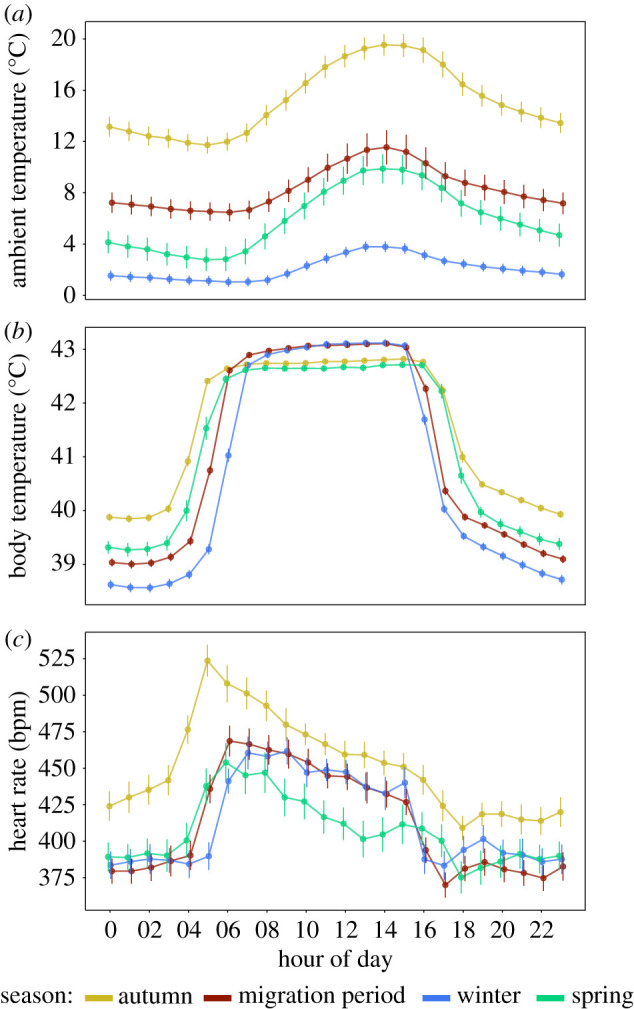
Figure 1.
Figure 1.
Daily variation in ambient temperature, body temperature, and heart rate during autumn (yellow, 1 Sep.–10 Oct.), migration period (red, 11 Oct.–20 Nov.), winter (blue, 21 Nov.–17 Feb.) and spring (green, 18 Feb.–11 Apr. 11). Plotted are hourly means across all three study years. Error bars represent 95% confidence intervals of the means and reflect the variation between days for the ambient temperature and between individuals for body temperature and heart rate.
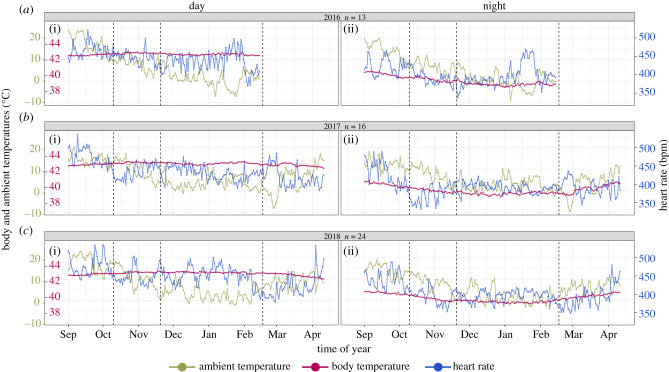
Figure 2.
Figure 2.
Ambient temperature (Ta, green, axis marks on the outer left), body temperature (Tb, red, axis marks on the inner left) and heart rate (fH, blue, axis marks on the right) of resident blackbirds in three consecutive years with corresponding sample sizes. Plotted values are means for individual days (i) and nights (ii) in the whole population. Dashed vertical lines separate the four seasons (40 days of autumn, 40 days of migration period, 90 days of winter and 53 days of spring) that we defined based upon departures of the migratory conspecifics of the partially migratory population.
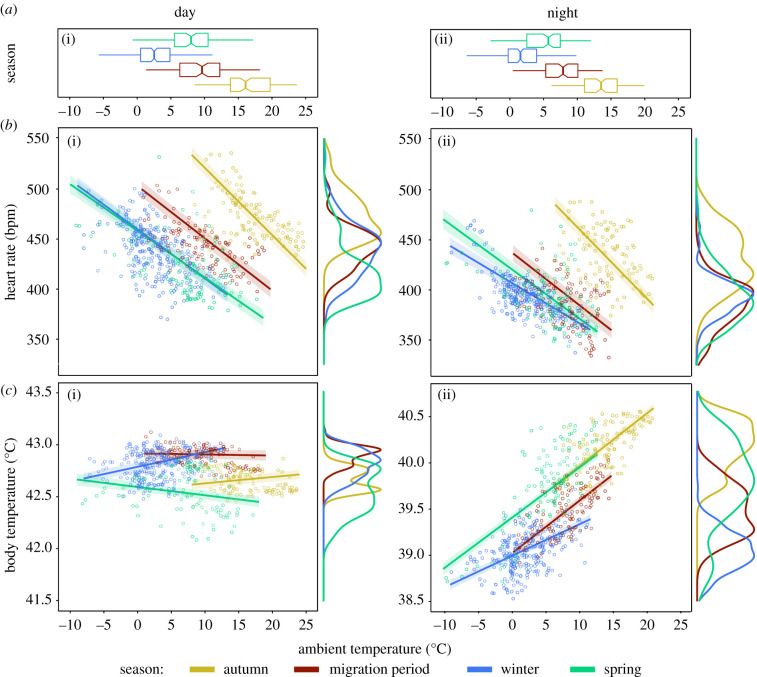
Figure 3.
Figure 3.
(a) Ambient temperature experienced by the birds over the course of the study. Each notched boxplot represents the corresponding season during day (i) and night (ii). Notches represent the medians surrounded by 95% confidence intervals. The boxed region defines 50% of the data while left and right whiskers mark the 75th and 25th percentiles with minimum and maximum values. (b) Heart rate and body temperature (c) of blackbirds in relation to ambient temperature at different times of the day. Plotted circles are mean values for single days (i)/nights (ii) during autumn (yellow, 1 Sep.–10 Oct.), migration period (red, 11 Oct.–20 Nov.), winter (blue, 21 Nov.–17 Feb.) and spring (green, 18 Feb.–11 Apr.). Lines are predicted values of the calculated general linear mixed model with respective 95% confidence intervals as ribbons around them. Density plots on the right of every scatterplot in (b), (c) show the distribution of Tb and fH independent of Ta.
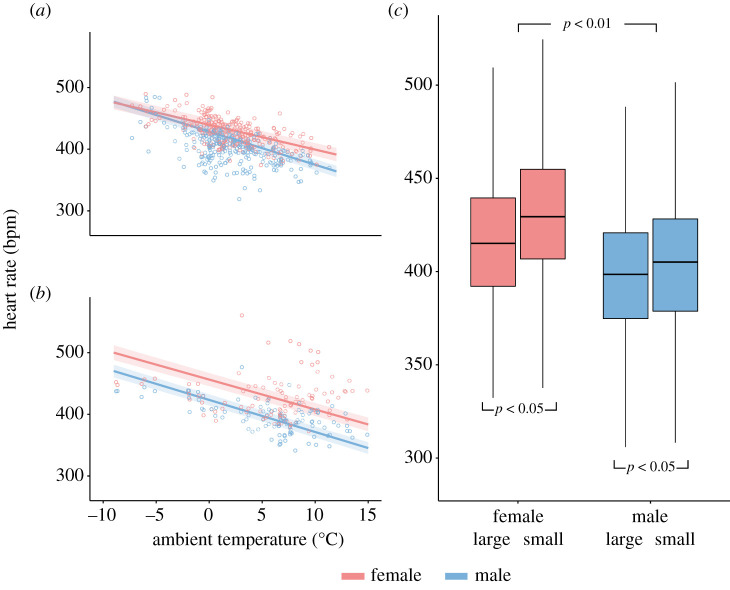
Figure 4.
Figure 4.
Heart rates of male and female blackbirds in relation to ambient temperatures in (a) winter and (b) spring. Plotted circles are daily mean values for each sex. Lines are predicted values of the general linear mixed model with respective 95% confidence intervals as ribbons around them; (c) comparison of daily mean heart rates between male and female blackbirds and larger and smaller individuals (larger/smaller than mean tarsus size) within each sex, with corresponding significance levels.

References

    1. Lima SL. 1986. Predation risk and unpredictable feeding conditions: determinants of body mass in birds. Ecology 67, 377-385. (10.2307/1938580) - DOI
    1. Prinzinger R, Preßmar A, Schleucher E. 1991. Body temperature in birds. Comp. Biochem. Physiol. A Physiol. 99, 499-506. (10.1016/0300-9629(91)90122-S) - DOI
    1. Clarke A, Pörtner HO. 2010. Temperature, metabolic power and the evolution of endothermy. Biol. Rev. 85, 703-727. (10.1111/j.1469-185X.2010.00122.x) - DOI - PubMed
    1. Grigg GC, Beard LA, Augee ML. 2004. The evolution of endothermy and its diversity in mammals and birds. Physiol. Biochem. Zool. 77, 982-997. (10.1086/425188) - DOI - PubMed
    1. Dawson A. 2017. Daily cycles in body temperature in a songbird change with photoperiod and are weakly circadian. J. Biol. Rhythms 32, 177-183. (10.1177/0748730417691206) - DOI - PubMed

Publication types