


The economic burden of COVID-19 in the United States: Estimates and projections under an infection-based herd immunity approach
- PMID: 34123719
- PMCID: PMC8186726
- DOI: 10.1016/j.jeoa.2021.100328
The economic burden of COVID-19 in the United States: Estimates and projections under an infection-based herd immunity approach
Abstract
Objectives: To assess the economic burden of COVID-19 that would arise absent behavioral or policy responses under the herd immunity approach in the United States and compare it to the total burden that also accounts for estimates of the value of lives lost.
Methods: We use the trajectories of age-specific human and physical capital in the production process to calculate output changes based on a human capital-augmented production function. We also calculate the total burden that results when including the value of lives lost as calculated from mortality rates of COVID-19 and estimates for the value of a statistical life in the United States based on studies assessing individual's willingness to pay to avoid risks.
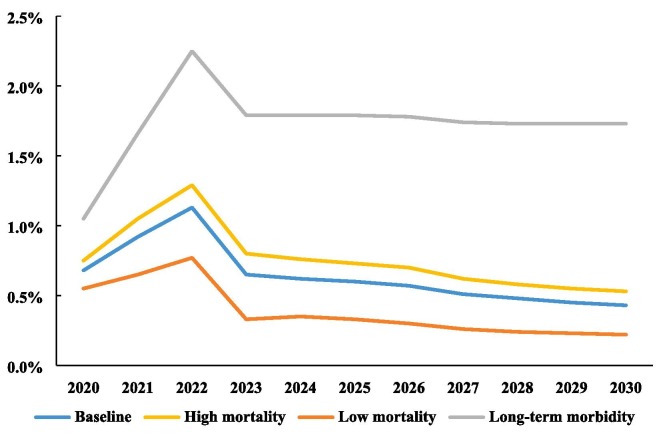
Results: Our results indicate that the GDP loss associated with unmitigated COVID-19 would amount to a cumulative US$1.4 trillion by 2030 assuming that 60 percent of the population is infected over three years. This is equivalent to around 7.7 percent of GDP in 2019 (in constant 2010 US$) or an average tax on yearly output of 0.6 percent. After applying the value of a statistical life to account for the value of lives lost, our analyses show that the total burden can mount to between US$17 and 94 trillion over the next decade, which is equivalent to an annual tax burden between 8 and 43 percent.
Conclusion: Our results show that the United States would incur a sizeable burden if it adopted a non-interventionist herd immunity approach.
Funding: Research reported in this paper was supported by the Alexander von Humboldt Foundation, the Bill & Melinda Gates Foundation (Project INV-006261), and the Sino-German Center for Research Promotion (Project C-0048), which is funded by the German Research Foundation (DFG) and the National Natural Science Foundation of China (NSFC). Preparation of this article was also supported by the Value of Vaccination Research Network (VoVRN) through a grant from the Bill & Melinda Gates Foundation (Grant OPP1158136). The content is solely the responsibility of the authors.
Keywords: COVID-19; Economic burden; Health-augmented macroeconomic model; Herd immunity; Human capital; Production function; United States; Value of a statistical life.
© 2021 Elsevier B.V. All rights reserved.
Conflict of interest statement
The authors declare that they have no known competing financial interests or personal relationships that could have appeared to influence the work reported in this paper.
Figures
References
-
- Acemoglu, D., Chernozhukov, V., Werning, I., & Whinston, M. D. A multi-risk SIR model with optimally targeted lockdown (2020) (0898-2937). Retrieved from Cambridge, Massachusetts.
-
- Ahmed H., Patel K., Greenwood D.C., Halpin S., Lewthwaite P., Salawu A., Jones A. Long-term clinical outcomes in survivors of severe acute respiratory syndrome and Middle East respiratory syndrome coronavirus outbreaks after hospitalisation or ICU admission: a systematic review and meta-analysis. J. Rehabil. Med. 2020;52(5) jrm00063. - PubMed
-
- Axios. (Jun 23, 2020). Why the pandemic isn't like a hurricane. Retrieved from https://www.axios.com/larry-kudlow-coronavirus-big-bad-hurricane-00025a6....
LinkOut - more resources
Full Text Sources