. 2021 May 20:11:672562.
doi: 10.3389/fcimb.2021.672562. eCollection 2021.

RT-qPCR Assays for Rapid Detection of the N501Y, 69-70del, K417N, and E484K SARS-CoV-2 Mutations: A Screening Strategy to Identify Variants With Clinical Impact

Affiliations

RT-qPCR Assays for Rapid Detection of the N501Y, 69-70del, K417N, and E484K SARS-CoV-2 Mutations: A Screening Strategy to Identify Variants With Clinical Impact

Natali Vega-Magaña et al. Front Cell Infect Microbiol. .

Abstract

Background: Several variants of the SARS-CoV-2 have been documented globally during the current COVID-19 pandemic. The N501Y, 69-70del, K417N, and E484K SARS-CoV-2 mutations have been documented among the most relevant due to their potential pathogenic biological effects. This study aimed to design, validate, and propose a fast real-time RT-qPCR assay to detect SARS-CoV-2 mutations with possible clinical and epidemiological relevance in the Mexican population.

Methods: Targeting spike (S) gene mutations of SARS-CoV-2 (N501Y, 69-70del, K417N, and E484K), specific primers, and probes for three specific quantitative reverse transcription PCR (RT-qPCR) assays were designed, and validated using Sanger sequencing. These assays were applied in clinical samples of 1060 COVID-19 patients from Jalisco Mexico.

Results: In silico analyzes showed high specificity of the three assays. Amplicons of samples were confirmed through sequencing. The screening of samples of COVID-19 patients allowed the identification of the E484K mutation in nine individuals and the identification of P.2 Brazilian variant in Mexico.

Conclusion: This work provides low-cost RT-qPCR assays for rapid screening and molecular surveillance of mutations with potential clinical impact. This strategy allowed the detection of E484K mutation and P.2 variant for the first time in samples from the Mexican population.

Keywords: E484K; P.2 variant detection; SARS-CoV-2; SARS-CoV-2 mutation screening; SARS-CoV-2 mutations; epidemiological surveillance; molecular screening.


Conflict of interest statement

Authors RS-S, AV-L, RV-Z, BG-O, MD-S, and OG-G have a working relationship with Genes2Life SAPI de CV. The remaining authors declare that the research was conducted in the absence of any commercial or financial relationships that could be construed as a potential conflict of interest.

Figures
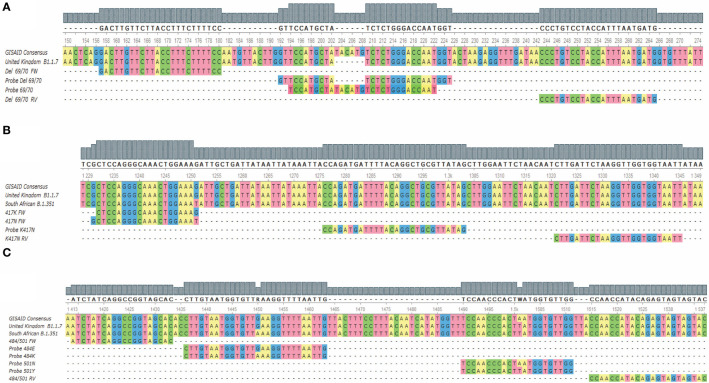
Figure 1
Figure 1
Alignment of the hybridization regions of the oligonucleotides and the probes with the target sequences for the three assays. (A) Shows the alignment for the 69/70 deletion assay; (B) shows the alignment for the K417N mutation assay; (C) shows the alignment for the E484K/N501Y assay. FW, Forward; RV, reverse.
Figure 2
Figure 2
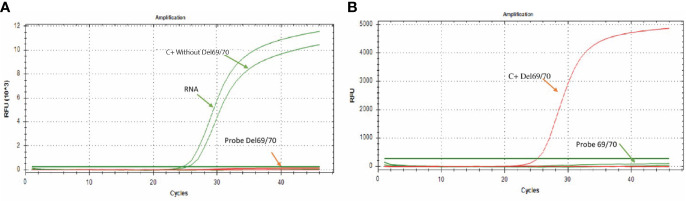
Amplification curves for the 69/70 assay. (A) The green color curve shows the amplification of the probe directed to the sequence without deletion (FAM) in a sample of SARS-CoV-2 positive patient; the curve of the probe directed to the sequence that presents the 69/70 deletion remains without signal of amplification. (B) The red curve shows the probe amplification directed to the 69/70 deletion (CFR 610) using the synthetic control containing the 69/70 deletion. In contrast, the probe directed to the sequence that does not present the deletion 69/70 remains without amplification signal.
Figure 3
Figure 3
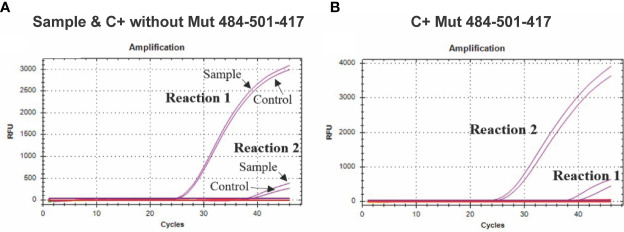
Amplification curves for the K417N assay. (A) The curves of four independent reactions are shown; the purple curves with a lower Cq value show the forward primer amplification directed to the sequence without K417N mutation (Reaction 1) in a sample of COVID-19 patients or control C+ without-Mut. In comparison, the signal with a higher Cq value shows the amplification when using the primer directed to the sequence that presents the mutation (Reaction 2), which presents an evident lag, in comparison to the first reaction. (B) The purple curves with a lower Cq value show the amplification of the forward primer directed to the K417N mutation (417N Fw) (Reaction 2) using synthetic control C+ Mut484-501-417 (which contains the mutation). In comparison, the amplification curve with a higher Cq value shows the amplification when using the primer directed to the sequence that does not present the mutation (Reaction 1) using the same control.
Figure 4
Figure 4
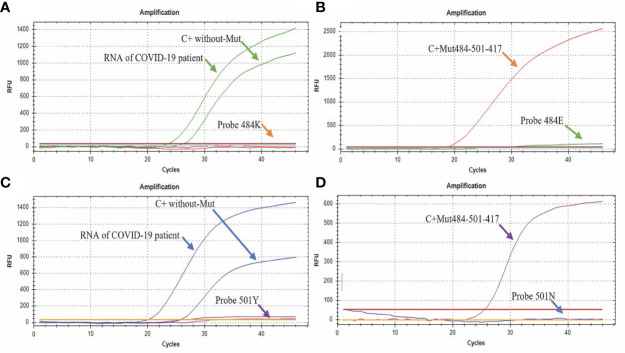
Amplification curves of the E484K/N501Y Assay. (A) The green curve shows the amplification of the probe directed to the sequence without the E484K mutation (FAM), while the signal by the probe directed to the sequence that presents the mutation remains without amplification signal; (B) the orange curve shows the amplification of the probe directed to the E484K mutation (CFR 610), while the probe directed to the sequence without mutation remains without amplification signal; (C) the blue curve shows the amplification of the probe directed to the sequence without mutation N501Y (HEX), while the probe directed to the sequence with the mutation remains without amplification signal; (D) the purple curve shows the amplification of the probe directed to the mutation N501Y (Quasar670) with the control containing the mutation (C+ Mut484-501-417), while the probe directed to the sequence without the mutation remains without amplification signal.
Figure 5
Figure 5
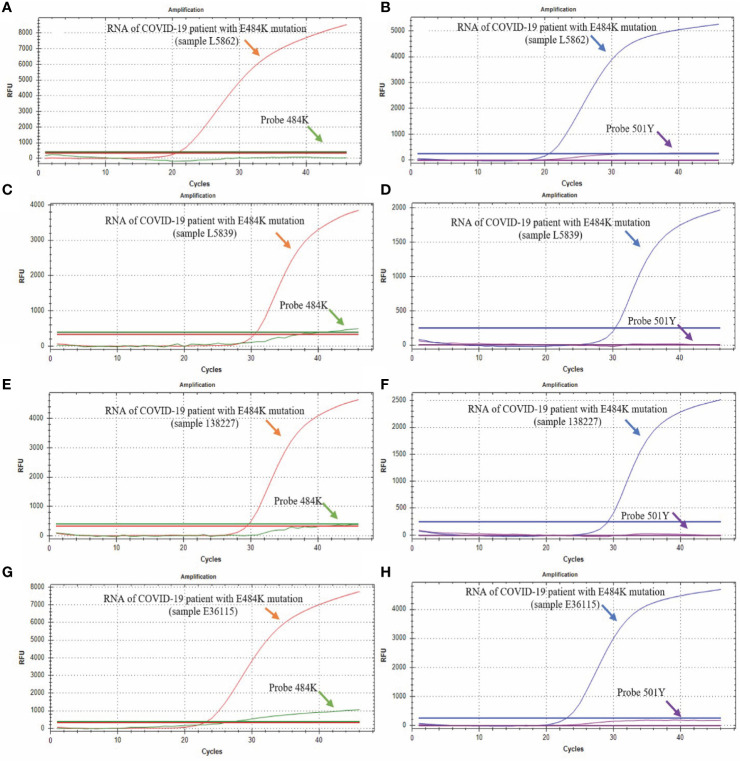
Detection of E484K and N501Y mutations. The green curve corresponds to the probe that detects the sequence without the E484K mutation (Probe 484E); the red curve corresponds to the probe that detects the sequence with the E484K mutation (Probe 484K); the blue curve corresponds to the probe that detects the sequence without the N501Y mutation, and the purple curve corresponds to the probe that detects the sequence with the N501Y mutation. (A, B) show the results from the L5862 patient; (C, D) show the results from the L5039 patient; (E, F) show the results from the 138227 patient; (G, H) show the results from the E36115 patient.
Figure 6
Figure 6
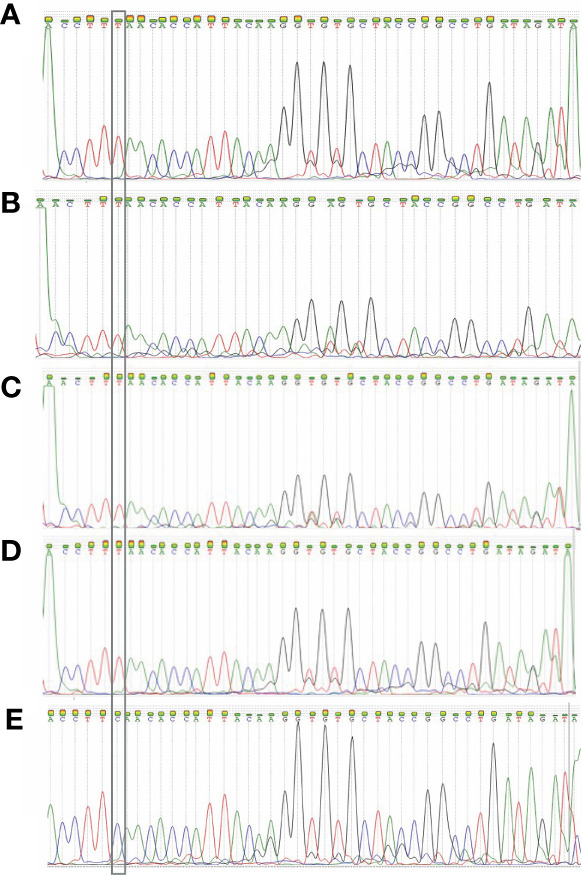
Electropherograms obtained from the Sanger sequencing of four samples. (A) 150441 patient; (B) 150 450 patient; (C) 138227 patient; (D) 139093 patient; (E) L782 patient. The first 4 samples show the E484K mutation, and the fifth is a wild-type sample. The inset highlights the position of the mutation, which shows that the original base “C” changed to a “T”.

References

    1. Al-Qaaneh A. M., Alshammari T., Aldahhan R., Aldossary H., Alkhalifah Z. A., Borgio J. F. (2021). Genome Composition and Genetic Characterization of SARS-Cov-2. Saudi J. Biol. Sci. 28, 1978–1989. 10.1016/j.sjbs.2020.12.053 - DOI - PMC - PubMed
    1. Andreano E., Piccini G., Licastro D., Casalino L., Johnson N. V., Paciello I., et al. . (2020). Sars-CoV-2 Escape In Vitro From a Highly Neutralizing COVID-19 Convalescent Plasma. BioRxiv Prepr. Serv. Biol. 10.1101/2020.12.28.424451 - DOI - PMC - PubMed
    1. Arif T. B. (2021). The 501.V2 and B.1.1.7 Variants of Coronavirus Disease 2019 (COVID-19): A New Time-Bomb in the Making? Infect. Control Hosp. Epidemiol. 1–2. 10.1017/ice.2020.1434 - DOI - PMC - PubMed
    1. Bal A., Destras G., Gaymard A., Stefic K., Marlet J., Eymieux S., et al. . (2021). Two-Step Strategy for the Identification of SARS-CoV-2 Variant of Concern 202012/01 and Other Variants With Spike Deletion H69-V70, France, August to December 2020. Euro Surveill. 26. 10.2807/1560-7917.ES.2021.26.9.210013 - DOI - PMC - PubMed
    1. Bolotin S., Robertson A. V., Eshaghi A., De Lima C., Lombos E., Chong-King E., et al. . (2009). Development of a Novel Real-Time Reverse-Transcriptase PCR Method for the Detection of H275Y Positive Influenza A H1N1 Isolates. J. Virol. Methods 158, 190–194. 10.1016/j.jviromet.2009.01.016 - DOI - PMC - PubMed

Publication types

Substances