. 2021 Jun 14;11(1):95.
doi: 10.1186/s13613-021-00883-9.

Prevalence and risk factors of hemodynamic instability associated with preload-dependence during continuous renal replacement therapy in a prospective observational cohort of critically ill patients

Affiliations

Prevalence and risk factors of hemodynamic instability associated with preload-dependence during continuous renal replacement therapy in a prospective observational cohort of critically ill patients

Guillaume Chazot et al. Ann Intensive Care. .

Abstract

Background: Hemodynamic instability is a frequent complication of continuous renal replacement therapy (CRRT). Postural tests (i.e., passive leg raising in the supine position or Trendelenburg maneuver in the prone position) combined with measurement of cardiac output are highly reliable to identify preload-dependence and may provide new insights into the mechanisms involved in hemodynamic instability related to CRRT (HIRRT). We aimed to assess the prevalence and risk factors of HIRRT associated with preload-dependence in ICU patients. We conducted a single-center prospective observational cohort study in ICU patients with acute kidney injury KDIGO 3, started on CRRT in the last 24 h, and monitored with a PiCCO® device. The primary endpoint was the rate of HIRRT episodes associated with preload-dependence during the first 7 days after inclusion. HIRRT was defined as the occurrence of a mean arterial pressure below 65 mmHg requiring therapeutic intervention. Preload-dependence was assessed by postural tests every 4 h, and during each HIRRT episode. Data are expressed in median [1st quartile-3rd quartile], unless stated otherwise.

Results: 42 patients (62% male, age 69 [59-77] year, SAPS-2 65 [49-76]) were included 6 [1-16] h after CRRT initiation and studied continuously for 121 [60-147] h. A median of 5 [3-8] HIRRT episodes occurred per patient, for a pooled total of 243 episodes. 131 episodes (54% [CI95% 48-60%]) were associated with preload-dependence, 108 (44%, [CI95% 38-51%]) without preload-dependence, and 4 were unclassified. Multivariate analysis (using variables collected prior to HIRRT) identified the following variables as risk factors for the occurrence of HIRRT associated with preload-dependence: preload-dependence before HIRRT [odds ratio (OR) = 3.82, p < 0.001], delay since last HIRRT episode > 8 h (OR = 0.56, p < 0.05), lactate (OR = 1.21 per 1-mmol L-1 increase, p < 0.05), cardiac index (OR = 0.47 per 1-L min-1 m-2 increase, p < 0.001) and SOFA at ICU admission (OR = 0.91 per 1-point increase, p < 0.001). None of the CRRT settings was identified as risk factor for HIRRT.

Conclusions: In this single-center study, HIRRT associated with preload-dependence was slightly more frequent than HIRRT without preload-dependence in ICU patients undergoing CRRT. Testing for preload-dependence could help avoiding unnecessary decrease of fluid removal in preload-independent HIRRT during CRRT.

Keywords: Acute circulatory failure; Acute kidney injury; Hemodynamic instability; Net ultrafiltration rate; Preload-dependence; Pulse contour; Renal replacement therapy; Thermodilution.


Conflict of interest statement

The authors declare that they have no competing interests.

Figures

Fig. 1
Fig. 1
Study flowchart. CRRT continuous renal replacement therapy, RRT renal replacement therapy
Fig. 2
Fig. 2
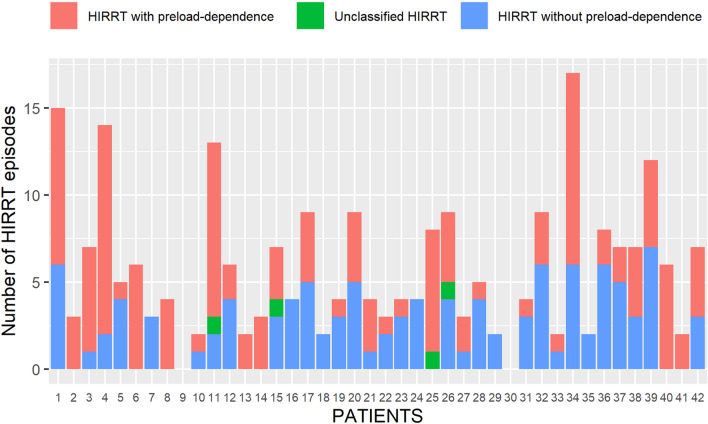
HIRRT episodes as a function of preload-dependence status per patient. HIRRT hemodynamic instability related to renal replacement therapy
Fig. 3
Fig. 3
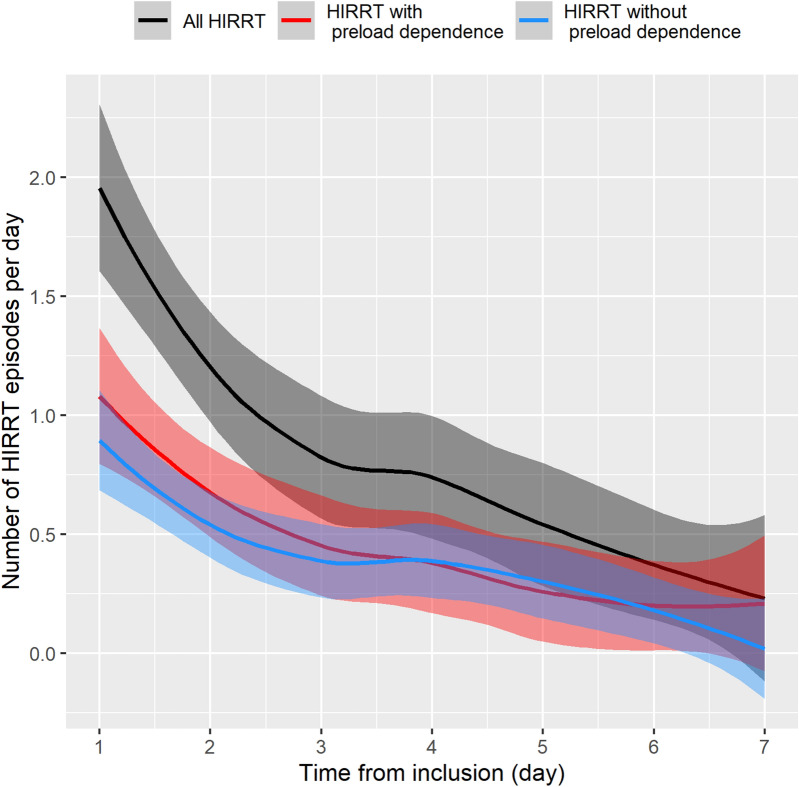
Number of HIRRT episodes per day and per patient following inclusion. Continuous lines are local polynomial regression (LOESS) fits of individual data points. Shaded areas are 95% confidence level interval for predictions. HIRRT hemodynamic instability related to renal replacement therapy
Fig. 4
Fig. 4
Therapeutic management of HIRRT. Values per type of HIRRT do not add up to 100% since multiple interventions could be selected by attending physician. HIRRT hemodynamic instability related to renal replacement therapy, NS not significant, UF ultrafiltration
Fig. 5
Fig. 5
Forest plot of risk factors for occurrence of HIRRT associated with preload-dependence in multivariate analysis. Bars are 95% confidence interval of odds ratios. CITD cardiac index assessed by thermodilution, HIRRT hemodynamic instability related to renal replacement therapy, ICU intensive care unit, OR odds ratio. *This cut-off value was chosen as it maximized the Youden’s index in univariate analysis. The following variables were entered into the multivariate full model: preload-dependence on the preceding measurement before HIRRT (yes/no), delay since last HIRRT episode > 8 h (yes/no), delay since CRRT onset, cardiac index assessed by thermodilution on the preceding measurement before HIRRT, global end-diastolic volume on the preceding measurement before HIRRT, pulmonary vascular permeability index on the preceding measurement before HIRRT, pulse pressure variation on the preceding measurement before HIRRT, systolic arterial pressure on the preceding measurement before HIRRT, mechanical ventilation status (yes/no) on the preceding measurement before HIRRT, sex male (yes/no), SOFA score at ICU admission, body weight on the day of hemodynamic measurement, SOFA score on the day of hemodynamic measurement; lactate on the day of hemodynamic measurement, base excess on the day of hemodynamic measurement, hemoglobin on the day of hemodynamic measurement, sepsis criteria on the day of hemodynamic measurement (yes/no), septic shock criteria on the day of hemodynamic measurement (yes/no). The following variables were not entered into the multivariate full model because of multicollinearity: cardiac index assessed by pulse contour analysis and global ejection fraction on the preceding measurement before HIRRT (collinearity with cardiac index assessed by thermodilution), stroke volume variation on the preceding measurement before HIRRT (collinearity with pulse pressure variation), mean and diastolic arterial pressure on the preceding measurement before HIRRT (collinearity with systolic arterial pressure), bicarbonate on the day of hemodynamic measurement (collinearity with base excess). No significant interaction was identified between any of the selected variables. C-statistic of the final model: 0.77. Model calibration assessed by the Hosmer–Lemeshow test: p = 0.76

References

    1. Hoste EAJ, Bagshaw SM, Bellomo R, Cely CM, Colman R, Cruz DN, et al. Epidemiology of acute kidney injury in critically ill patients: the multinational AKI-EPI study. Intensive Care Med. 2015;41:1411–1423. doi: 10.1007/s00134-015-3934-7. - DOI - PubMed
    1. RENAL Replacement Therapy Study Investigators. Bellomo R, Cass A, Cole L, Finfer S, Gallagher M, et al. An observational study fluid balance and patient outcomes in the randomized evaluation of normal vs. augmented level of replacement therapy trial. Crit Care Med. 2012;40:1753–1760. doi: 10.1097/CCM.0b013e318246b9c6. - DOI - PubMed
    1. Bouchard J, Soroko SB, Chertow GM, Himmelfarb J, Ikizler TA, Paganini EP, et al. Fluid accumulation, survival and recovery of kidney function in critically ill patients with acute kidney injury. Kidney Int. 2009;76:422–427. doi: 10.1038/ki.2009.159. - DOI - PubMed
    1. Burton JO, Jefferies HJ, Selby NM, McIntyre CW. Hemodialysis-induced cardiac injury: determinants and associated outcomes. Clin J Am Soc Nephrol. 2009;4:914–920. doi: 10.2215/CJN.03900808. - DOI - PMC - PubMed
    1. Silversides JA, Pinto R, Kuint R, Wald R, Hladunewich MA, Lapinsky SE, et al. Fluid balance, intradialytic hypotension, and outcomes in critically ill patients undergoing renal replacement therapy: a cohort study. Crit Care. 2014;18:624. doi: 10.1186/s13054-014-0624-8. - DOI - PMC - PubMed

LinkOut - more resources