


Public support for healthy supermarket initiatives focused on product placement: a multi-country cross-sectional analysis of the 2018 International Food Policy Study
- PMID: 34127002
- PMCID: PMC8201822
- DOI: 10.1186/s12966-021-01149-0
Public support for healthy supermarket initiatives focused on product placement: a multi-country cross-sectional analysis of the 2018 International Food Policy Study
Abstract
Background: Food retail environments have an influential role in shaping purchasing behavior and could contribute to improving dietary patterns at a population level. However, little is known about the level of public support for different types of initiatives to encourage healthy food choices in supermarkets, and whether this varies across countries or context. The current study aimed to explore the level of support for three potential supermarket initiatives focused on product placement across five countries, and factors that may influence this support.
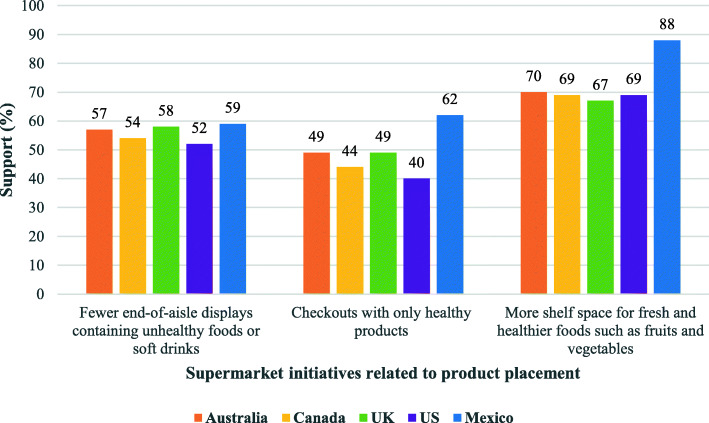
Methods: A total of 22,264 adults from Australia, Canada, Mexico, the United Kingdom and the United States (US) provided information on support for three supermarket initiatives related to product placement (targeting product positioning: 'checkouts with only healthy products', 'fewer end-of-aisle displays containing unhealthy foods or soft drinks' or availability: 'more shelf space for fresh and healthier foods') as part of the online 2018 International Food Policy Study. The proportion of respondents that supported each initiative was assessed across countries, and multivariable logistic regression analyses were conducted to evaluate the influence of sociodemographic factors on support.
Results: The initiative that received the highest support was 'more shelf space for fresh and healthier foods': 72.0% [95% CI 71.3-72.7], whereas 'checkouts with only healthy products' received the lowest support: 48.6% [95% CI 47.8-49.4]. The level of support differed between countries (p < 0.001 for all initiatives), with the US generally showing the lowest support and Mexico the highest. Noteworthy, in the overall sample, there was not much opposition to any of the initiatives (2.5-14.2%), whereas there was a large proportion of neutral responses (25.5-37.2%). Respondents who were older, female, highly educated, and those who reported having more nutrition knowledge tended to be more supportive, with several differences between countries and initiatives.
Conclusions: Most people in the assessed five countries showed a generally high level of support for three placement initiatives in supermarkets to encourage healthy food choices. Support varied by type of initiative (i.e., product positioning or availability) and was influenced by several factors related to country context and sociodemographic characteristics. This evidence could prompt and guide retailers and policy makers to take stronger action to promote healthy food choices in stores.
Keywords: Attitudes; Diet; Food environment; Food policy; Retail; Supermarket.
Conflict of interest statement
The authors declare that they have no competing interests.
Figures
References
-
- Hawkes C. Dietary implications of supermarket development: a global perspective. Dev Policy Rev. 2008;26(6):657–692. doi: 10.1111/j.1467-7679.2008.00428.x. - DOI
Publication types
MeSH terms
Grants and funding
LinkOut - more resources
Full Text Sources
