


GPS driving: a digital biomarker for preclinical Alzheimer disease
- PMID: 34127064
- PMCID: PMC8204509
- DOI: 10.1186/s13195-021-00852-1
GPS driving: a digital biomarker for preclinical Alzheimer disease
Abstract
Background: Alzheimer disease (AD) is the most common cause of dementia. Preclinical AD is the period during which early AD brain changes are present but cognitive symptoms have not yet manifest. The presence of AD brain changes can be ascertained by molecular biomarkers obtained via imaging and lumbar puncture. However, the use of these methods is limited by cost, acceptability, and availability. The preclinical stage of AD may have a subtle functional signature, which can impact complex behaviours such as driving. The objective of the present study was to evaluate the ability of in-vehicle GPS data loggers to distinguish cognitively normal older drivers with preclinical AD from those without preclinical AD using machine learning methods.
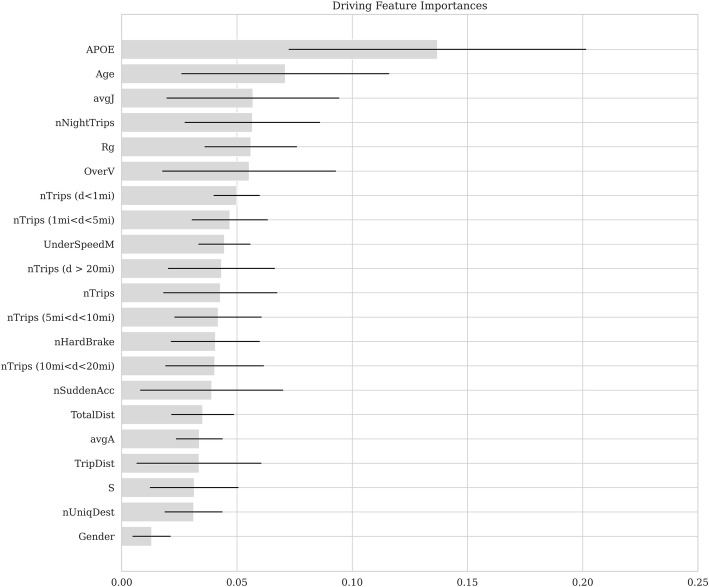
Methods: We followed naturalistic driving in cognitively normal older drivers for 1 year with a commercial in-vehicle GPS data logger. The cohort included n = 64 individuals with and n = 75 without preclinical AD, as determined by cerebrospinal fluid biomarkers. Four Random Forest (RF) models were trained to detect preclinical AD. RF Gini index was used to identify the strongest predictors of preclinical AD.
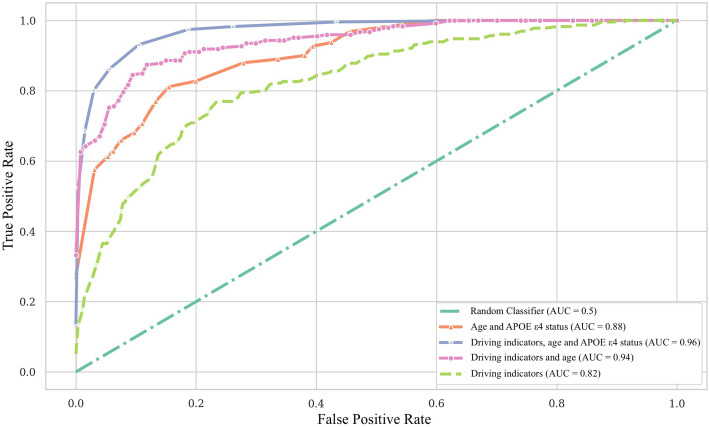
Results: The F1 score of the RF models for identifying preclinical AD was 0.85 using APOE ε4 status and age only, 0.82 using GPS-based driving indicators only, 0.88 using age and driving indicators, and 0.91 using age, APOE ε4 status, and driving. The area under the receiver operating curve for the final model was 0.96.
Conclusion: The findings suggest that GPS driving may serve as an effective and accurate digital biomarker for identifying preclinical AD among older adults.
Keywords: Global positioning system; Machine learning; Naturalistic driving; Preclinical Alzheimer disease.
Conflict of interest statement
The authors declare that they have no competing interests.
Figures
References
-
- World Alzheimer Report 2019: Attitudes to dementia. London: Alzheimer’s Disease International; 2019. (Alzheimer’s Disease International.).
-
- 2018 Alzheimer’s disease facts and figures. Alzheimer’s & Dementia. 2018 Mar 1;14(3):367–429.
-
- Roe CM, Ances BM, Head D, Babulal GM, Stout SH, Grant EA, Hassenstab J, Xiong C, Holtzman DM, Benzinger TLS, Schindler SE, Fagan AM, Morris JC. Incident cognitive impairment: longitudinal changes in molecular, structural and cognitive biomarkers. Brain. 2018;141(11):3233–3248. doi: 10.1093/brain/awy244. - DOI - PMC - PubMed
-
- 2020 Alzheimer’s disease facts and figures. Alzheimer’s & Dementia. 2020;16(3):391–460. - PubMed
Publication types
MeSH terms
Substances
Grants and funding
LinkOut - more resources
Full Text Sources
Medical
Miscellaneous
