


Natural human postural oscillations enhance the empathic response to a facial pain expression in a virtual character
- PMID: 34127724
- PMCID: PMC8203793
- DOI: 10.1038/s41598-021-91710-5
Natural human postural oscillations enhance the empathic response to a facial pain expression in a virtual character
Abstract
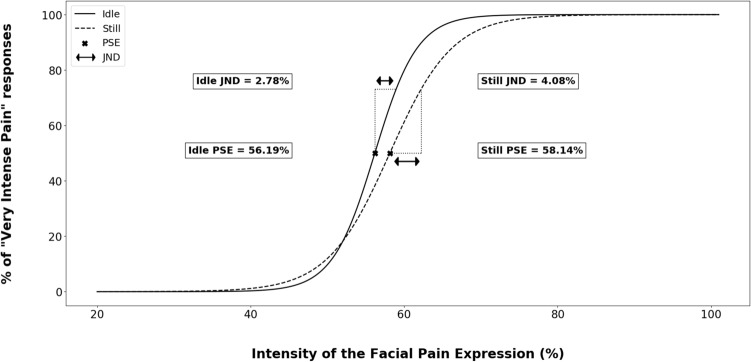
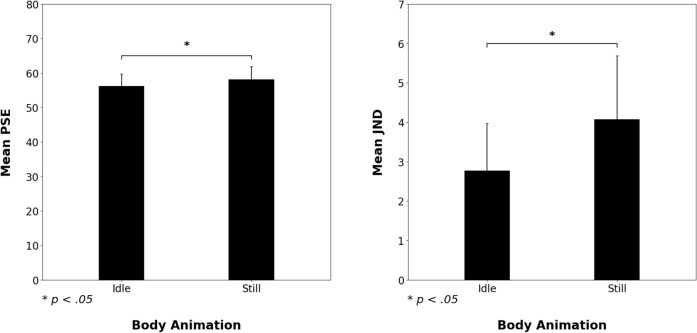
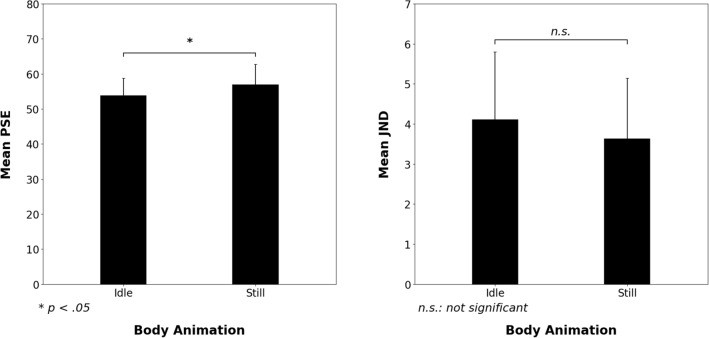
Virtual reality platforms producing interactive and highly realistic characters are being used more and more as a research tool in social and affective neuroscience to better capture both the dynamics of emotion communication and the unintentional and automatic nature of emotional processes. While idle motion (i.e., non-communicative movements) is commonly used to create behavioural realism, its use to enhance the perception of emotion expressed by a virtual character is critically lacking. This study examined the influence of naturalistic (i.e., based on human motion capture) idle motion on two aspects (the perception of other's pain and affective reaction) of an empathic response towards pain expressed by a virtual character. In two experiments, 32 and 34 healthy young adults were presented video clips of a virtual character displaying a facial expression of pain while its body was either static (still condition) or animated with natural postural oscillations (idle condition). The participants in Experiment 1 rated the facial pain expression of the virtual human as more intense, and those in Experiment 2 reported being more touched by its pain expression in the idle condition compared to the still condition, indicating a greater empathic response towards the virtual human's pain in the presence of natural postural oscillations. These findings are discussed in relation to the models of empathy and biological motion processing. Future investigations will help determine to what extent such naturalistic idle motion could be a key ingredient in enhancing the anthropomorphism of a virtual human and making its emotion appear more genuine.
Conflict of interest statement
The authors declare no competing interests.
Figures


References
-
- Egges, A., Molet, T. & Magnenat-Thalmann, N. Personalised real-time idle motion synthesis. In Proceedings of the 12th Pacific Conference on Computer Graphics and Applications 121–130 (2004).
-
- Groom V, et al. Evaluating the effects of behavioral realism in embodied agents. Int. J. Hum.-Comput. Stud. 2009;67:842–849. doi: 10.1016/j.ijhcs.2009.07.001. - DOI
Publication types
MeSH terms
LinkOut - more resources
Full Text Sources
Medical
