


Pediatric oncology clinician communication about sexual health with adolescents and young adults: A report from the children's oncology group
- PMID: 34128352
- PMCID: PMC8335832
- DOI: 10.1002/cam4.4077
Pediatric oncology clinician communication about sexual health with adolescents and young adults: A report from the children's oncology group
Abstract
Background: Sexual health (SH) is an important concern for adolescents and young adults (AYAs). This study determined current SH communication practices, barriers, and additional resources needed among pediatric oncology clinicians who treat AYAs.
Methods: A cross-sectional survey was developed by the Children's Oncology Group (COG) AYA Committee and sent to pediatric oncologists (n = 1,987; 85.9%) and advanced practice providers (APPs, n = 326; 14.1%) at 226 COG institutions. Responses were tabulated and compared using tests of proportion and trend.
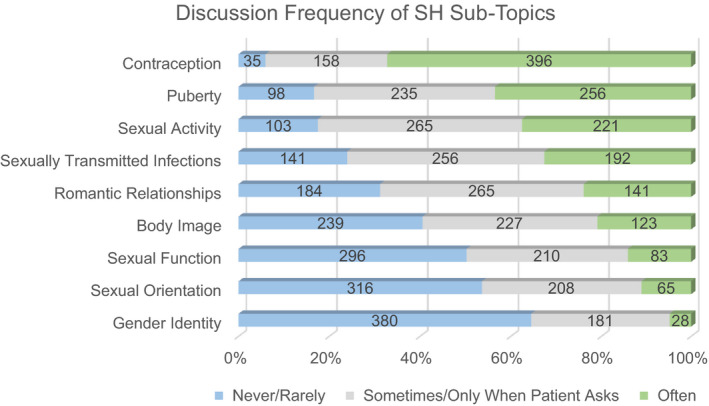
Results: The sample comprised 602 respondents from 168 institutions and was proportionally representative (468 oncologists [77.7%], 76 APPs [12.6%], 58 unidentified [9.6%]; institutional and provider response rates 74.3% and 26.2%, respectively). Almost half of respondents (41.7%) reported no/small role in SH care. Medical topics were discussed most often, including contraception (67.2%), puberty (43.5%), and sexual activity (37.5%). Topics never/rarely discussed included gender identity (64.5%), sexual orientation (53.7%), and sexual function (50.3%). Frequently cited communication barriers included lack of time, low priority, perceived patient discomfort, and the presence of a parent/guardian. Respondents endorsed the need for further education/resources on sexual function (66.1%), gender identity/sexual orientation (59.5%), and body image (46.6%). Preferred education modalities included dissemination of published guidelines (64.7%), skills training modules (62.9%), and webinars (45.3%). By provider type, responses were similar overall but differed for perception of role, barriers identified, and resources desired.
Conclusions: Many pediatric oncology clinicians play minimal roles in SH care of AYAs and most SH topics are rarely discussed. Provider-directed education/training interventions have potential for improving SH care of AYA cancer patients.
Keywords: adolescent and young adult; sexual and reproductive health in cancer; sexual health education; sexual health in pediatric oncology.
© 2021 The Authors. Cancer Medicine published by John Wiley & Sons Ltd.
Conflict of interest statement
The authors have no conflict of interest.
Figures
References
-
- Murphy D, Klosky JL, Reed DR, et al. The importance of assessing priorities of reproductive health concerns among adolescent and young adult patients with cancer. Cancer. 2015;121:2529‐2536. - PubMed
-
- Maslow B‐S, Morse CB, Schanne A, et al. Contraceptive use and the role of contraceptive counseling in reproductive‐aged women with cancer. Contraception. 2014;90:79‐85. - PubMed
-
- Murphy D, Klosky JL, Termuhlen A, et al. The need for reproductive and sexual health discussions with adolescent and young adult cancer patients. Contraception. 2013;88:215‐220. - PubMed
Publication types
MeSH terms
Grants and funding
LinkOut - more resources
Full Text Sources
Medical
