Review
. 2021 Jul 5;218(7):e20201541.
doi: 10.1084/jem.20201541. Epub 2021 Jun 15.

Inflammation as a regulator of hematopoietic stem cell function in disease, aging, and clonal selection

Affiliations
Review

Inflammation as a regulator of hematopoietic stem cell function in disease, aging, and clonal selection

Francisco Caiado et al. J Exp Med. .

Abstract

Inflammation is an evolutionarily selected defense response to infection or tissue damage that involves activation and consumption of immune cells in order to reestablish and maintain organismal integrity. In this process, hematopoietic stem cells (HSCs) are themselves exposed to inflammatory cues and via proliferation and differentiation, replace mature immune cells in a demand-adapted fashion. Here, we review how major sources of systemic inflammation act on and subsequently shape HSC fate and function. We highlight how lifelong inflammatory exposure contributes to HSC inflamm-aging and selection of premalignant HSC clones. Finally, we explore emerging areas of interest and open questions remaining in the field.


Conflict of interest statement

Disclosures: The authors declare no competing interests exist.

Figures
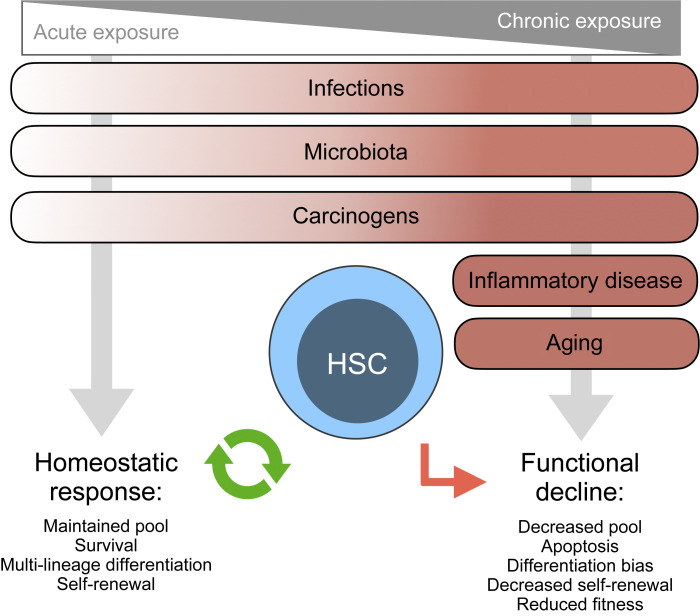
Figure 1.
Figure 1.
Causes and consequences of inflammation on HSC functionality. Schematic representation of current understanding in the field on the major causes of systemic inflammation known to impact HSC biology in mouse models (infection, microbiota, carcinogens, inflammatory diseases, aging). Each cause in distributed in a gradient regarding the duration of inflammation: acute to chronic. HSC properties during homeostatic responses (more frequently associated with acute inflammation) or functional decline (more frequently associated with chronic inflammation) are depicted.
Figure 2.
Figure 2.
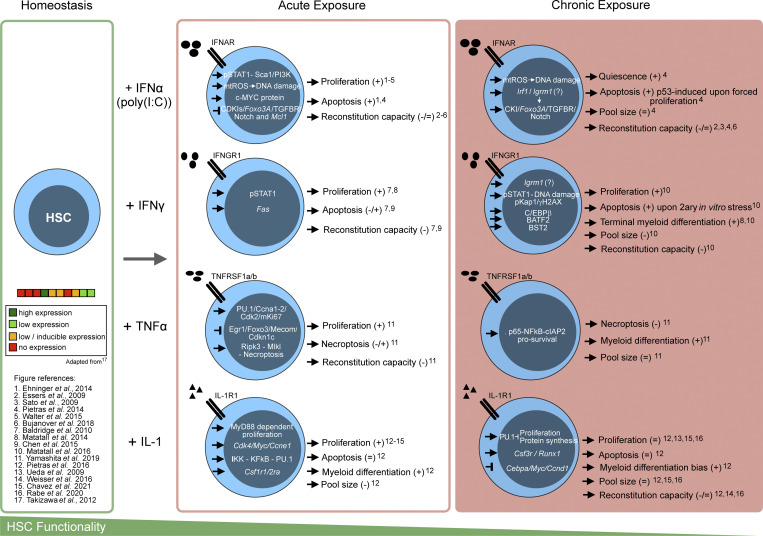
Effects of acute and chronic inflammatory signaling in HSC biology. Schematic representation of the antagonizing effects of acute or chronic in vivo cytokine exposure on murine HSC functions. Here, acute is defined has exposure of the indicated cytokine in one to three consecutive single daily doses, while chronic represents more than three consecutive daily exposures (in agreement with classic definitions in the field). The left panel depicts HSCs in homeostatic state and the published expression levels of cytokine receptors. Acute and chronic exposures panels depict the pathways and the respective cellular effects of the exposure to the indicated cytokines. The bottom scheme shows loss of HSC functionality from homeostasis to acute to chronic inflammatory exposure. 2ary, secondary.
Figure 3.
Figure 3.
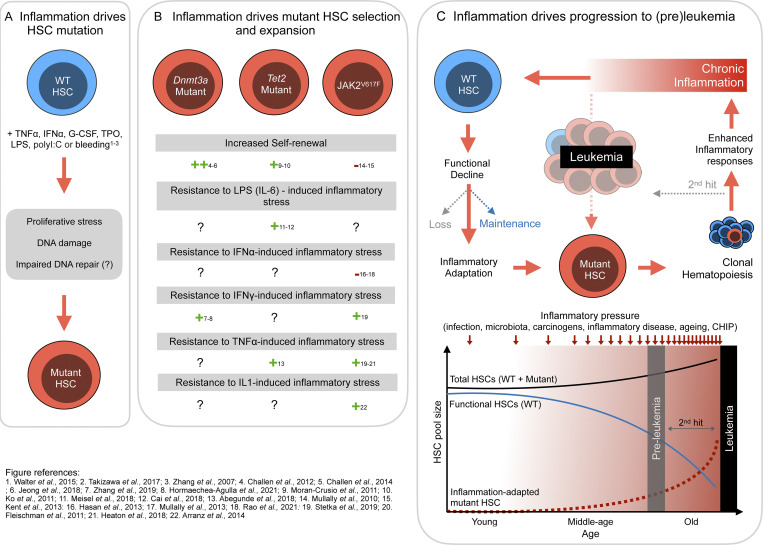
Proposed mechanisms of HSCs inflammation-driven evolution. Schematic representation of the three main processes by which sustained inflammation drives HSC somatic evolution. (A) Inflammation as a driver of mutation incidence in HSC by inducing increased proliferation stress and DNA damage. Impact of inflammation on DNA repair efficiency is unknown. (B) Inflammatory pressure leads to the selection and expansion of HSC-carrying mutations (in DNMT3A, TET, and JAK2). Depicted are the published adaptations of each mutation to inflammatory stress (++ strongly present, + present, − absent, ? unknown). (C) Speculative role of inflammation on establishment of clonal hematopoiesis and its progression to leukemia. Lifelong inflammatory exposure leads to functional decline of WT HSCs and selects inflammatory-adapted mutant HSCs that expand, leading to a preleukemic stage. Enhanced cytokine production by mutant myeloid cells further increased the systemic inflammatory load, leading to inflammatory-adapted mutant HSC clonal expansion and increasing the risk of secondary hit mutations and potential leukemia transformation.

References

    1. Abegunde, S.O., Buckstein R., Wells R.A., and Rauh M.J.. 2018. An inflammatory environment containing TNFα favors Tet2-mutant clonal hematopoiesis. Exp. Hematol. 59:60–65. 10.1016/j.exphem.2017.11.002 - DOI - PubMed
    1. Abelson, S., Collord G., Ng S.W.K., Weissbrod O., Mendelson Cohen N., Niemeyer E., Barda N., Zuzarte P.C., Heisler L., Sundaravadanam Y., et al. 2018. Prediction of acute myeloid leukaemia risk in healthy individuals. Nature. 559:400–404. 10.1038/s41586-018-0317-6 - DOI - PMC - PubMed
    1. Arandjelovic, S., and Ravichandran K.S.. 2015. Phagocytosis of apoptotic cells in homeostasis. Nat. Immunol. 16:907–917. 10.1038/ni.3253 - DOI - PMC - PubMed
    1. Arends, C.M., Galan-Sousa J., Hoyer K., Chan W., Jäger M., Yoshida K., Seemann R., Noerenberg D., Waldhueter N., Fleischer-Notter H., et al. 2018. Hematopoietic lineage distribution and evolutionary dynamics of clonal hematopoiesis. Leukemia. 32:1908–1919. 10.1038/s41375-018-0047-7 - DOI - PubMed
    1. Arranz, L., Sánchez-Aguilera A., Martín-Pérez D., Isern J., Langa X., Tzankov A., Lundberg P., Muntión S., Tzeng Y.S., Lai D.M., et al. 2014. Neuropathy of haematopoietic stem cell niche is essential for myeloproliferative neoplasms. Nature. 512:78–81. 10.1038/nature13383 - DOI - PubMed

Publication types