


Long-term Continuity of Antipsychotic Treatment for Schizophrenia: A Nationwide Study
- PMID: 34129663
- PMCID: PMC8530382
- DOI: 10.1093/schbul/sbab063
Long-term Continuity of Antipsychotic Treatment for Schizophrenia: A Nationwide Study
Abstract
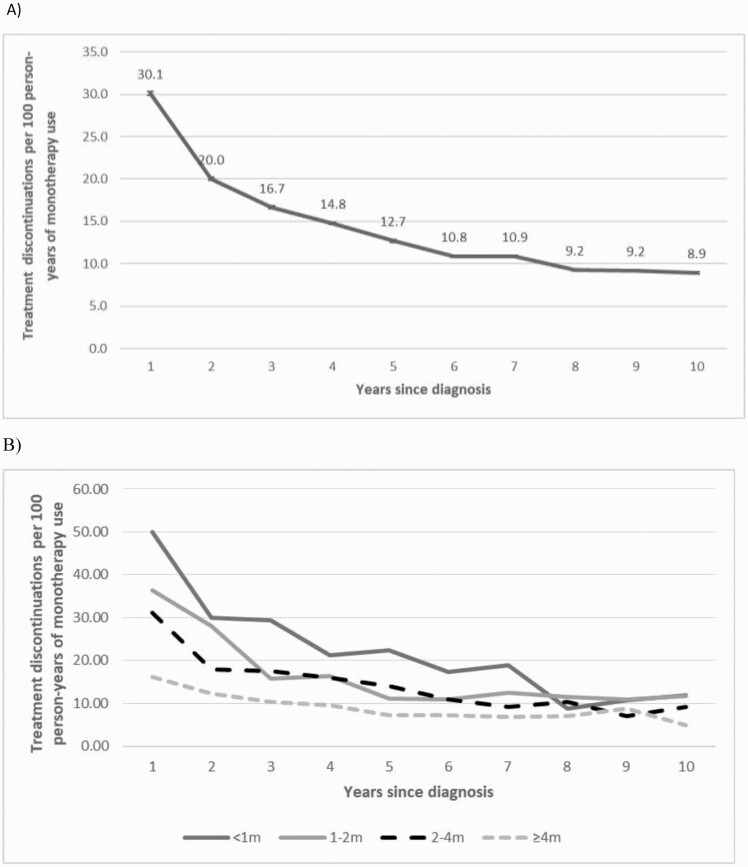
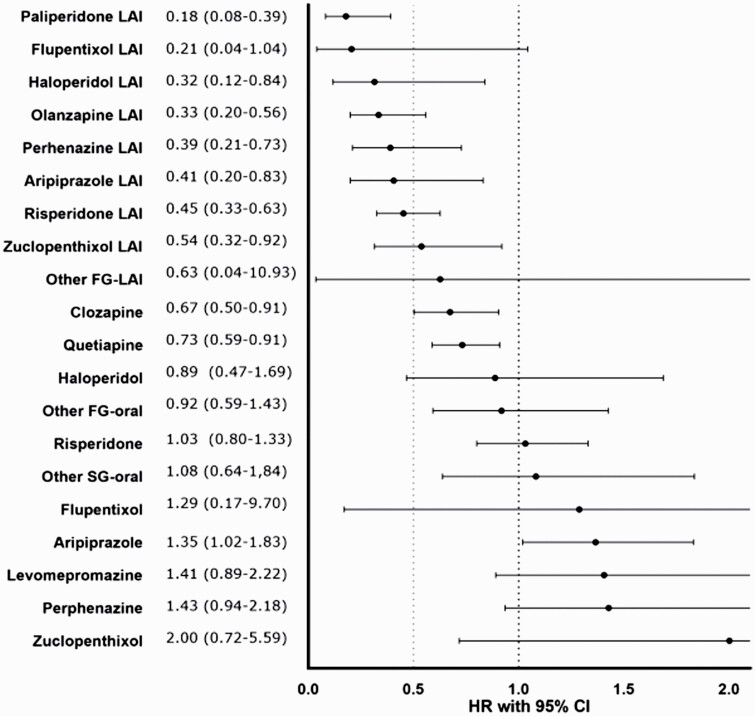
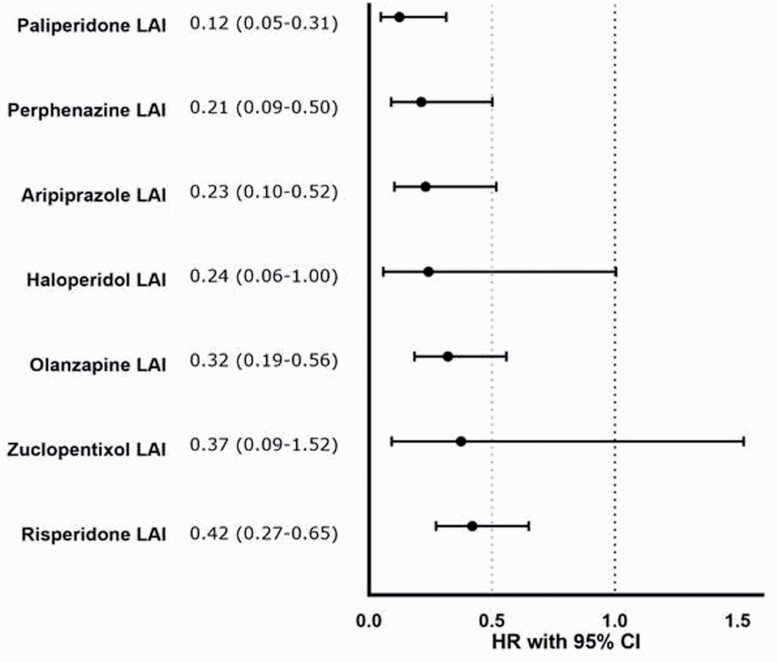
Schizophrenia often requires long-term treatment with antipsychotic medication. This study aims to measure the continuity of antipsychotic treatment over the course of illness in schizophrenia, as well as factors involved in the interruption of treatment. For this, we followed up a national cohort of first-episode psychosis patients in Finland for up to 18 years. Stratified Cox proportional hazards regressions were conducted for "within-participant" risk of discontinuation of subsequent treatments compared to the first, and by specific antipsychotic compared to oral olanzapine, the most prescribed antipsychotic in this cohort. Adjusted hazard ratios (aHRs) and 95% confidence intervals (95% CIs) were calculated. Among 3343 participants followed up for a mean of 8 years (SD = 4.93), the median number of continuous treatment episodes was 6 (interquartile range [IQR] = 3-11) with a median duration of 11.4 months (IQR = 5.3-25.6). In the first year after diagnosis, the incidence rate of treatment discontinuation was 30.12 (95% CI = 29.89-30.35) events per 100 participant-years, decreasing to 8.90 (95% CI = 8.75-9.05) in the 10th year. The risk of discontinuation progressively decreased over successive treatment episodes (aHR = 0.30; 95% CI = 0.20-0.46 for episodes after the 15th compared to the first). Individuals were 67% less likely to interrupt treatment with long-acting injectable than oral antipsychotics (aHR = 0.33; 95% CI = 0.27-0.41). Treatment for schizophrenia over the long term is often characterized by recurrent cycles of interruptions and reintroductions of antipsychotic medication, which is typically not recommended by management guidelines. Greater utilization of long-acting injectable formulations earlier in the course of illness may facilitate the continuity of antipsychotic treatment in schizophrenia.
Keywords: course of treatment; pharmacoepidemiology; treatment discontinuation.
© The Author(s) 2021. Published by Oxford University Press on behalf of the Maryland Psychiatric Research Center.All rights reserved. For permissions, please email: journals.permissions@oup.com.
Figures
References
-
- Leucht S, Tardy M, Komossa K, et al. Antipsychotic drugs versus placebo for relapse prevention in schizophrenia: a systematic review and meta-analysis. Lancet. 2012;379(9831):2063–2071. - PubMed
-
- Shimomura Y, Kikuchi Y, Suzuki T, Uchida H, Mimura M, Takeuchi H. Antipsychotic treatment in the maintenance phase of schizophrenia: an updated systematic review of the guidelines and algorithms. Schizophr Res. 2020;215:8–16. - PubMed
-
- Tiihonen J, Tanskanen A, Taipale H. 20-year nationwide follow-up study on discontinuation of antipsychotic treatment in first-episode schizophrenia. Am J Psychiatry. 2018;175(8):765–773. - PubMed
-
- Alvarez-Jimenez M, Priede A, Hetrick SE, et al. Risk factors for relapse following treatment for first episode psychosis: a systematic review and meta-analysis of longitudinal studies. Schizophr Res. 2012;139(1–3):116–128. - PubMed
Publication types
MeSH terms
Substances
LinkOut - more resources
Full Text Sources
Medical
