. 2021 Jun 16;19(1):118.
doi: 10.1186/s12915-021-01052-x.

Large-scale genomic analysis reveals the genetic cost of chicken domestication

Affiliations

Large-scale genomic analysis reveals the genetic cost of chicken domestication

Ming-Shan Wang et al. BMC Biol. .

Abstract

Background: Species domestication is generally characterized by the exploitation of high-impact mutations through processes that involve complex shifting demographics of domesticated species. These include not only inbreeding and artificial selection that may lead to the emergence of evolutionary bottlenecks, but also post-divergence gene flow and introgression. Although domestication potentially affects the occurrence of both desired and undesired mutations, the way wild relatives of domesticated species evolve and how expensive the genetic cost underlying domestication is remain poorly understood. Here, we investigated the demographic history and genetic load of chicken domestication.

Results: We analyzed a dataset comprising over 800 whole genomes from both indigenous chickens and wild jungle fowls. We show that despite having a higher genetic diversity than their wild counterparts (average π, 0.00326 vs. 0.00316), the red jungle fowls, the present-day domestic chickens experienced a dramatic population size decline during their early domestication. Our analyses suggest that the concomitant bottleneck induced 2.95% more deleterious mutations across chicken genomes compared with red jungle fowls, supporting the "cost of domestication" hypothesis. Particularly, we find that 62.4% of deleterious SNPs in domestic chickens are maintained in heterozygous states and masked as recessive alleles, challenging the power of modern breeding programs to effectively eliminate these genetic loads. Finally, we suggest that positive selection decreases the incidence but increases the frequency of deleterious SNPs in domestic chicken genomes.

Conclusion: This study reveals a new landscape of demographic history and genomic changes associated with chicken domestication and provides insight into the evolutionary genomic profiles of domesticated animals managed under modern human selection.

Keywords: Bottleneck; Deleterious mutation; Domestic chicken; Domestication; Genetic load.


Conflict of interest statement

The authors declare that they have no competing interests.

Figures
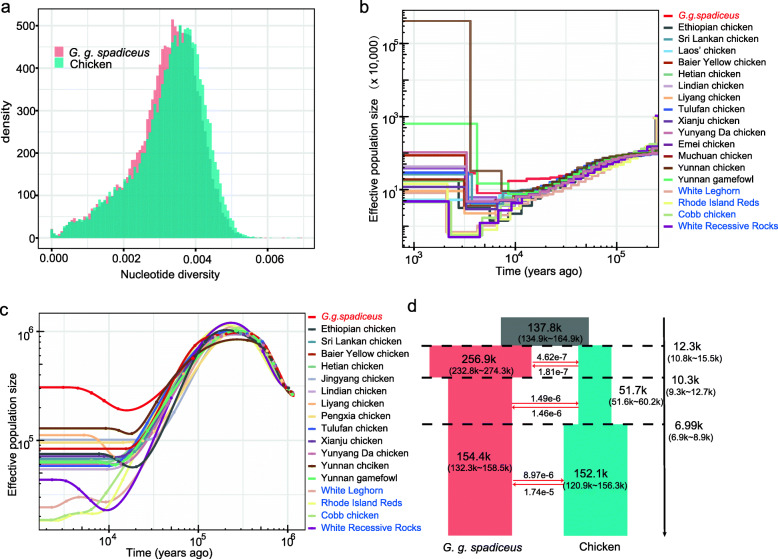
Fig. 1
Fig. 1
Genomic diversity and demographic history for both domestic chicken and G. g. spadiceus. a Nucleotide diversity for domestic chicken and G. g. spadiceus. In this analysis, the average nucleotide diversity for domestic chicken was calculated based on 696 samples, and for G. g. spadiceus, it was calculated based on 35 samples (after removing 10 admixed samples). b MSMC analysis of the historical population size of 18 chicken populations and GGS. c SMC++ analysis of the historical population size of 17 chicken populations and GGS. A bottleneck is evident in all chicken populations and pronounced in commercial chickens. Breed information for commercial chickens was in blue. d Dadi analysis showing the divergence and splitting of domestic chickens from GGS
Fig. 2
Fig. 2
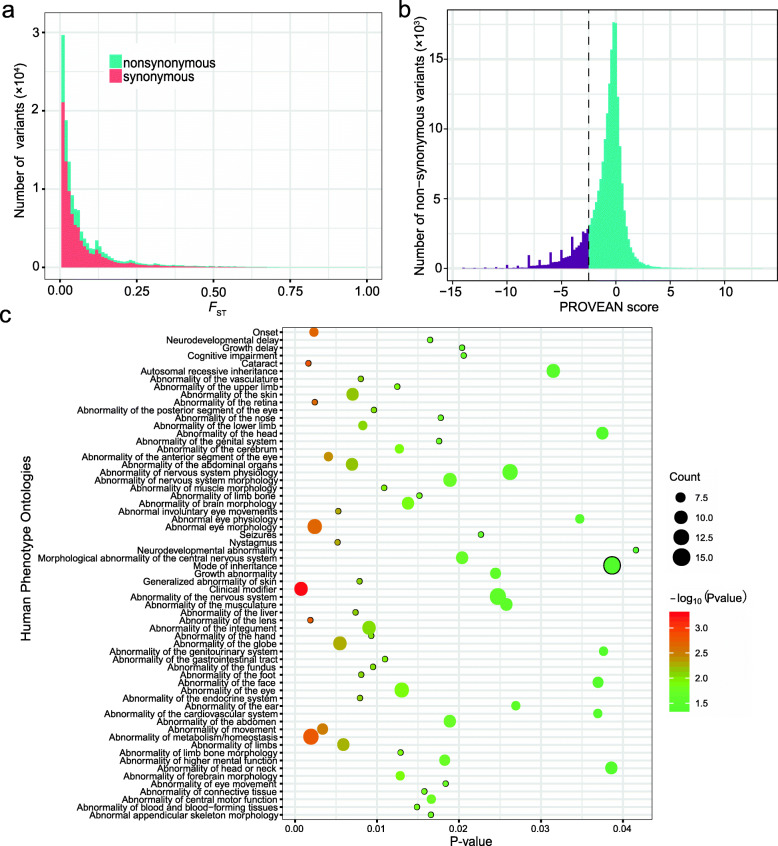
The distribution and functional enrichment analyses of high-impact mutations. a Distribution of pairwise FST between domestic chickens and GGS for non-synonymous and synonymous mutations (stacked on the plot). b Distribution of the effects of variants predicted by PROVEAN. The more negative the score is, the more likely the variant impacts protein function. The PROVEAN score threshold used in this study is drawn as a vertical dashed line (score ≤ −2.5). c HPO analysis of genes carrying alleles with PROVEAN score < −10. P-values were corrected using Benjamini-Hochberg FDR. Count depicts the number of genes for each category. We only show HPO terms with more than six enriched genes
Fig. 3
Fig. 3
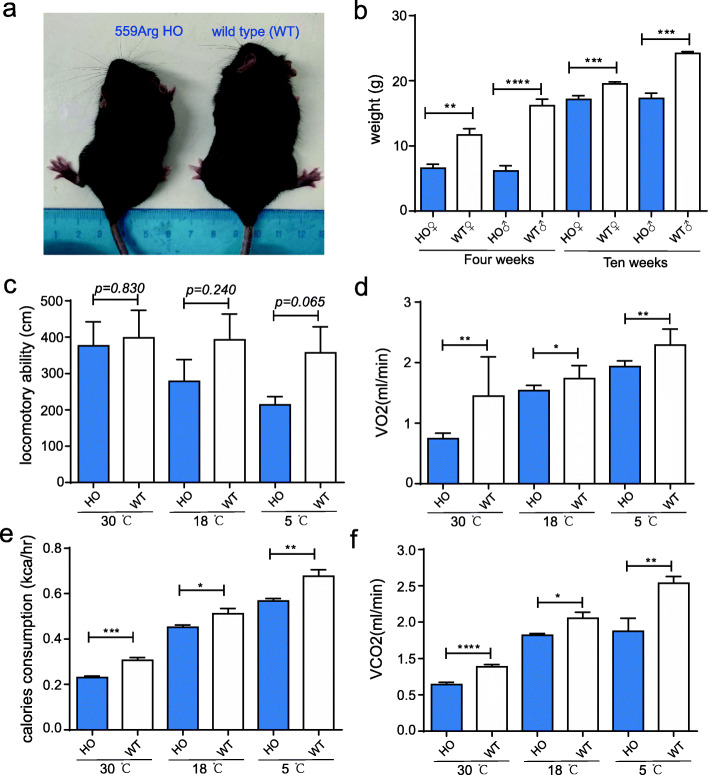
Testing the function of TSHR-Gly559Arg using transgenic mouse model assay. a Photograph showing TSHR-559Arg knock-in homozygous (HO) and wild-type (WT) mice at 4 months old. b Bar plot shows that HO mice have significantly lower body weight than wild-type mice. c No difference in total locomotive ability between HO and wild-type mice. df HO mice have significantly lower oxygen consumption (VO2), calorie consumption, and carbon dioxide exhalation (VCO2) compared to wild-type mice. In b, n = 6 HO and n = 8 WT female and n = 8 HO and n = 8 WT male 4-week-old mice, as well as n = 7 HO and n = 7 WT female and n = 12 HO and n = 14 WT male 10-week-old mice were analyzed. In cf, n = 8 for both HO and WT male mice were analyzed for each test. *P < 0.05; **P < 0.01;***P < 0.001; ****P < 0.0001. Statistical significance was measured by Student’s t-test (two-tailed)
Fig. 4
Fig. 4
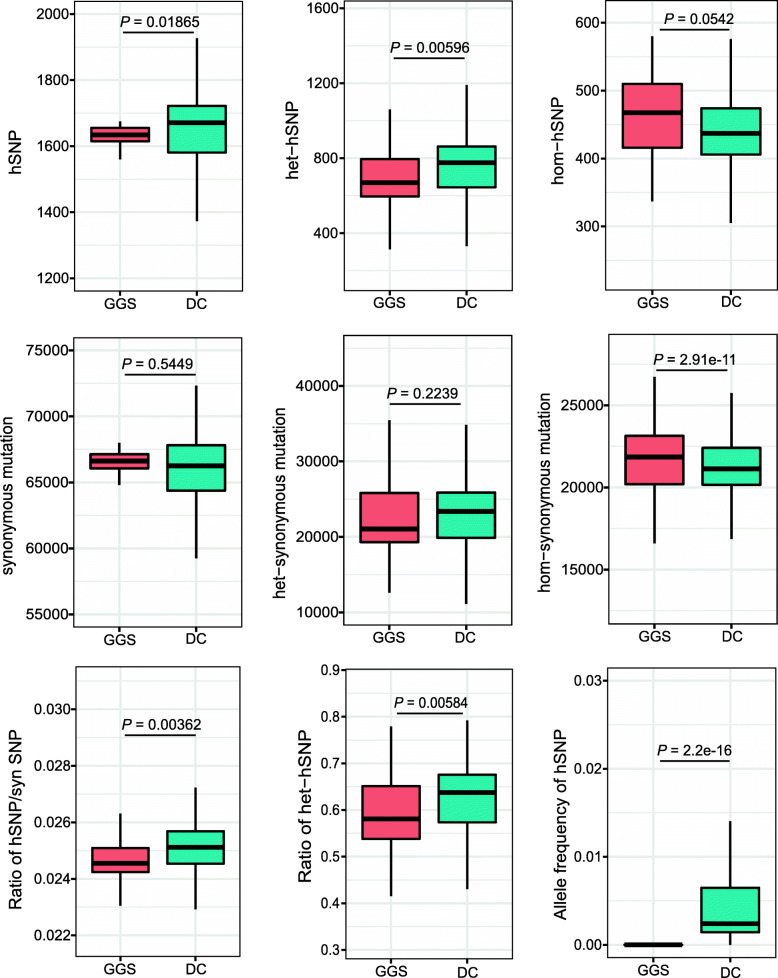
The frequency and number of high-impact mutations in domestic chickens and G. g. spadiceus. P-values were computed by the Wilcoxon signed-rank test between domestic chicken (DC; n = 696) and G. g. spadiceus (GGS; n = 35)

References

    1. Bosse M, Megens HJ, Derks MFL, de Cara AMR, Groenen MAM. Deleterious alleles in the context of domestication, inbreeding, and selection. Evol Appl. 2019;12(1):6–17. doi: 10.1111/eva.12691. - DOI - PMC - PubMed
    1. Makino T, Rubin CJ, Carneiro M, Axelsson E, Andersson L, Webster MT. Elevated proportions of deleterious genetic variation in domestic animals and plants. Genome Biol Evol. 2018;10(1):276–290. doi: 10.1093/gbe/evy004. - DOI - PMC - PubMed
    1. Agrawal AF, Whitlock MC. Inferences about the distribution of dominance drawn from yeast gene knockout data. Genetics. 2011;187(2):553–566. doi: 10.1534/genetics.110.124560. - DOI - PMC - PubMed
    1. Groß C, Bortoluzzi C, de Ridder D, Megens H-J, Groenen MAM, Reinders M, et al. Evolutionarily conserved non-protein-coding regions in the chicken genome harbor functionally important variation. bioRxiv. 2020; 10.1101/2020.03.27.012005.
    1. Carneiro M, Rubin CJ, Di Palma F, Albert FW, Alfoldi J, Martinez Barrio A, Pielberg G, Rafati N, Sayyab S, Turner-Maier J, et al. Rabbit genome analysis reveals a polygenic basis for phenotypic change during domestication. Science (New York, NY) 2014;345(6200):1074–1079. doi: 10.1126/science.1253714. - DOI - PMC - PubMed

Publication types