


'I hated being ghosted' - The relevance of social participation for living well with post-stroke aphasia: Qualitative interviews with working aged adults
- PMID: 34132006
- PMCID: PMC8369109
- DOI: 10.1111/hex.13291
'I hated being ghosted' - The relevance of social participation for living well with post-stroke aphasia: Qualitative interviews with working aged adults
Abstract
Background: In the context of increasing incidence of stroke in working aged adults, there is a specific need to explore the views of working aged adults with post-stroke aphasia, whose communication difficulties may result in restricted social participation, loss of employment and changed relationship and parenting roles. This study aimed to explore the perspectives of working aged adults with post-stroke aphasia in relation to social participation and living well with aphasia (LWA).
Design and participants: We conducted qualitative interviews with 14 people with post-stroke aphasia (PWA). Data were analysed following principles of reflexive, thematic analysis. Patient or Public Contribution: A Public and Patient Involvement aphasia advisory group inputted into the study design and interpretation of data.
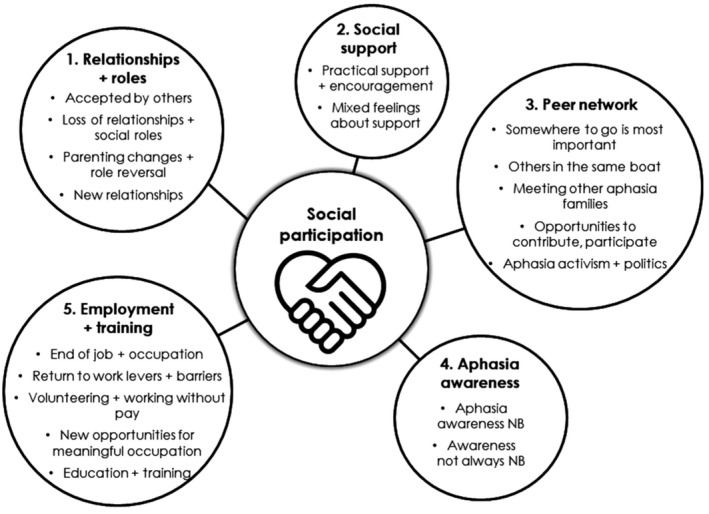
Results: Social participation spanned 5 themes: Relationships and roles; Social support; Peer network, Aphasia awareness; and Employment and training. Meaningful, interesting social participation for LWA is individually defined. Working aged PWA may require flexible support with parenting, accessing a diverse social network and finding opportunities for meaningful social connection, training and employment.
Conclusions: The findings extend knowledge of social participation in the context of LWA for working aged adults by elucidating the individually defined nature of meaningful participation and how PWA may need flexible support with parenting, accessing a diverse social network and training and employment. For aphasia research, policy and services to be relevant, it is crucial that working aged PWA are meaningfully involved in setting the aphasia agenda.
Keywords: Aphasia; patient involvement; rehabilitation; social participation; social support; stroke.
© 2021 The Authors. Health Expectations published by John Wiley & Sons Ltd.
Conflict of interest statement
The authors declare no competing interests.
Figures
References
-
- Kagan A, Simmons‐Mackie N. From my perspective: changing the aphasia narrative. ASHA Leader. 2013;18(11):6‐8. 10.1044/leader.FMP.18112013.6 - DOI
-
- Aphasia Institute . What is aphasia? Masked competence ‐ knowing more than you can say 2015 [01.06.2020]. Available from: https://www.aphasia.ca/home‐page/about‐aphasia/what‐is‐aphasia/. Accessed June 1, 2021.
-
- Baker C, Worrall L, Rose M, Ryan B. ‘It was really dark’: the experiences and preferences of people with aphasia to manage mood changes and depression. Aphasiology. 2020;34(1):19‐46. 10.1080/02687038.2019.1673304 - DOI
-
- Black‐Schaffer R, Osberg J. Return to work after stroke: development of a predictive model. Arch Phys Med Rehabil. 1990;71:285‐290. - PubMed
Publication types
MeSH terms
LinkOut - more resources
Full Text Sources
Medical
