. 2021 Jun 16;78(8):859-867.
doi: 10.1001/jamapsychiatry.2021.1290. Online ahead of print.

Neurocognitive Functioning in Individuals at Clinical High Risk for Psychosis: A Systematic Review and Meta-analysis

Affiliations

Neurocognitive Functioning in Individuals at Clinical High Risk for Psychosis: A Systematic Review and Meta-analysis

Ana Catalan et al. JAMA Psychiatry. .

Abstract

Importance: Neurocognitive functioning is a potential biomarker to advance detection, prognosis, and preventive care for individuals at clinical high risk for psychosis (CHR-P). The current consistency and magnitude of neurocognitive functioning in individuals at CHR-P are undetermined.

Objective: To provide an updated synthesis of evidence on the consistency and magnitude of neurocognitive functioning in individuals at CHR-P.

Data sources: Web of Science database, Cochrane Central Register of Reviews, and Ovid/PsycINFO and trial registries up to July 1, 2020.

Study selection: Multistep literature search compliant with Preferred Reporting Items for Systematic Reviews and Meta-analyses and Meta-analysis of Observational Studies in Epidemiology performed by independent researchers to identify original studies reporting on neurocognitive functioning in individuals at CHR-P.

Data extraction and synthesis: Independent researchers extracted the data, clustering the neurocognitive tasks according to 7 Measurement and Treatment Research to Improve Cognition in Schizophrenia (MATRICS) domains and 8 CHR-P domains. Random-effect model meta-analyses, assessment of publication biases and study quality, and meta-regressions were conducted.

Main outcomes and measures: The primary effect size measure was Hedges g of neurocognitive functioning in individuals at CHR-P (1) compared with healthy control (HC) individuals or (2) compared with individuals with first-episode psychosis (FEP) or (3) stratified for the longitudinal transition to psychosis.

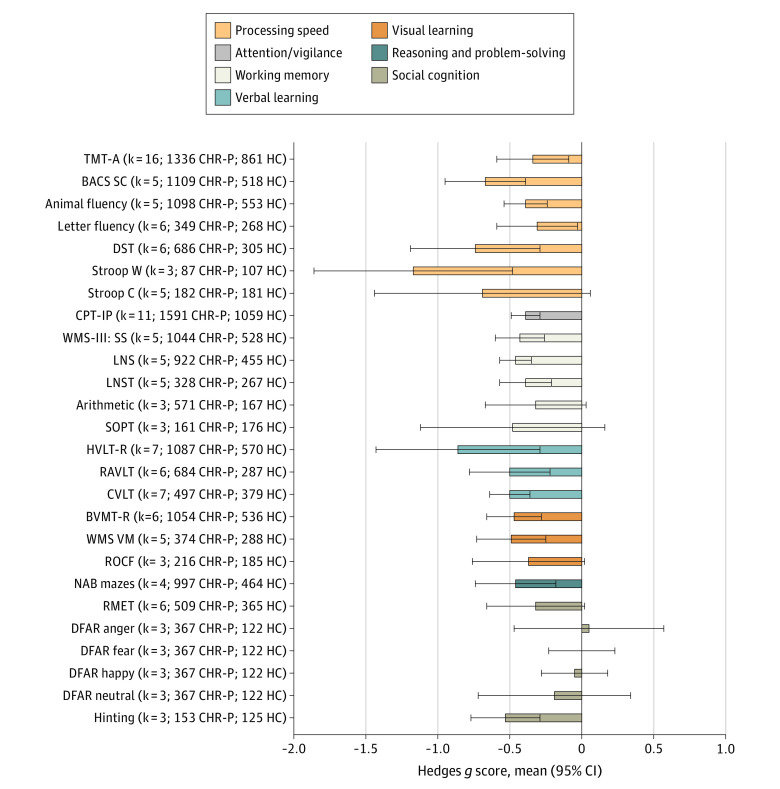
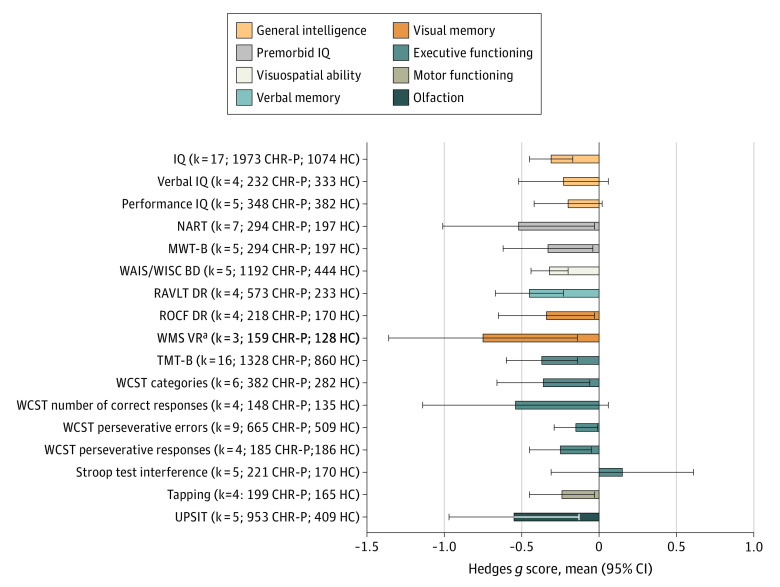
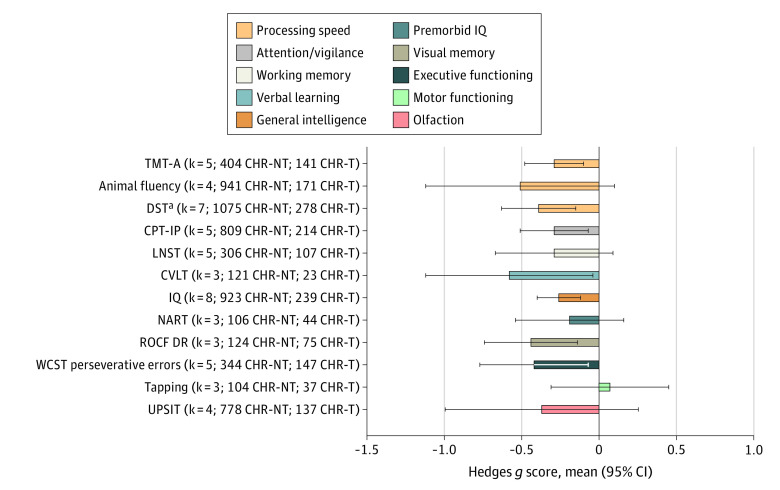
Results: A total of 78 independent studies were included, consisting of 5162 individuals at CHR-P (mean [SD; range] age, 20.2 [3.3; 12.0-29.0] years; 2529 [49.0%] were female), 2865 HC individuals (mean [SD; range] age, 21.1 [3.6; 12.6-29.2] years; 1490 [52.0%] were female), and 486 individuals with FEP (mean [SD; range] age, 23.0 [2.0; 19.1-26.4] years; 267 [55.9%] were female). Compared with HC individuals, individuals at CHR-P showed medium to large deficits on the Stroop color word reading task (g = -1.17; 95% CI, -1.86 to -0.48), Hopkins Verbal Learning Test-Revised (g = -0.86; 95% CI, -1.43 to -0.28), digit symbol coding test (g = -0.74; 95% CI, -1.19 to -0.29), Brief Assessment of Cognition Scale Symbol Coding (g = -0.67; 95% CI, -0.95 to -0.39), University of Pennsylvania Smell Identification Test (g = -0.55; 95% CI, -0.97 to -0.12), Hinting Task (g = -0.53; 95% CI, -0.77 to -0.28), Rey Auditory Verbal Learning Test (g = -0.50; 95% CI, -0.78 to -0.21), California Verbal Learning Test (CVLT) (g = -0.50; 95% CI, -0.64 to -0.36), and National Adult Reading Test (g = -0.52; 95% CI, -1.01 to -0.03). Individuals at CHR-P were less impaired than individuals with FEP. Longitudinal transition to psychosis from a CHR-P state was associated with medium to large deficits in the CVLT task (g = -0.58; 95% CI, -1.12 to -0.05). Meta-regressions found significant effects for age and education on processing speed.

Conclusions and relevance: Findings from this meta-analysis support neurocognitive dysfunction as a potential detection and prognostic biomarker in individuals at CHR-P. These findings may advance clinical research and inform preventive approaches.


Conflict of interest statement

Conflict of Interest Disclosures: Dr Catalan reports personal fees from Janssen-Cilag and grants from the Carlos III Health Institute outside the submitted work. Dr Salazar de Pablo reports grants from Fundación Alicia Koplowitz and personal fees from Janssen-Cilag outside the submitted work. Dr Fusar-Poli reports research fees from Lundbeck and honoraria from Lundbeck, Angelini, Menarini, and Boehringer Ingelheim outside the submitted work. No other disclosures were reported.

Figures

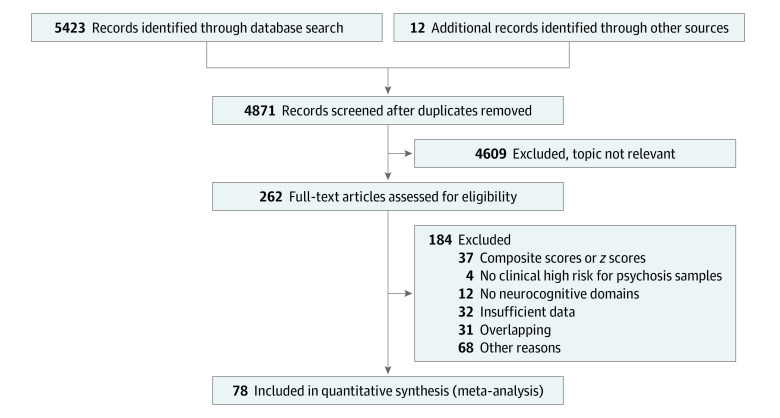
Figure 1.
Figure 1.. PRISMA Flowchart Outlining the Study Selection Process
Figure 2.
Figure 2.. Neurocognitive Task-Level Functioning of Individuals at Clinical High Risk for Psychosis (CHR-P) Compared With Healthy Control (HC) Individuals Across the 7 Measurement and Treatment Research to Improve Cognition in Schizophrenia Domains
Hedges g scores (mean and 95% CI) are given (negative values indicate worse performance among individuals at CHR-P vs HC individuals), along with the number of studies (k) included and sample size. BACS SC indicates Brief Assessment of Cognition Scale Symbol Coding; BVMT-R, Brief Visuospatial Memory Test–Revised; CPT-IP, Continuous Performance Test–Identical Pairs; CVLT, California Verbal Learning Test; DFAR, Degraded Facial Affect Recognition; DST, digit symbol coding test; HVLT-R, Hopkins Verbal Learning Test–Revised; LNS, Letter Number Span; LNST, Letter Number Sequencing Test; NAB Mazes, Neuropsychological Assessment Battery Mazes; RAVLT, Rey Auditory Verbal Learning Test; RMET, Reading the Mind in the Eyes Test; ROCF, Rey-Osterrieth Complex Figure Immediate Recall; SOPT, Self-ordered Pointing Test; Stroop C, Stroop color naming task; Stroop W, Stroop color word reading task; TMT-A, Trail Making Test–Part A; WMS-III: SS, Wechsler Memory Scale III: Spatial Span; WMS VM, Wechsler Memory Scale Immediate Visual Memory.
Figure 3.
Figure 3.. Neurocognitive Task-Level Functioning of Individuals at Clinical High Risk for Psychosis (CHR-P) Compared With Healthy Control (HC) Individuals Across the CHR-P Domains
Hedges g scores (mean and 95% CI) are given (negative values indicate worse performance in individuals at CHR-P vs HC individuals), along with the number of studies included (k) and sample size. IQ indicates Wechsler Intelligence Scales (full); Verbal IQ, Wechsler Intelligence Scales (verbal); Performance IQ, Wechsler Intelligence Scales performance; MWT-B, Mehrfach-Wortschaftz-Intelligenz Test–Part B; NART, National Adult Reading Test; RAVLT DR, Rey Auditory Verbal Learning Test Delayed Recall; ROCF DR, Rey-Osterrieth Complex Figure Delayed Recall; TMT-B, Trail Making Test–Part B; UPSIT, University of Pennsylvania Smell Identification Test; WAIS/WISC BD, Wechsler Adult Intelligence Scale/Wechsler Intelligence Scale for Children Block Design; WCST, Wisconsin Card Sorting Test; WMS VR, Wechsler Memory Scale Visual Reproduction Delayed Recall. aAffected by publication bias.
Figure 4.
Figure 4.. Neurocognitive Task-Level Functioning of Individuals at Clinical High Risk for Psychosis (CHR-P) Developing Psychosis Compared With Those Not Developing Psychosis Across the Measurement and Treatment Research to Improve Cognition in Schizophrenia and CHR-P Domains
Hedges g scores (mean and 95% CI) are given (negative values indicate worse performance in individuals at CHR-P who transitioned to psychosis [CHR-T] vs individuals at CHR-P who did not transition to psychosis [CHR-NT] groups), along with the number of studies included (k) and sample size. CPT-IP indicates Continuous Performance Test–Identical Pairs; CVLT, California Verbal Learning Test; DST, digit symbol coding test; IQ, Wechsler Intelligence Scales (full); LNST, Letter Number Sequencing Test; NART, National Adult Reading Test; ROCF DR, Rey-Osterrieth Complex Figure Delayed Recall; TMT-A, Trail Making Test–Part A; UPSIT, University of Pennsylvania Smell Identification Test; WCST, Wisconsin Card Sorting Test. aAffected by publication bias.
Figure 5.
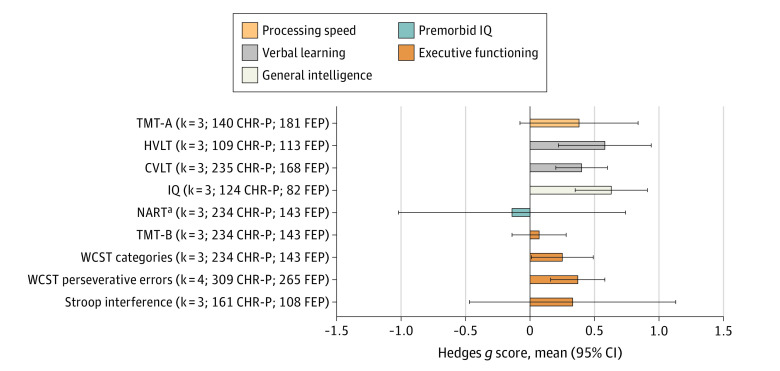
Figure 5.. Neurocognitive Task-Level Functioning of Individuals at Clinical High Risk for Psychosis (CHR-P) Compared With Individuals With First-Episode Psychosis (FEP) Across Measurement and Treatment Research to Improve Cognition in Schizophrenia and CHR-P Domains
Hedges g scores (mean and 95% CI) across neurocognitive tasks are given (negative values indicate worse performance in individuals at CHR-P compared with individuals with FEP) along with the number of studies included (k) and sample size. CVLT indicates California Verbal Learning Test; HVLT-R, Hopkins Verbal Learning Test–Revised; IQ, Wechsler Intelligence Scales (full); NART, National Adult Reading Test; TMT-A, Trail Making Test–Part A; TMT-B, Trail Making Test–Part B; WCST, Wisconsin Card Sorting Test. aAffected by publication bias.

References

    1. Fusar-Poli P. The clinical high-risk state for psychosis (CHR-P), Version II. Schizophr Bull. 2017;43(1):44-47. doi: 10.1093/schbul/sbw158 - DOI - PMC - PubMed
    1. Catalan A, Salazar de Pablo G, Vaquerizo Serrano J, et al. Annual research review: prevention of psychosis in adolescents—systematic review and meta-analysis of advances in detection, prognosis and intervention. J Child Psychol Psychiatry. 2020;62(5):657-673. doi: 10.1111/jcpp.13322 - DOI - PubMed
    1. Fusar-Poli P, Salazar de Pablo G, Correll CU, et al. Prevention of psychosis: advances in detection, prognosis, and intervention. JAMA Psychiatry. 2020;77(7):755-765. doi: 10.1001/jamapsychiatry.2019.4779 - DOI - PubMed
    1. Fusar-Poli P, McGorry PD, Kane JM. Improving outcomes of first-episode psychosis: an overview. World Psychiatry. 2017;16(3):251-265. doi: 10.1002/wps.20446 - DOI - PMC - PubMed
    1. National Institute for Health and Care Excellence NICE Guideline . Psychosis and schizophrenia in adults: prevention and management. Accessed December 1, 2020. https://www.nice.org.uk/guidance/cg178