. 2021 Oct;88(4):619-631.
doi: 10.1007/s00280-021-04318-x. Epub 2021 Jun 16.

Pharmacokinetics of preoperative intraperitoneal 5-FU in patients with pancreatic ductal adenocarcinoma

Affiliations

Pharmacokinetics of preoperative intraperitoneal 5-FU in patients with pancreatic ductal adenocarcinoma

Mikael Öman et al. Cancer Chemother Pharmacol. 2021 Oct.

Abstract

Purpose: The aim was to investigate the pharmacokinetics of preoperatively administered intraperitoneal (IP) 5-FU in patients with resectable pancreatic ductal adenocarcinoma (PDAC) by analyzing levels of 5-FU and target metabolites in peritoneal fluid, plasma, liver, lymph nodes, pancreatic tumour, and pancreatic tissue. These results were correlated to expression of genes encoding enzymes of the 5-FU pathway and cell membrane transporters of 5-FU and FdUMP.

Methods: Twenty-two patients with PDAC were treated with IP 5-FU before surgery. The postoperative treatment followed a routine clinical protocol. 5-FU and its metabolites were analyzed by LC-MS/MS. The expression of genes encoding enzymes and transporters in the 5-FU pathway was analyzed by qPCR.

Results: After IP treatment, 5-FU could be detected in plasma, lymph nodes, liver, pancreatic tumour, and pancreatic tissue. The highest 5-FU concentration was found in the liver, also expressing high levels of the 5-FU transporter OAT2. 5-FU was converted to active FdUMP in all tissues and the highest concentration was measured in lymph nodes, liver and pancreatic tumour (18.5, 6.1 and 6.7 pmol/g, respectively). There was a correlation between the FdUMP and dUr levels in lymph nodes (r = 0.70, p = 0.0076). In tumours, there was an association between OAT2 expression and FdUMP concentration.

Conclusion: The study shows uptake of IP 5-FU and drug metabolism to active FdUMP in pancreatic tumour, liver, and lymph nodes. Extended studies are warranted to evaluate the IP route for 5-FU administration in PDAC patients.

Keywords: 5-Fluorouracil; Gene expression; Intraperitoneal chemotherapy; Pancreatic cancer; Pharmacokinetics.


Conflict of interest statement

No affiliation or financial involvement in any organization or entity with a direct financial interest in the subject, matter or materials discussed in the manuscript exists.

Figures
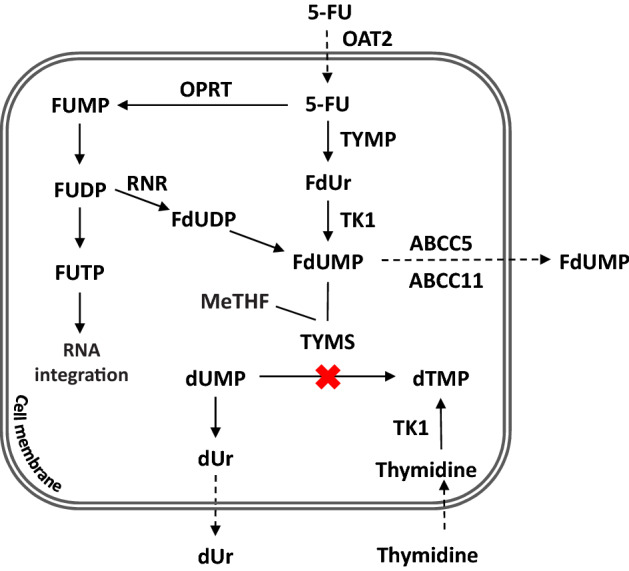
Fig. 1
Fig. 1
Simplified schematic of the intracellular conversion of 5-FU to FdUMP. 5-FU is converted to the active metabolite FdUMP by two main routes. In one route, the enzyme thymidine phosphorylase (TYMP) catalyzes the conversion of 5-FU to fluorodeoxyuridine (FdUr), which in the next step is phosphorylated to FdUMP by thymidine kinase (TK1). In the other route, the enzyme orotate phosphoribosyltransferase (OPRT) converts 5-FU to fluorouridine monophosphate (FUMP) which subsequently is phosphorylated to fluorouridine diphosphate (FUDP) by kinases. The enzyme ribonucleotide reductase (RNR) then converts FUDP to fluorodeoxyuridine diphosphate (FdUDP) which is dephosphorylated to FdUMP
Fig. 2
Fig. 2
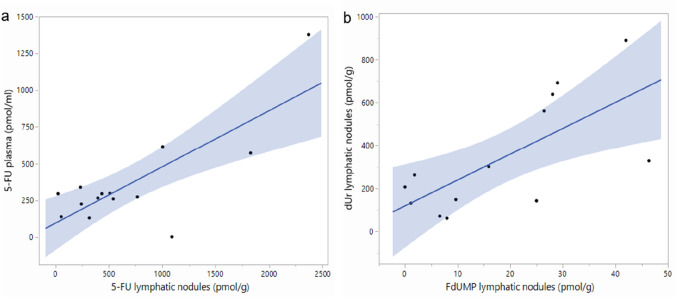
a Scatter plots showing a positive correlation between a) 5-FU levels in plasma and lymph nodes before resection (r = 0.78, p = 0.0009), and b between dUr and FdUMP levels in lymph nodes before resection (r = 0.70, p = 0.0076). The fit confidence region is shown as a blue-shaded area. 5-FU, 5-flurorouracil; dUr, deoxyuridine; FdUMP, 5-fluorodeoxyuridine monophosphate
Fig. 3
Fig. 3
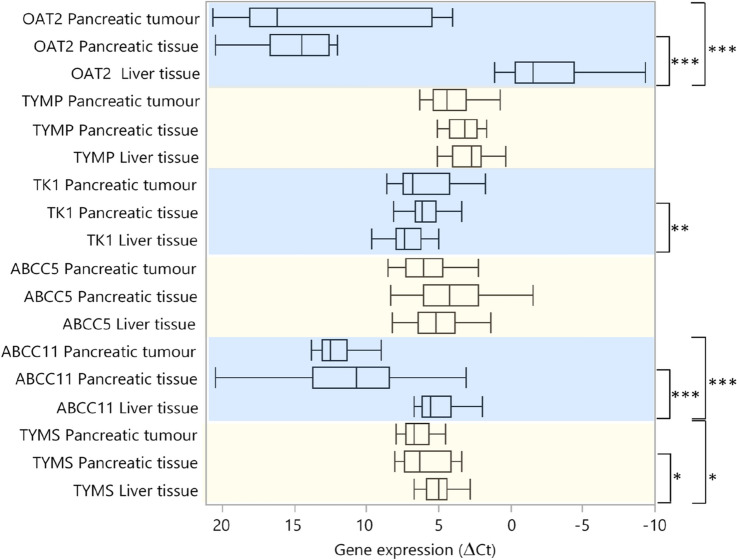
Comparison of gene expression in pancreatic tumour, pancreatic tissue, and liver tissue. The expression levels are presented as box plots with median values and ranges. Note that a high ΔCt value represents low gene expression and vice versa. The asterisks denote significance levels: *p ≤ 0.05, **p ≤ 0.01, ***p ≤ 0.00. OAT2, organic anion transporter 2; TYMP, thymidine phosphorylase; TK1, thymidine kinase 1; ABCC5, ATP-binding cassette subfamily C member 5; ABCC11, ATP-binding cassette subfamily C member 11; TYMS, thymidylate synthase
Fig. 4
Fig. 4
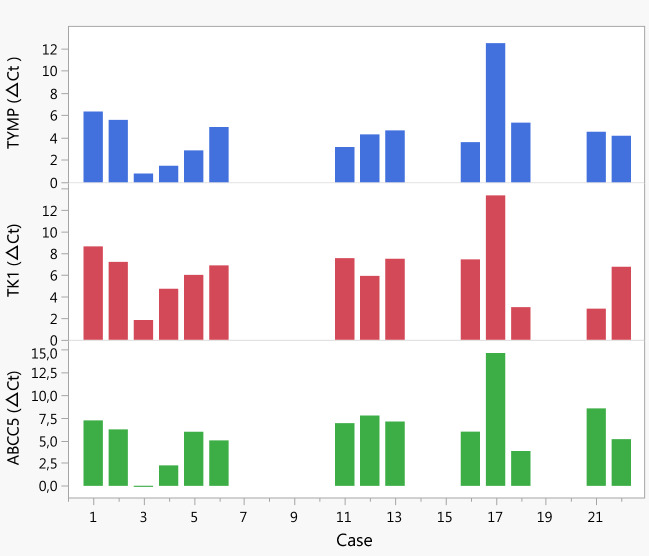
TYMP, TK1, and ABCC5 gene expression in pancreatic tumour of individual cases. Note that high ΔCt values correspond to low gene expression and vice versa. Pancreatic tumour tissue was not available for gene expression analysis from case 7–10, 14–15, and 19–20. TYMP, thymidine phosphorylase; TK1, thymidine kinase 1; ABCC5, ATP-binding cassette subfamily C member 5

References

    1. Collaborators GBDPC The global, regional, and national burden of pancreatic cancer and its attributable risk factors in 195 countries and territories, 1990–2017: a systematic analysis for the Global Burden of Disease Study 2017. Lancet Gastroenterol Hepatol. 2019;4(12):934–947. doi: 10.1016/S2468-1253(19)30347-4. - DOI - PMC - PubMed
    1. Rawla P, Sunkara T, Gaduputi V. Epidemiology of pancreatic cancer: global trends, etiology and risk factors. World J Oncol. 2019;10(1):10–27. doi: 10.14740/wjon1166. - DOI - PMC - PubMed
    1. Stathis A, Moore MJ. Advanced pancreatic carcinoma: current treatment and future challenges. Nat Rev Clin Oncol. 2010;7(3):163–172. doi: 10.1038/nrclinonc.2009.236. - DOI - PubMed
    1. Tingstedt B, Andersson B, Jonsson C, Formichov V, Bratlie SO, Ohman M, Karlsson BM, Ansorge C, Segersvard R, Gasslander T. First results from the Swedish National Pancreatic and Periampullary Cancer Registry. HPB (Oxf) 2019;21(1):34–42. doi: 10.1016/j.hpb.2018.06.1811. - DOI - PubMed
    1. Tanaka M, Mihaljevic AL, Probst P, Heckler M, Klaiber U, Heger U, Buchler MW, Hackert T. Meta-analysis of recurrence pattern after resection for pancreatic cancer. Br J Surg. 2019;106(12):1590–1601. doi: 10.1002/bjs.11295. - DOI - PubMed

Publication types

MeSH terms

Substances