Review
. 2021 May 31:12:679739.
doi: 10.3389/fimmu.2021.679739. eCollection 2021.

The GIMAP Family Proteins: An Incomplete Puzzle

Affiliations
Review

The GIMAP Family Proteins: An Incomplete Puzzle

Marc-André Limoges et al. Front Immunol. .

Abstract

Overview: Long-term survival of T lymphocytes in quiescent state is essential to maintain their cell numbers in secondary lymphoid organs and in peripheral circulation. In the BioBreeding diabetes-prone strain of rats (BB-DP), loss of functional GIMAP5 (GTPase of the immune associated nucleotide binding protein 5) results in profound peripheral T lymphopenia. This discovery heralded the identification of a new family of proteins initially called Immune-associated nucleotide binding protein (IAN) family. In this review we will use 'GIMAP' to refer to this family of proteins. Recent studies suggest that GIMAP proteins may interact with each other and also be involved in the movement of the cellular cargo along the cytoskeletal network. Here we will summarize the current knowledge on the characteristics and functions of GIMAP family of proteins.

Keywords: AIG domain; B cells; GIMAP5; T lymphocyte; gimap; lymphopenia.


Conflict of interest statement

The authors declare that the research was conducted in the absence of any commercial or financial relationships that could be construed as a potential conflict of interest.

Figures
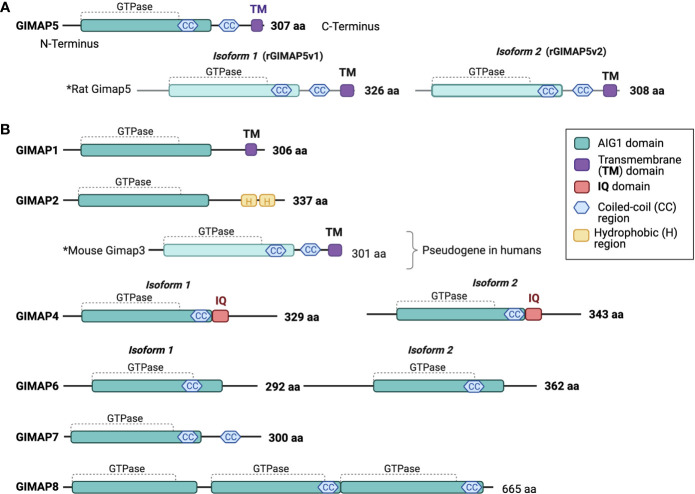
Figure 1
Figure 1
Human GIMAP family protein structure. Predicted structural domains of human GIMAP family members. (A) The 307-amino acid long human GIMAP5 protein contains the GIMAP GTPase domain, coiled-coil (CC) regions and a C-terminal transmembrane (TM) domain. Rat GIMAP5 protein is found in two isoforms that differ in length (GIMAP5v1 and GIMAP5v2). Both retain the CC regions and the TM domain. (B) Predicted structures of other human GIMAP family proteins and mouse GIMAP3, as the latter is a pseudogene in humans. The calmodulin interaction domain (IQ) is unique to both GIMAP4 isoforms. The drawings are not to scale.
Figure 2
Figure 2
T cell signaling pathways that are influenced by GIMAP5. Following TCR stimulation by MHC:peptide complex or by Ab-mediated TCR cross-linking, LCK phosphorylates CD3 zeta chains and ZAP70, resulting in the phosphorylation of LAT that acts as a scaffold for downstream signaling molecules such as PLCγ. Activation of the PI3K/AKT signaling pathway downstream of TCR phosphorylates and inhibits the TSC1/2 complex, relieving repression of the mTORC1 kinase and leading to activation of downstream signaling events. IL-7 signaling stimulates STAT5 and also activates the PI3K/AKT pathway. GIMAP5 deficiency in rat and mouse T cells compromises proximal TCR signaling characterized by reduced Tyr phosphorylation of ZAP70 and LAT, but results in constitutive activation of AKT and mTORC1. GIMAP5 deficient T cells also display reduced IL-7-induced STAT5 phosphorylation. It is unclear how GIMAP5 impacts the TCR and IL-7R signaling pathways and regulates AKT activity (, , –42).
Figure 3
Figure 3
Regulation of Calcium homeostasis in rat T cells by GIMAP5. TCR-induced PLCγ activation leads to cleavage of plasma membrane-associated phosphatidylinositol 4,5 bisphosphate (PIP2) to generate inositol 1,4,5-triphosphate (IP3). IP3 binds to its receptor IP3R on the endoplasmic reticulum (ER) and triggers Ca2+ release from the ER store, resulting in a conformational change in the ER-localized STIM1 protein. This event relays a signal to open the Ca2+ release-activated Ca2+ channel (CRAC) on the plasma membrane, inducing the capacitative Ca2+ entry. The rising concentration of cytosolic calcium ([Ca2+]c) activates the Ca2+ uniporter on the mitochondrial membrane to uptake Ca2+, which is released later via the Na+/Ca2+ exchanger. In addition to ER, lysosomes also release a significant amount of Ca2+ following cell activation. Loss of GIMAP5 does not affect TCR- or thapsigargin- induced Ca2+ release from the ER stores but reduces Ca2+entry from extracellular milieu. GIMAP5 resides on lysosomes and the loss of GIMAP5 reduces lysosomal and mitochondrial Ca2+ content, presumably leading to feedback inhibition of the CRAC channels by cytosolic Ca2+. How GIMAP5 integrates TCR signaling to regulate lysosomal and mitochondrial Ca2+ to promote T cell survival and functions remains to be elucidated (28, 30, 31).
Figure 4
Figure 4
Subcellular localization of various GIMAP proteins in T cells. The known subcellular localization of mammalian GIMAP proteins in T lymphocytes is indicated. For the sake of simplicity, species-specific expression pattern of some GIMAP proteins are omitted. Details are given in the text and Table 1 . Events that are predicted but require experimental confirmation are indicated by question marks. Ref- GIMAP5: (–33); GIMAP1: (33); GIMAP2: (45); GIMAP3: (47); GIMAP4: (49); GIMAP6: (51); GIMAP7: (45); GIMAP8: (55).

References

    1. Ramanathan S, Poussier P. BB Rat Lyp Mutation and Type 1 Diabetes. Immunol Rev (2001) 184:161–71. 10.1034/j.1600-065x.2001.1840115.x - DOI - PubMed
    1. Hornum L, Romer J, Markholst H. The Diabetes-Prone BB Rat Carries a Frameshift Mutation in Ian4, a Positional Candidate of Iddm1. Diabetes (2002) 51(6):1972–9. 10.2337/diabetes.51.6.1972 - DOI - PubMed
    1. MacMurray AJ, Moralejo DH, Kwitek AE, Rutledge EA, Van Yserloo B, Gohlke P, et al. Lymphopenia in the BB Rat Model of Type 1 Diabetes is Due to a Mutation in a Novel Immune-Associated Nucleotide (Ian)-Related Gene. Genome Res (2002) 12(7):1029–39. 10.1101/gr.412702 - DOI - PMC - PubMed
    1. Krucken J, Schroetel RM, Muller IU, Saidani N, Marinovski P, Benten WP, et al. Comparative Analysis of the Human Gimap Gene Cluster Encoding a Novel GTPase Family. Gene (2004) 341:291–304. 10.1016/j.gene.2004.07.005 - DOI - PubMed
    1. Colle E, Guttmann RD, Seemayer T. Spontaneous Diabetes Mellitus Syndrome in the Rat. I. Association With the Major Histocompatibility Complex. J Exp Med (1981) 154(4):1237–42. 10.1084/jem.154.4.1237 - DOI - PMC - PubMed

Publication types

LinkOut - more resources
