. 2020 May 29;12(1):117.
doi: 10.1007/s40820-020-00459-5.

Tailoring the Meso-Structure of Gold Nanoparticles in Keratin-Based Activated Carbon Toward High-Performance Flexible Sensor

Affiliations

Tailoring the Meso-Structure of Gold Nanoparticles in Keratin-Based Activated Carbon Toward High-Performance Flexible Sensor

Aniruddha B Patil et al. Nanomicro Lett. .

Abstract

Flexible biosensors with high accuracy and reliable operation in detecting pH and uric acid levels in body fluids are fabricated using well-engineered metal-doped porous carbon as electrode material. The gold nanoparticles@N-doped carbon in situ are prepared using wool keratin as both a novel carbon precursor and a stabilizer. The conducting electrode material is fabricated at 500 °C under customized parameters, which mimics A-B type (two different repeating units) polymeric material and displays excellent deprotonation performance (pH sensitivity). The obtained pH sensor exhibits high pH sensitivity of 57 mV/pH unit and insignificant relative standard deviation of 0.088%. Conversely, the composite carbon material with sp2 structure prepared at 700 °C is doped with nitrogen and gold nanoparticles, which exhibits good conductivity and electrocatalytic activity for uric acid oxidation. The uric acid sensor has linear response over a range of 1-150 µM and a limit of detection 0.1 µM. These results will provide new avenues where biological material will be the best start, which can be useful to target contradictory applications through molecular engineering at mesoscale.

Keywords: Flexible biosensor; Health monitoring; Metal nanoparticle carbon composite; Structure engineering; Wool keratin.


Figures

Fig. 1
Fig. 1
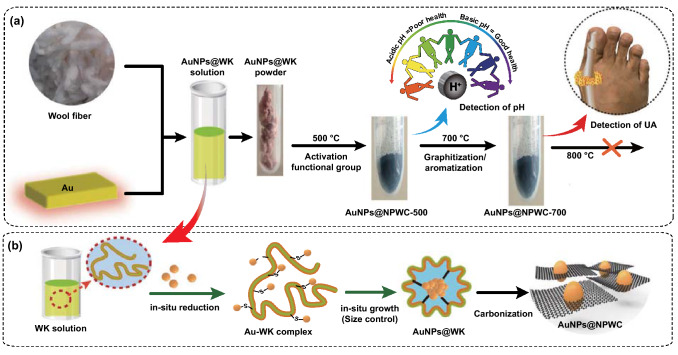
Schematic representation for the fabrication of a wool keratin-encapsulated gold nanoparticles and b nitrogen-doped aromatized carbon
Fig. 2
Fig. 2
Preparation of well-engineered AuNP-doped porous carbonaceous materials. a Controlled preparation process of AuNPs@NPWC with structure manipulation to achieve diverse performance to target different applications. At 500 °C carbonization temperature, composite material possessing high % of N in the form of graphitic, pyridinic, and pyrrolic with carboxylic groups showing high sensitivity toward pH sensing, whereas at carbonization temperature 700 °C, composite material owed more aromatization, high porosity, tightly anchored, and well-dispersed spherical AuNPs, which is more sensitive for UA sensing application. b Schematic illustration showing in situ reduction and synthesis of AuNPs with subsequent encapsulation to the final carbonized AuNPs@NPWC composite material
Fig. 3
Fig. 3
Effect of carbonization temperature from 400 to 800 °C on carbon skeleton and morphology of the AuNPs. a Schematic illustration. bf TEM images showing effect of carbonization temperature morphology and dispersion of the AuNPs. gk Effect on the aromatized carbon skeleton. lp SEM images showing effect of carbonization temperature morphology and dispersion of the AuNPs. q Corresponding XRD pattern. r Corresponding Raman spectra
Fig. 4
Fig. 4
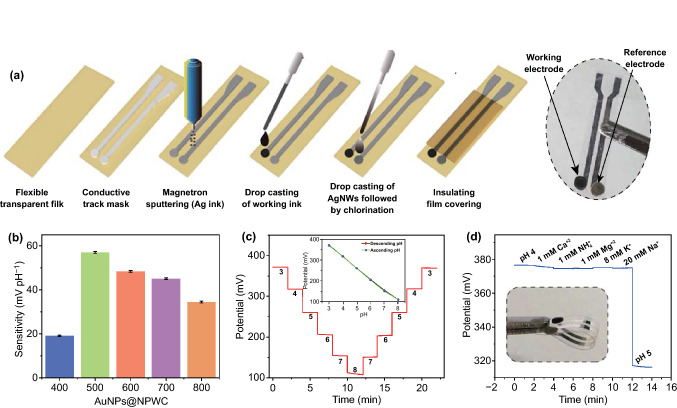
General strategy and response of pH sensor: a Fabrication of two electrode strip-based flexible sensor, b pH sensitivity of carbonized composite materials, c repeatability analysis and d selectivity of AuNPs@NPWC-500 modified pH sensor (inset showing hysteresis analysis)
Fig. 5
Fig. 5
General strategy and response of UA sensor: a Reaction scheme showing non-enzymatic electrocatalytic UA oxidation reaction. b Schematic illustration of three-electrode flexible strip-based sensor. c Cyclic voltammograms of 1.0 mM UA in 0.1 M PBS (pH = 7) using different electrodes. d Cyclic voltammograms of 1.0 mM UA in 0.1 M PBS (pH = 7) and without UA only 0.1 M PBS (pH = 7) using AuNPs@NPWC-700 modified sensor. e DPV curves of AuNPs@NPWC-700 electrode in different concentrations of UA (1–150 µM) containing 0.1 M PBS (pH = 7) solution, the plot of oxidation currents versus the concentration of UA (inset). f Correlation between the developed biosensor and the commercial standard UA meter

References

    1. Sackmann EK, Fulton AL, Beebe DJ. The present and future role of microfluidics in biomedical research. Nature. 2014;507:181–189. doi: 10.1038/nature13118. - DOI - PubMed
    1. Oh SY, Hong SY, Jeong YR, Yun J, Park H, et al. Skin-attachable, stretchable electrochemical sweat sensor for glucose and pH detection. ACS Appl. Mater. Interfaces. 2018;10:13729–13740. doi: 10.1021/acsami.8b03342. - DOI - PubMed
    1. Rock KL, Kataoka H, Lai JJ. Uric acid as a danger signal in gout and its comorbidities. Nat. Rev. Rheumatol. 2013;9:13–23. doi: 10.1038/nrrheum.2012.143. - DOI - PMC - PubMed
    1. Nurmohamed MT, Heslinga M, Kitas GD. Cardiovascular comorbidity in rheumatic diseases. Nat. Rev. Rheumatol. 2015;11:693–704. doi: 10.1038/nrrheum.2015.112. - DOI - PubMed
    1. Xing Y, Shi C, Zhao J, Qiu W, Lin N, et al. Mesoscopic-functionalization of silk fibroin with gold nanoclusters mediated by keratin and bioinspired silk synapse. Small. 2017;13:1702390. doi: 10.1002/smll.201702390. - DOI - PubMed

LinkOut - more resources