


Persistent Racial/Ethnic Disparities in Fatal Unintentional Drowning Rates Among Persons Aged ≤29 Years - United States, 1999-2019
- PMID: 34138831
- PMCID: PMC8220955
- DOI: 10.15585/mmwr.mm7024a1
Persistent Racial/Ethnic Disparities in Fatal Unintentional Drowning Rates Among Persons Aged ≤29 Years - United States, 1999-2019
Abstract
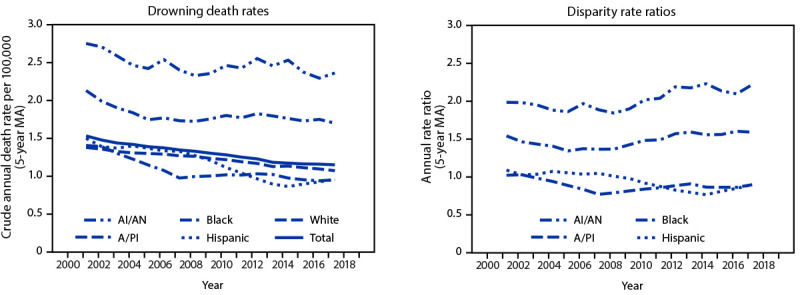
During 1999-2019, a total of 81,947 unintentional drowning deaths occurred in the United States (1). Drowning is one of the three leading causes of unintentional injury death among persons aged ≤29 years and results in more deaths among children aged 1-4 years than any other cause except birth defects (2). Drowning death rates have decreased since 1990 (declining by 57% worldwide and by 32% in the United States) (3). However, because of racial/ethnic disparities in drowning risk, rates remain high among certain racial/ethnic groups, particularly American Indian or Alaska Native (AI/AN) persons and Black or African-American (Black) persons (4). To assess whether decreasing drowning death rates have been accompanied by reductions in racial/ethnic disparities, and to further describe these disparities by age group and setting, CDC analyzed U.S. mortality data during 1999-2019. The drowning death rate among persons aged ≤29 years was 1.3 per 100,000 population. The rate per 100,000 among AI/AN persons (2.5) and Black persons (1.8) was higher than among all other racial/ethnic groups and was 2.0 and 1.5 times higher than among White persons (1.2). Racial/ethnic disparities in drowning death rates did not significantly decline for most groups, and the disparity in rates among Black persons compared with White persons increased significantly from 2005-2019. Drowning death rates are associated with persistent and concerning racial/ethnic disparities. A better understanding of the factors that contribute to drowning disparities is needed. Implementing and evaluating community-based interventions, including those promoting basic swimming and water safety skills, among disproportionately affected racial/ethnic groups could help reduce drowning disparities.
Conflict of interest statement
All authors have completed and submitted the International Committee of Medical Journal Editors form for disclosure of potential conflicts of interest. No potential conflicts of interest were disclosed.
Figures
References
-
- CDC. CDC WONDER. Underlying cause of death, 1999–2019. Atlanta, GA: US Department of Health and Human Services, CDC; 2021. https://wonder.cdc.gov/ucd-icd10.html
-
- CDC. Web-based Injury Statistics Query and Reporting System (WISQARS). WISQARS fatal injury data visualization. Atlanta, GA: US Department of Health and Human Services, CDC; 2021. https://wisqars-viz.cdc.gov:8006/lcd/home
MeSH terms
LinkOut - more resources
Full Text Sources
Medical
