


Effect of HIV infection on growth and bone density in peripubertal children in the era of antiretroviral therapy: a cross-sectional study in Zimbabwe
- PMID: 34139202
- PMCID: PMC8295041
- DOI: 10.1016/S2352-4642(21)00133-4
Effect of HIV infection on growth and bone density in peripubertal children in the era of antiretroviral therapy: a cross-sectional study in Zimbabwe
Abstract
Background: Faltered linear growth and pubertal delay, which are both common in children with HIV in sub-Saharan Africa, might affect adolescent bone accrual and future fragility fracture risk. We investigated the association of HIV with bone density adjusted for skeletal size in peripubertal children in Zimbabwe.
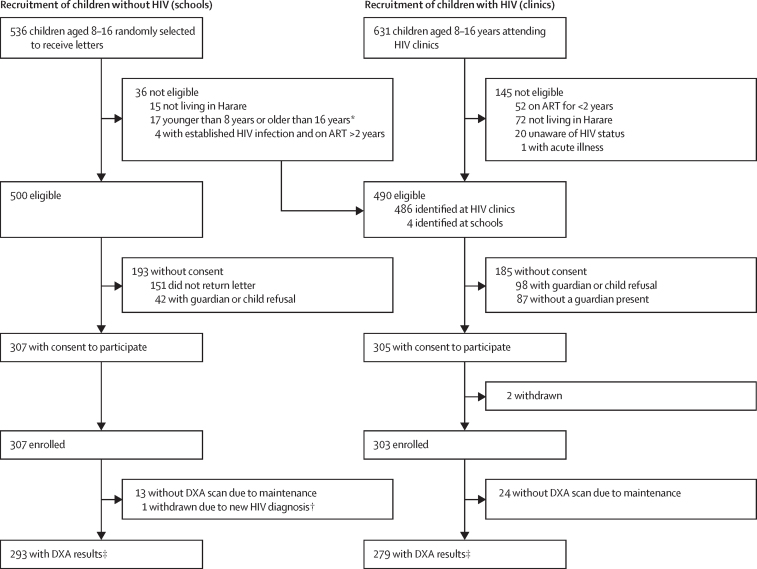
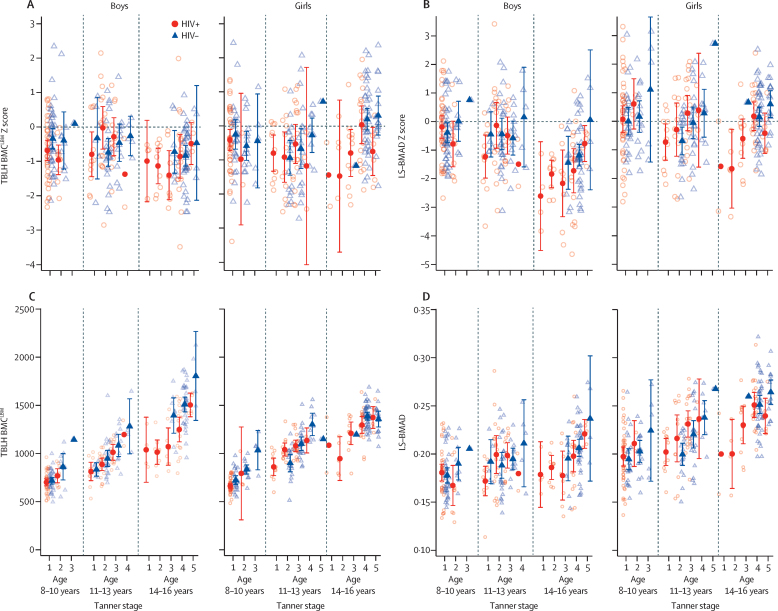
Methods: We did a cross-sectional study of baseline data from the IMVASK cohort, which enrolled children aged 8-16 years with HIV who had been taking antiretroviral therapy (ART) for at least 2 years, and children of the same age without HIV. Children with HIV were recruited from public sector HIV clinics at Parirenyatwa General Hospital and Harare Central Hospital (Harare, Zimbabwe), and children without HIV were recruited from six schools in the same suburbs that the hospitals serve. Sociodemographic, clinical, and anthropometric data were collected. Dual-energy X-ray absorptiometry (DXA) was used to measure the bone outcomes of total-body less-head bone mineral content for lean mass adjusted for height (TBLH-BMCLBM), and lumbar spine bone mineral apparent density (LS-BMAD), and we assessed the prevalence of low TBLH-BMCLBM and low LS-BMAD (defined by Z-scores of less than -2·0). Size adjustment techniques were used to overcome the size dependence of DXA measurement. We used linear regression models, with multiple imputation for missing data, to assess relationships between risk factors and TBLH-BMCLBM and LS-BMAD Z-scores in children with and without HIV.
Findings: We recruited 303 children with HIV (mean age 12·4 years [SD 2·5]; 151 [50%] girls) and 306 children without HIV (mean age 12·5 years [SD 2·5]; 155 [51%] girls). In children with HIV, median age of HIV diagnosis was 3·0 years (IQR 1·2-5·8), and median ART duration was 8·1 years (6·2-9·5); for 102 (34%) children, ART included tenofovir disoproxil fumarate (TDF). Children with HIV had a higher prevalence of low TBLH-BMCLBM Z-score than children without HIV (29 [10%] of 279 children with available data vs 18 [6%] of 292 with available data; p=0·066) and a higher prevalence of low LS-BMAD Z-score (40 [14%] of 279 vs 17 [6%] of 293 with available data; p=0·0007). HIV and male sex were associated with earlier pubertal (Tanner) stage. The negative associations between HIV and Z-scores for TBLH-BMCLBM and LS-BMAD were more pronounced with pubertal maturation, particularly in girls. Among children with HIV, TDF exposure and orphanhood were associated with lower TBLH-BMCLBM Z-score in confounder-adjusted analysis. Current TDF use (vs non-TDF-based ART) was associated with a reduction in TBLH-BMCLBM Z-score of 0·41 (95% CI 0·08-0·74; p=0·015) and in LS-BMAD Z-score of 0·31 (0·08-0·69; p=0·12).
Interpretation: Despite ART, HIV is associated with substantial skeletal deficits towards the end of puberty. The extent of bone deficits associated with TDF and its widespread use in children in sub-Saharan Africa are a concern for future adult fracture risk.
Funding: Wellcome Trust.
Copyright © 2021 The Author(s). Published by Elsevier Ltd. This is an Open Access article under the CC BY 4.0 license. Published by Elsevier Ltd.. All rights reserved.
Conflict of interest statement
Declaration of interests RR (grant number 206764/Z/17/Z) and RAF (grant number 206316/Z/17/Z) are funded by the Wellcome Trust. CM-K is funded by a National Institute of Health Fogarty Trent Fellowship. AMR is partially supported by the UK Medical Research Council (MRC) and the UK Department for International Development (DFID) under the MRC/DFID Concordat agreement, which is also part of the European and Developing Countries Clinical Trials Partnership 2 programme supported by the EU (grant number MR/R010161/1). All other authors declare no competing interests.
Figures
References
-
- Kekitiinwa A, Lee KJ, Walker AS. Differences in factors associated with initial growth, CD4, and viral load responses to ART in HIV-infected children in Kampala, Uganda, and the United Kingdom/Ireland. J Acquir Immune Defic Syndr. 2008;49:384–392. - PubMed
-
- Hernandez CJ, Beaupré GS, Carter DR. A theoretical analysis of the relative influences of peak BMD, age-related bone loss and menopause on the development of osteoporosis. Osteoporos Int. 2003;14:843–847. - PubMed
Publication types
MeSH terms
Substances
Grants and funding
LinkOut - more resources
Full Text Sources
Medical
