Review
. 2021 Jul 10;72(14):5134-5157.
doi: 10.1093/jxb/erab256.

Harnessing translational research in wheat for climate resilience

Affiliations
Review

Harnessing translational research in wheat for climate resilience

Matthew P Reynolds et al. J Exp Bot. .

Abstract

Despite being the world's most widely grown crop, research investments in wheat (Triticum aestivum and Triticum durum) fall behind those in other staple crops. Current yield gains will not meet 2050 needs, and climate stresses compound this challenge. However, there is good evidence that heat and drought resilience can be boosted through translating promising ideas into novel breeding technologies using powerful new tools in genetics and remote sensing, for example. Such technologies can also be applied to identify climate resilience traits from among the vast and largely untapped reserve of wheat genetic resources in collections worldwide. This review describes multi-pronged research opportunities at the focus of the Heat and Drought Wheat Improvement Consortium (coordinated by CIMMYT), which together create a pipeline to boost heat and drought resilience, specifically: improving crop design targets using big data approaches; developing phenomic tools for field-based screening and research; applying genomic technologies to elucidate the bases of climate resilience traits; and applying these outputs in developing next-generation breeding methods. The global impact of these outputs will be validated through the International Wheat Improvement Network, a global germplasm development and testing system that contributes key productivity traits to approximately half of the global wheat-growing area.

Keywords: Abiotic; big data; breeding; climate resilience; environment; genetic resources; genomics; international collaboration; phenomics; physiology.


Figures

Fig. 1.
Fig. 1.
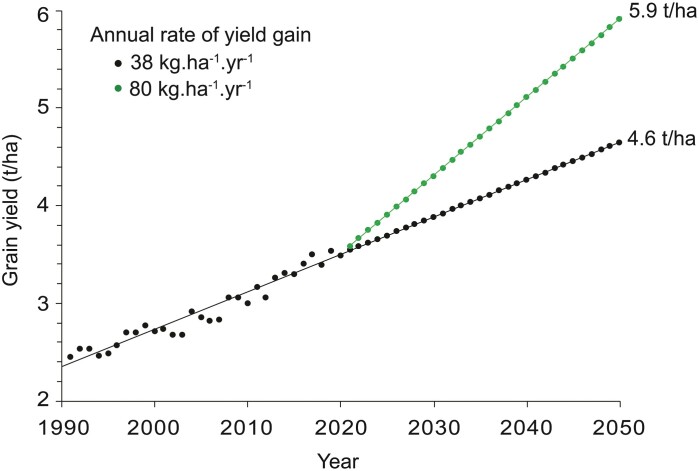
Historical and future projected grain yield for wheat. Historical data from the previous 30 years were used. A similar yield trend was observed with 60 previous years of data (Wulff and Dhugga, 2018). The average annual yield increase over the last 30 years has been 38 kg ha−1 year−1. Extrapolation with the current annual rate of gain to 2050 leads to 4.6 t ha−1 grain yield, which is an increase of a little over 30% above the 2020 level of 3.5 t ha−1 (black). Projected need (green) from a growing and increasingly affluent population is ~1.3 billion Mt by 2050 (Ray et al., 2013), which, in order to be met, requires an annual rate of gain of 80 kg ha−1 year−1 for a yield of 5.9 t ha−1. Updated data (13 August 2020) for wheat production were downloaded from United States Department of Agriculture–Economic Research Service site (https://www.ers.usda.gov/data-products/wheat-data/).
Fig. 2.
Fig. 2.
Public and private breeding programmes that have received germplasm under the International Wheat Improvement Network.
Fig. 3.
Fig. 3.
Spring bread wheat released by region and origin through the IWIN, 1994–2014 (Lantican et al., 2016). Adapted under CC BY-NC.
Fig. 4.
Fig. 4.
Main research steps involved in translating promising technologies into genetic gains (graphical abstract, adapted from Reynolds and Langridge, 2016). Reprinted under licence CC BY-NC-ND.
Fig. 5.
Fig. 5.
Harnessing research across a global wheat improvement network for climate resilience: research gaps, interactive goals, and outcomes.
Fig. 6.
Fig. 6.
Diversity analysis of domesticated hexaploid accessions (from Sansaloni et al., 2020). Multidimensional scaling plot of 56 342 domesticated hexaploid accessions with 66 067 SNP markers differentiated by biological status based on passport information (breeder elite line, landraces, cultivar, synthetic, etc.) enabling selection of research panels based on molecular diversity. Reprinted under licence CC BY.
Fig. 7.
Fig. 7.
Examples of different classes and applications of breeder-friendly phenotyping (adapted from Reynolds et al., 2020). Abbreviations: NVDI, normalized difference vegetation index; SPAD, a chlorophyll meter. Reprinted under licence CC BY-NC-ND.
Fig. 8.
Fig. 8.
Pre-breeding pipeline incorporating diverse genetic resources into elite widely adapted materials and delivering semi-elite high-value germplasm as the stress adaptive trait yield nurseries (SATYNs) to countries around the world.
Fig. 9.
Fig. 9.
Different streams of a pre-breeding pipeline for spring wheat breeding at CIMMYT, including selection with and without fungicide treatment, marker-assisted backcrossing, and speed breeding. Lines undergo genomic selection and rust screening, and are further examined for agronomic traits routinely at the F4:7 stage, though these examinations may occur in earlier generations depending on the model and needs. Lines with good trait values as well as rust resistance are included in the stress adaptive trait yield nurseries (SATYNs), for global distribution through the IWIN, while those that have good trait value, but are susceptible to rust, are recycled into the programme through trait nurseries and germplasm panels used in crossing.

References

    1. Aberkane H, Payne T, Kishii M, Smale M, Amri A, Jamora N. 2020. Transferring diversity of goat grass to farmers’ fields through the development of synthetic hexaploid wheat. Food Security 12, 1017–1033.
    1. Acuña-Galindo MA, Mason RE, Subramanian NK, Hays DB. 2015. Meta-analysis of wheat QTL regions associated with adaptation to drought and heat stress. Crop Science 55, 477–492.
    1. Afzal F, Li H, Gul A, et al. . 2019. Genome-wide analyses reveal footprints of divergent selection and drought adaptive traits in synthetic-derived wheats. G3 9, 1957–1973. - PMC - PubMed
    1. Ahkami AH, Allen White R, Handakumbura PP, Jansson C. 2017. Rhizosphere engineering: enhancing sustainable plant ecosystem productivity. Rhizosphere 3, 233–243.
    1. Amani I, Fischer A, Reynolds MP. 1996. Canopy temperature depression association with yield of irrigated spring wheat cultivars in a hot climate. Journal of Agronomy and Crop Science 176, 119–129.

Publication types