Observational Study
. 2021 Jun 22;77(24):3031-3041.
doi: 10.1016/j.jacc.2021.04.059.

Triglycerides and Residual Atherosclerotic Risk

Affiliations
Observational Study

Triglycerides and Residual Atherosclerotic Risk

Sergio Raposeiras-Roubin et al. J Am Coll Cardiol. .

Abstract

Background: Even when low-density lipoprotein-cholesterol (LDL-C) levels are lower than guideline thresholds, a residual risk of atherosclerosis remains. It is unknown whether triglyceride (TG) levels are associated with subclinical atherosclerosis and vascular inflammation regardless of LDL-C.

Objectives: This study sought to assess the association between serum TG levels and early atherosclerosis and vascular inflammation in apparently healthy individuals.

Methods: An observational, longitudinal, and prospective cohort study, including 3,754 middle-aged individuals with low to moderate cardiovascular risk from the PESA (Progression of Early Subclinical Atherosclerosis) study who were consecutively recruited between June 2010 and February 2014, was conducted. Peripheral atherosclerotic plaques were assessed by 2-dimensional vascular ultrasound, and coronary artery calcification (CAC) was assessed by noncontrast computed tomography, whereas vascular inflammation was assessed by fluorine-18 fluorodeoxyglucose uptake on positron emission tomography.

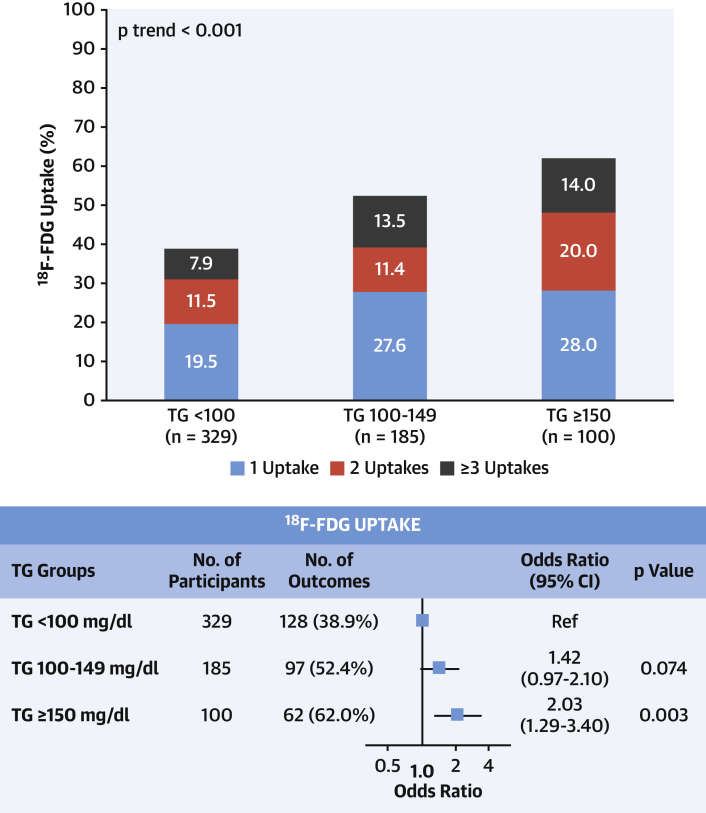
Results: Atherosclerotic plaques and CAC were observed in 58.0% and 16.8% of participants, respectively, whereas vascular inflammation was evident in 46.7% of evaluated participants. After multivariate adjustment, TG levels ≥150 mg/dl showed an association with subclinical noncoronary atherosclerosis (odds ratio [OR]: 1.35; 95% confidence interval [CI]: 1.08 to 1.68; p = 0.008). This association was significant for groups with high LDL-C (OR: 1.42; 95% CI: 1.11 to 1.80; p = 0.005) and normal LDL-C (OR: 1.85; 95% CI: 1.08 to 3.18; p = 0.008). No association was found between TG level and CAC score. TG levels ≥150 mg/dl were significantly associated with the presence of arterial inflammation (OR: 2.09; 95% CI: 1.29 to 3.40; p = 0.003).

Conclusions: In individuals with low to moderate cardiovascular risk, hypertriglyceridemia was associated with subclinical atherosclerosis and vascular inflammation, even in participants with normal LDL-C levels. (Progression of Early Subclinical Atherosclerosis [PESA]; NCT01410318).

Keywords: CACS; arterial inflammation; coronary calcification; subclinical atherosclerosis; triglycerides.


Conflict of interest statement

Funding Support and Author Disclosures The PESA study is funded by the National Center for Cardiovascular Research (CNIC) and Santander Bank. The study also has received funding from the Carlos III Health Institute (ISCIII; PI15/02019, PI17/00590, and PI20/00819) and the European Regional Development Fund. The CNIC is supported by the ISCIII, the Ministry of Science and Innovation, and the Pro CNIC Foundation. CNIC is a Severo Ochoa Center of Excellence (SEV-2015-0505). The funders had no role in the design and conduct of the study; the collection, management, analysis, and interpretation of the data; the preparation, review, or approval of the manuscript; or the decision to submit the manuscript for publication. Dr. Ibáñez is the recipient of a European Research Council grant MATRIX (ERC-COG-2018-ID: 819775). All other authors have reported that they have no relationships relevant to the contents of this paper to disclose.

Figures
None
Graphical abstract
Figure 1
Figure 1
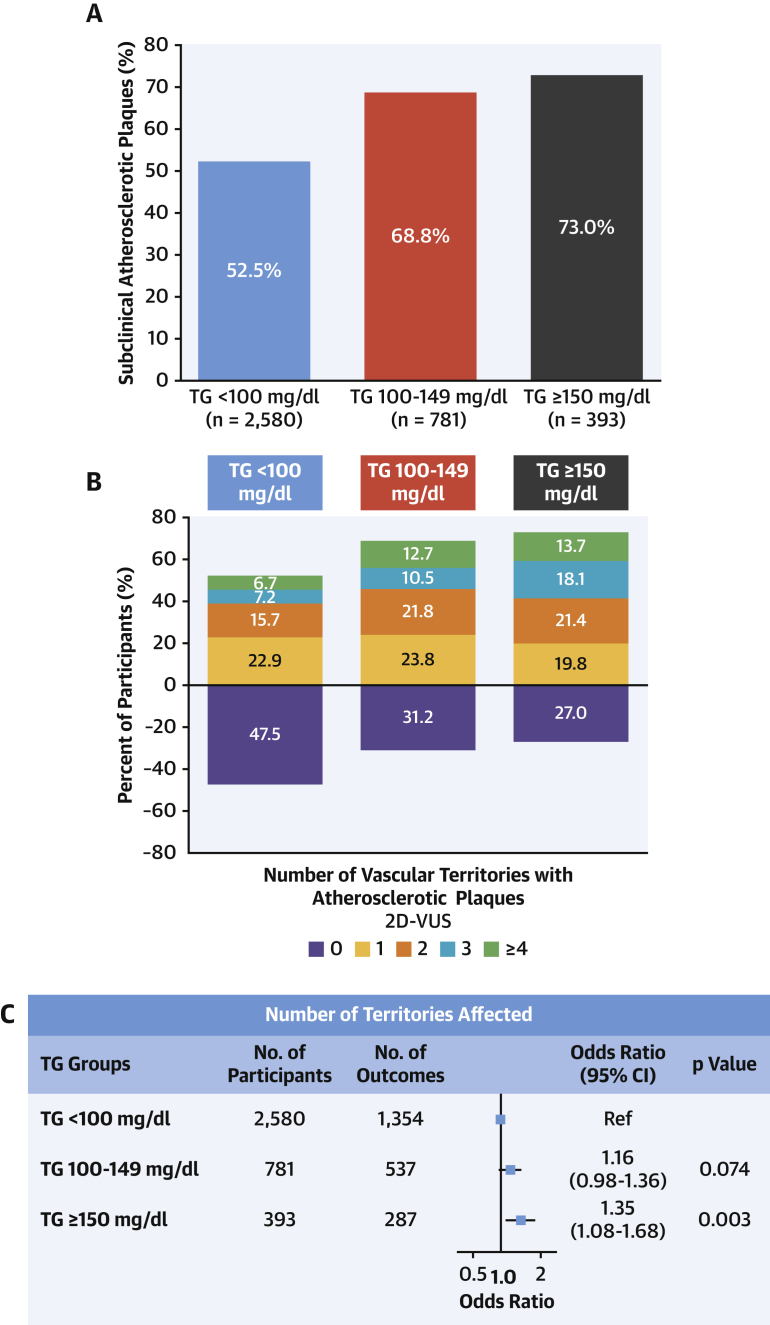
Prevalence and Extension of Subclinical Atherosclerosis According to TG Levels (A) Percentage of subjects with atherosclerotic plaques in the different groups according to triglyceride (TG) levels. (B) Distribution of subclinical atherosclerosis evaluated with number of noncoronary vascular territories affected according to triglyceride levels. (C) Ordinal regression model to assess the relationship between triglyceride levels and the number of noncoronary atherosclerotic territories (0, 1, 2, 3, ≥4). Results were adjusted for potential confounders, including age, sex, systolic blood pressure, low-density lipoprotein cholesterol, high-density lipoprotein cholesterol, smoking, glycated hemoglobin, body mass index, family history of cardiovascular disease, moderate to vigorous physical activity, ethanol consumption, and eating pattern. CI = confidence interval; 2D-VUS = 2-dimensional vascular ultrasound.
Figure 2
Figure 2
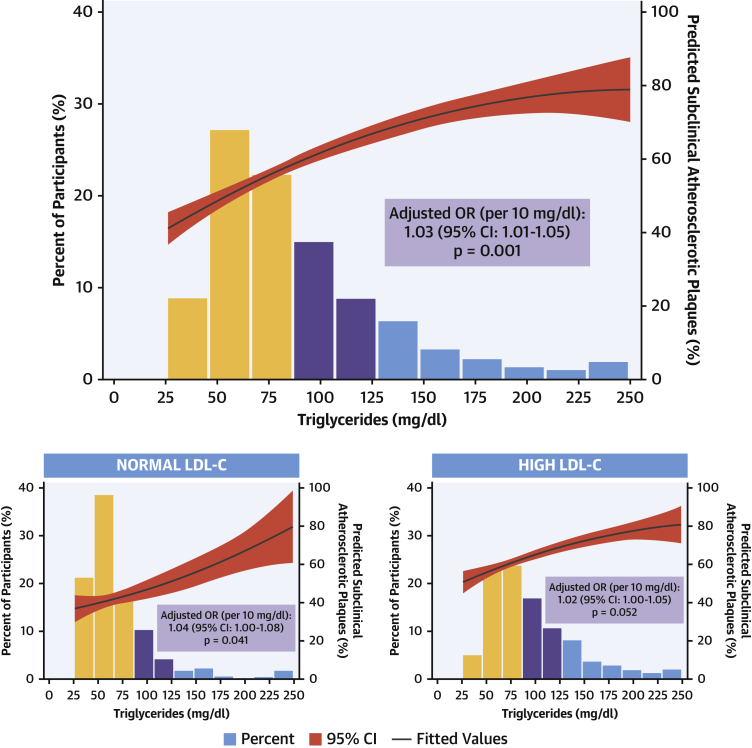
Association Between TG Levels and Presence of Subclinical Atherosclerotic Plaques (Top) The relationship between triglyceride (TG) levels as a continuous variable and the risk of subclinical atherosclerosis was graphically represented using a quadratic fit. Triglyceride levels were truncated at 250 mg/dl because only 58 participants had values >250 mg/dl. The predicted percentage of subclinical atherosclerotic plaques is shown by the black line with its 95% confidence interval (CI) in red, and it is represented in the right y-axis. A binary regression model was used to assess the relationship between triglyceride levels and the presence of atherosclerotic plaques, after adjusting for age, sex, systolic blood pressure, low-density lipoprotein cholesterol (LDL-C), high-density lipoprotein cholesterol, smoking, glycated hemoglobin, body mass index, family history of cardiovascular disease, moderate to vigorous physical activity, ethanol consumption, and eating pattern. (Bottom) Results after repeating analysis by groups of low-density lipoprotein cholesterol (normal: <116 mg/dl for individuals at low cardiovascular risk and <100 mg/dl for those at moderate cardiovascular risk). OR = odds ratio.
Central Illustration
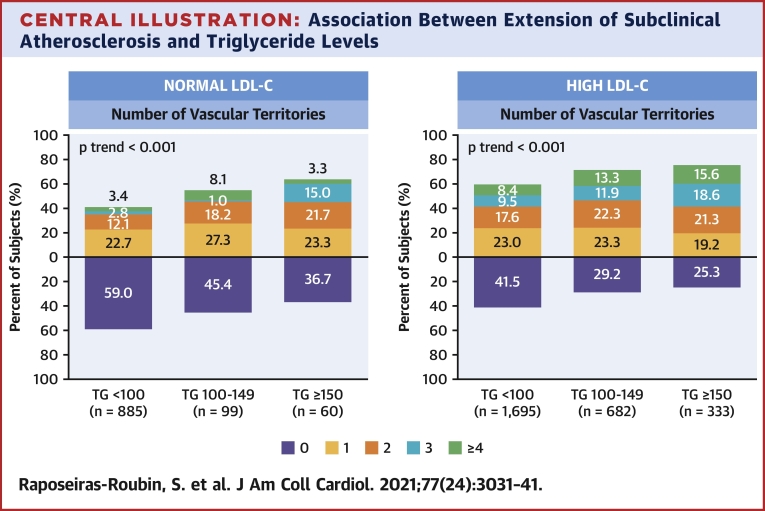
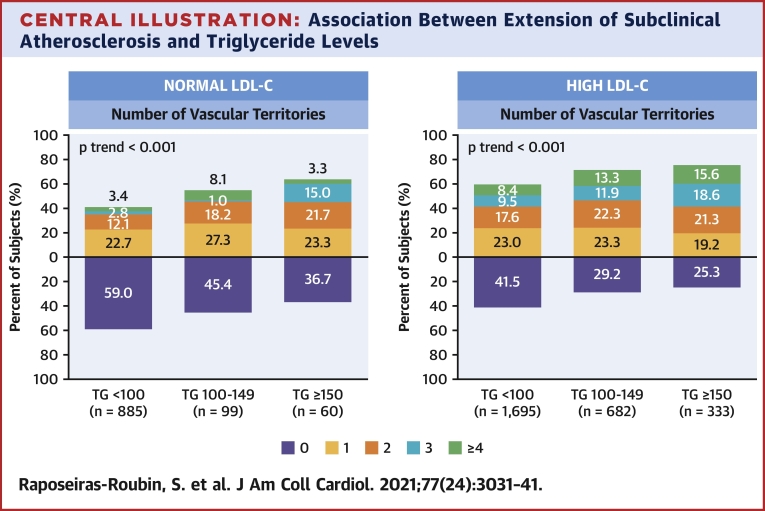
Association Between Extension of Subclinical Atherosclerosis and Triglyceride Levels Distribution of number of vascular territories affected with subclinical atherosclerosis according to triglyceride levels in patients with normal and high low-density lipoprotein cholesterol. Normal low-density lipoprotein cholesterol levels were defined as values within recommended targets by European Society of Cardiology guidelines (<116 mg/dl for individuals at low cardiovascular risk and <100 mg/dl for those at moderate cardiovascular risk). High low-density lipoprotein cholesterol levels were defined as those higher than recommended values. LDL-C = low-density lipoprotein cholesterol; TG = triglycerides.
Figure 3
Figure 3
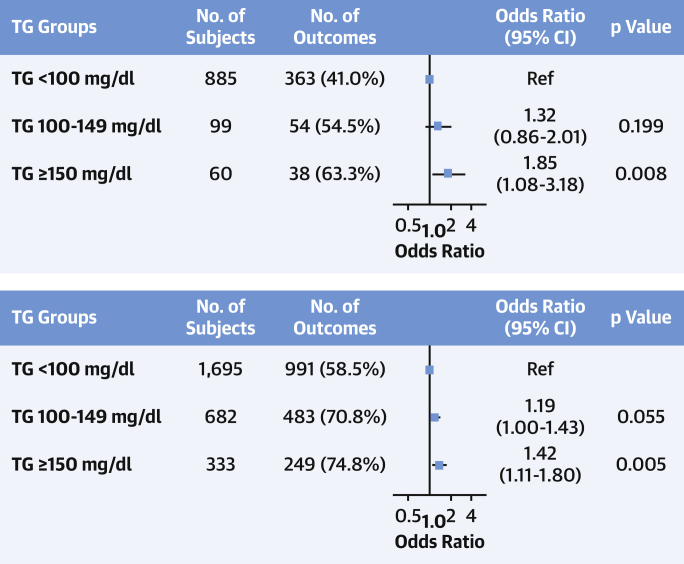
Subclinical Atherosclerosis and TGs According to LDL-C Levels Forest plot showing the relationship between triglyceride (TG) levels and the number of noncoronary atherosclerotic territories (0, 1, 2, 3, ≥4) according to low-density lipoprotein cholesterol (LDL-C) levels. Results were assessed by ordinal regression analysis adjusted for potential confounders, including age, sex, systolic blood pressure, low-density lipoprotein cholesterol, high-density lipoprotein cholesterol, smoking, glycated hemoglobin, body mass index, family history of cardiovascular disease, moderate to vigorous physical activity, ethanol consumption, and eating pattern. CI = confidence interval.
Figure 4
Figure 4
Relationship Between Arterial Inflammation and TG Levels (Top) Distribution of arterial inflammation evaluated with number of fluorine-18 fluorodeoxyglucose (18F-FDG) uptakes assessed by positron emission tomography according to levels triglyceride (TG) levels. (Bottom) Binary logistic regression model to assess the relationship between triglyceride levels and arterial fluorine-18 fluorodeoxyglucose uptake. Results were adjusted for potential confounders, including age, sex, smoking, and obesity. CI = confidence interval.

Comment in

References

    1. Ference B.A., Kastelein J.J.P., Ray K.K. Association of triglyceride-lowering LPL variants and LDL-C-lowering LDLR variants with risk of coronary heart disease. JAMA. 2019;321:364–373. - PMC - PubMed
    1. Borén J., Chapman M.J., Krauss R.M. Low-density lipoproteins cause atherosclerotic cardiovascular disease: pathophysiological, genetic, and therapeutic insights: a consensus statement from the European Atherosclerosis Society Consensus Panel. Eur Heart J. 2020;41:2313–2330. - PMC - PubMed
    1. Lee H., Park J.B., Hwang I.C. Association of four lipid components with mortality, myocardial infarction, and stroke in statin-naive young adults: a nationwide cohort study. Eur J Prev Cardiol. 2020;27:870–881. - PubMed
    1. Fernandez-Friera L., Fuster V., Lopez-Melgar B. Vascular inflammation in subclinical atherosclerosis detected by hybrid PET/MRI. J Am Coll Cardiol. 2019;73:1371–1382. - PubMed
    1. Budoff M.J., Young R., Lopez V.A. Progression of coronary calcium and incident coronary heart disease events: MESA (Multi-Ethnic Study of Atherosclerosis) J Am Coll Cardiol. 2013;61:1231–1239. - PMC - PubMed

Publication types

Associated data