. 2021 Jun 17;12(1):3700.
doi: 10.1038/s41467-021-23930-2.

Impacts of detritivore diversity loss on instream decomposition are greatest in the tropics

Luz Boyero  1   2 Naiara López-Rojo  3 Alan M Tonin  4 Javier Pérez  3 Francisco Correa-Araneda  5 Richard G Pearson  6   7 Jaime Bosch  8   9 Ricardo J Albariño  10 Sankarappan Anbalagan  11 Leon A Barmuta  12 Ana Basaguren  3 Francis J Burdon  13 Adriano Caliman  14 Marcos Callisto  15 Adolfo R Calor  16 Ian C Campbell  17 Bradley J Cardinale  18 J Jesús Casas  19 Ana M Chará-Serna  20   21 Eric Chauvet  22 Szymon Ciapała  23 Checo Colón-Gaud  24 Aydeé Cornejo  25 Aaron M Davis  6 Monika Degebrodt  26 Emerson S Dias  27 María E Díaz  28   29 Michael M Douglas  30 Andrea C Encalada  31   32 Ricardo Figueroa  29 Alexander S Flecker  33 Tadeusz Fleituch  34 Erica A García  35 Gabriela García  36 Pavel E García  37   38 Mark O Gessner  26   39 Jesús E Gómez  40 Sergio Gómez  33 Jose F Gonçalves Jr  4 Manuel A S Graça  32 Daniel C Gwinn  41 Robert O Hall Jr  42 Neusa Hamada  43 Cang Hui  44   45 Daichi Imazawa  46 Tomoya Iwata  47 Samuel K Kariuki  48 Andrea Landeira-Dabarca  31   41 Kelsey Laymon  24 María Leal  49 Richard Marchant  50 Renato T Martins  43 Frank O Masese  51 Megan Maul  52 Brendan G McKie  13 Adriana O Medeiros  16 Charles M M' Erimba  48 Jen A Middleton  30 Silvia Monroy  3 Timo Muotka  53 Junjiro N Negishi  54 Alonso Ramírez  55 John S Richardson  56 José Rincón  49 Juan Rubio-Ríos  19 Gisele M Dos Santos  15   57 Romain Sarremejane  53 Fran Sheldon  58 Augustine Sitati  51 Nathalie S D Tenkiano  59 Scott D Tiegs  52 Janine R Tolod  54 Michael Venarsky  58 Anne Watson  12 Catherine M Yule  60
Affiliations

Impacts of detritivore diversity loss on instream decomposition are greatest in the tropics

Luz Boyero et al. Nat Commun. .

Abstract

The relationship between detritivore diversity and decomposition can provide information on how biogeochemical cycles are affected by ongoing rates of extinction, but such evidence has come mostly from local studies and microcosm experiments. We conducted a globally distributed experiment (38 streams across 23 countries in 6 continents) using standardised methods to test the hypothesis that detritivore diversity enhances litter decomposition in streams, to establish the role of other characteristics of detritivore assemblages (abundance, biomass and body size), and to determine how patterns vary across realms, biomes and climates. We observed a positive relationship between diversity and decomposition, strongest in tropical areas, and a key role of abundance and biomass at higher latitudes. Our results suggest that litter decomposition might be altered by detritivore extinctions, particularly in tropical areas, where detritivore diversity is already relatively low and some environmental stressors particularly prevalent.


Conflict of interest statement

The authors declare no competing interests.

Figures
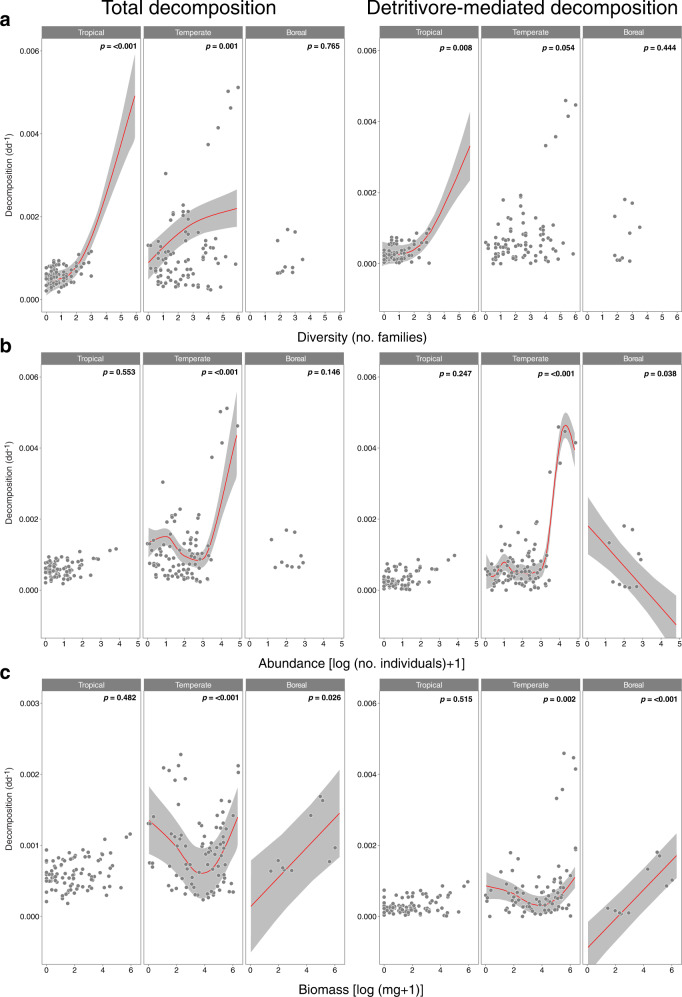
Fig. 1
Fig. 1. Generalised additive models exploring the influence of detritivore diversity, abundance and biomass on decomposition in different latitudinal zones (tropical: ≤23°; temperate: 24–60°; and boreal: >60°).
Variation in total and detritivore-mediated decomposition (measured as the proportion of litter mass loss per degree day, dd; mean ± SE) with a detritivore diversity (number of families per litterbag), b log-transformed abundance (number of individuals per litterbag) and c log-transformed biomass (mg per litterbag), in different latitudinal zones. Lines represent the smoothers and shading the 95% confidence intervals from generalised additive models for significant relationships (p-value < 0.05); whole-model results are given in Supplementary Table 3.
Fig. 2
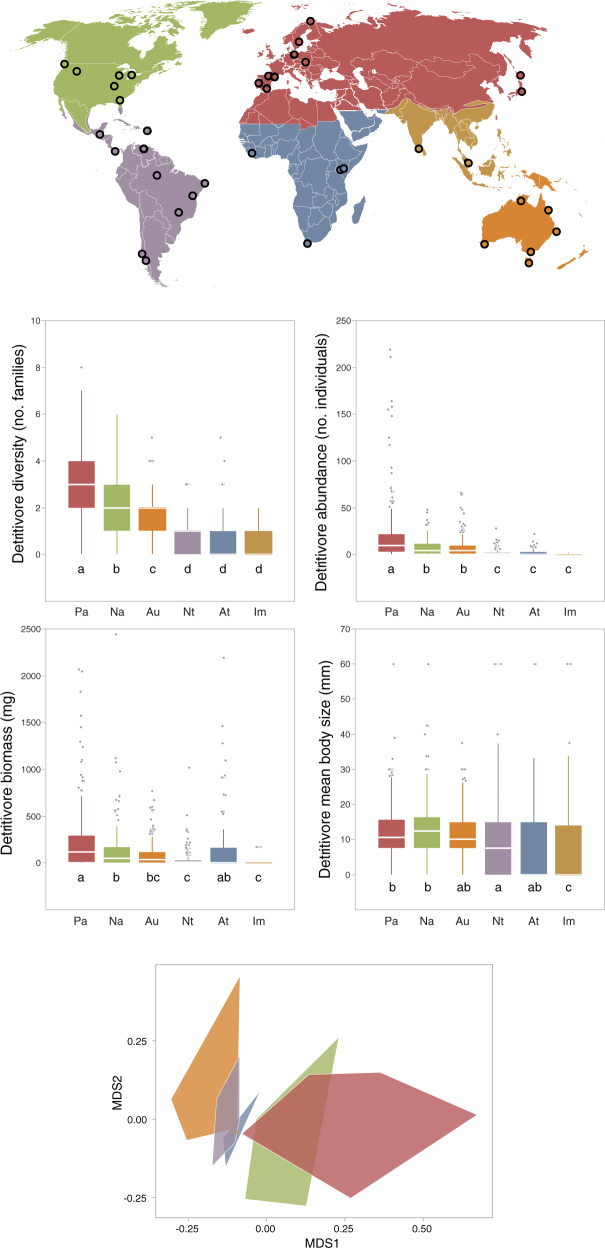
Fig. 2. Global distribution of study sites in different biogeographic realms (Pa, Palearctic; Na, Nearctic; Au, Australasian; Nt, Neotropical; At, Afrotropical; Im, Indomalayan); n = 38.
Box plots show the median, interquartile range and minimum-maximum range of litter-consuming detritivore diversity (number of families per litterbag), abundance (number of individuals per litterbag), biomass (mg per litterbag) and mean body size (mm) in each realm (ordered from highest to lowest diversity); different letters indicate significant differences. The NMDS ordination of litter-consuming detritivores with realms is represented by polygons of different colours as in maps and box plots. Significant differences in assemblage structure were: Pa vs. Na, At, Au, Im; Na vs. Nt, Au; Nt vs. Au.
Fig. 3
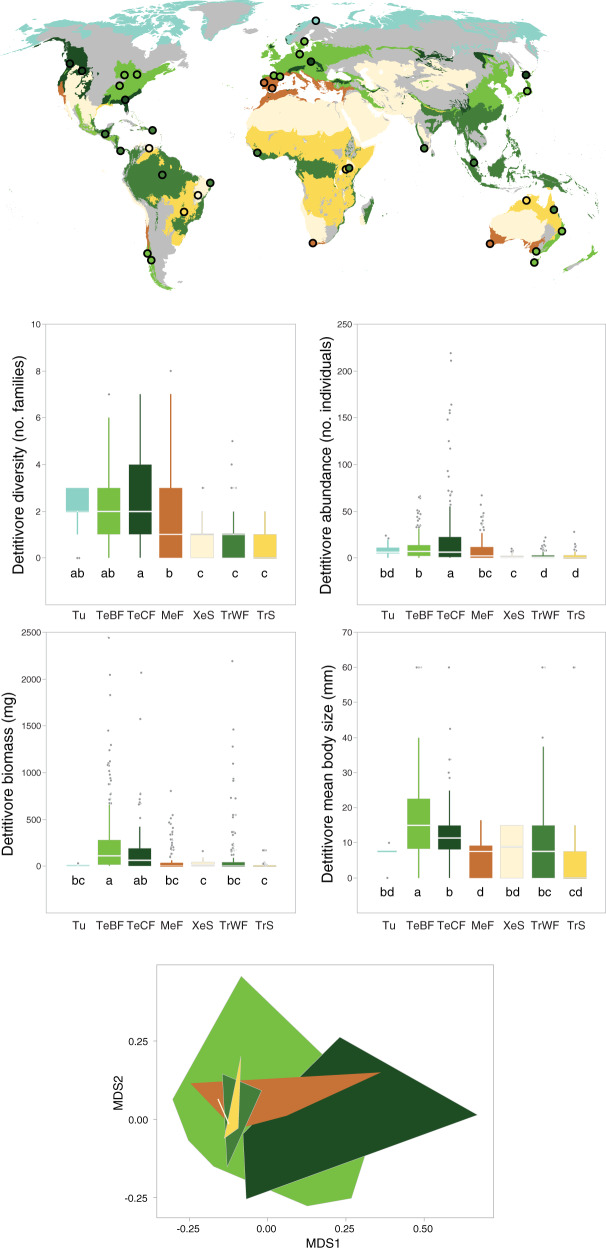
Fig. 3. Global distribution of study sites in different biomes (Tu, tundra; TeBF, temperate broadleaf forest; TeCF, temperate coniferous forest; MeF, Mediterranean forest; XeS, xeric shrubland; TrWF, tropical wet forest; TrS, tropical savanna); n = 38.
Box plots show the median, interquartile range and minimum-maximum range of litter-consuming detritivore diversity (number of families per litterbag), abundance (number of individuals per litterbag), biomass (mg per litterbag) and mean body size (mm) in each biome (ordered from highest to lowest diversity); different letters indicate significant differences. The NMDS ordination of litter-consuming detritivores with biomes is represented by polygons of different colours as in maps and box plots. Significant differences in assemblage structure were: TrWF vs. TeBF, TeCF, MeF.
Fig. 4
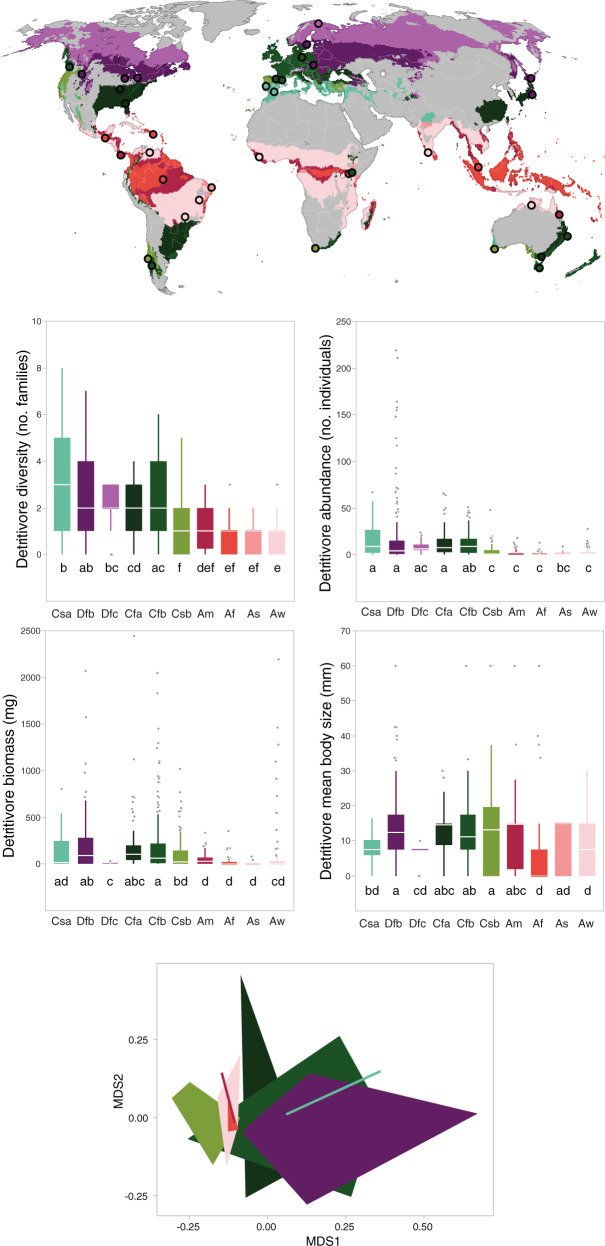
Fig. 4. Global distribution of study sites in different climates [A, equatorial (Af, fully humid; Am, monsoon; As, with dry summer; Aw, with dry winter); C, warm temperate (Cfa, fully humid with hot summer; Cfb, fully humid with warm summer; Csa, with dry and hot summer; Csb, with dry and warm summer); D, snow (Dfb, fully humid with warm summer; Dfc, fully humid with cold summer)]; n = 38.
Box plots show the median, interquartile range and minimum-maximum range of litter-consuming detritivore diversity (number of families per litterbag), abundance (number of individuals per litterbag), biomass (mg per litterbag) and mean body size (mm) in each climate (ordered from highest to lowest diversity); different letters indicate significant differences. The NMDS ordination of litter-consuming detritivores with biomes is represented by polygons of different colours as in maps and box plots. Significant differences in assemblage structure were: Aw vs. Cfb, Cfa, Dfb; Af vs. Cfa, Cfb, Dfb.
Fig. 5
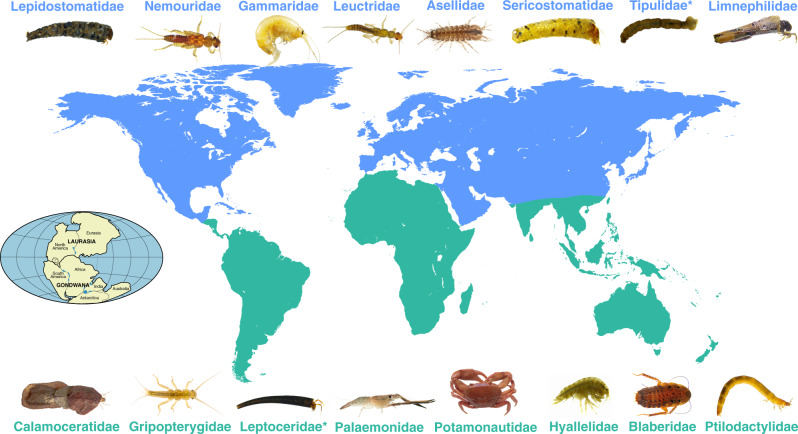
Fig. 5. Distribution of detritivore families in our study, which was predominantly Laurasian (blue) or Gondwanan (green); insert indicates origins of those two regions (≈200 Ma).
Photographs represent a subset of families (ordered left to right from the most to the least abundant in our study) and asterisks denote families that were globally distributed but more abundant in one of the two areas. A complete list of families is provided in Supplementary Table 1. Photograph credits: L. Boyero, A. Cornejo, R. Figueroa, N. López-Rojo, F. Masese, J. Pérez, J. Rubio-Ríos, J. Vieira and C. M. Yule.

References

    1. van der Plas F. Biodiversity and ecosystem functioning in naturally assembled communities. Biol. Rev. 2019;94:1220–1245. - PubMed
    1. Isbell F, et al. Quantifying effects of biodiversity on ecosystem functioning across times and places. Ecol. Lett. 2018;21:763–778. doi: 10.1111/ele.12928. - DOI - PMC - PubMed
    1. Naeem S, Thompson LJ, Lawler SP, Lawton JH, Woodfin RM. Declining biodiversity can alter the performance of ecosystems. Nature. 1994;368:734–737. doi: 10.1038/368734a0. - DOI
    1. Cardinale BJ. Impacts of biodiversity loss. Science. 2012;336:552–553. doi: 10.1126/science.1222102. - DOI - PubMed
    1. Caliman A, Pires AF, Esteves FA, Bozelli RL, Farjalla VF. The prominence of and biases in biodiversity and ecosystem functioning research. Biodivers. Conserv. 2010;19:651–664. doi: 10.1007/s10531-009-9725-0. - DOI

Publication types