


Trolls Without Borders: A Cross-Cultural Examination of Victim Reactions to Verbal and Silent Aggression Online
- PMID: 34140907
- PMCID: PMC8203910
- DOI: 10.3389/fpsyg.2021.549955
Trolls Without Borders: A Cross-Cultural Examination of Victim Reactions to Verbal and Silent Aggression Online
Abstract
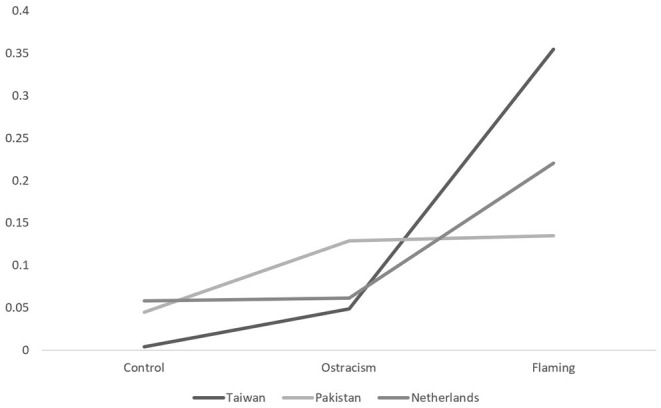
Trolling-the online exploitation of website, chat, or game mechanics at another user's expense-can and does take place all over cyberspace. It can take myriad forms, as well-some verbal, like trash-talking an opponent in a game, and some silent, like refusing to include a new player in a team effort during an in-game quest. However, despite this variety, there are few to no studies comparing the effects of these differing trolling types on victims. In addition, no study has yet taken into account users' offline cultural context and norms into the trolling victim experience. To fill this gap in the literature, the present study put participants from three culturally-distinct countries-Pakistan, Taiwan, and the Netherlands-in a simulated trolling interaction using the Cyberball game. Participants were either flamed (read: harshly insulted) or ostracized by a member of their own cultural group (ingroup) or a minority member (outgroup), and the participants' emotional responses, behavioral intentions toward the other players, and messages sent during the game were taken as indicators of their response to the trolling. Results showed that our Taiwanese sample used the most reactive aggression when trolled and our Dutch sample was the most passive. In addition, ostracism generally produced the desire to repair relationships, irrespective of cultural context, and perpetrator culture (ingroup or outgroup) only produced an effect in the behavioral intentions of our Pakistani sample. Overall, it would appear that online and offline culture interact to produce the variety of responses to trolling seen in extant literature. Additional implications for future research into computer-mediated communication and online aggression are also discussed.
Keywords: Cyberball; cross-cultural comparisons; experiment; face; flaming; honor; ostracism; trolling interactions.
Copyright © 2021 Cook, Schaafsma, Antheunis, Shahid, Lin and Nijtmans.
Conflict of interest statement
The authors declare that the research was conducted in the absence of any commercial or financial relationships that could be construed as a potential conflict of interest.
Figures


References
-
- Anjum G., Castano E., Aziz M. (2017). Reparations to the victims of the US drone strikes: youth perspective from Pakistan, in Securing Peace and Prosperity, eds Aneel S. S., Haroon U. T., Niazi I. (Lahore: Sang-e-Meel Publications; ), 245–249.
-
- Anjum G., Kessler T., Aziz M. (2019). Cross-cultural exploration of honor: perception of honor in Germany, Pakistan, and South Korea. Psychol. Stud. 64, 147–160. 10.1007/s12646-019-00484-4 - DOI
-
- Anjum G., Kidd D. C., Aziz M. (2018). Hope in times of terrorism: action-expressions speak louder than passive-sorrows. J. Behav. Sci. 28, 1–17.
LinkOut - more resources
Full Text Sources
Miscellaneous
