


The Value of Songs for Teaching and Learning Cardiopulmonary Resuscitation (CPR) Competencies: A Systematic Review
- PMID: 34141503
- PMCID: PMC8204400
- DOI: 10.7759/cureus.15053
The Value of Songs for Teaching and Learning Cardiopulmonary Resuscitation (CPR) Competencies: A Systematic Review
Abstract
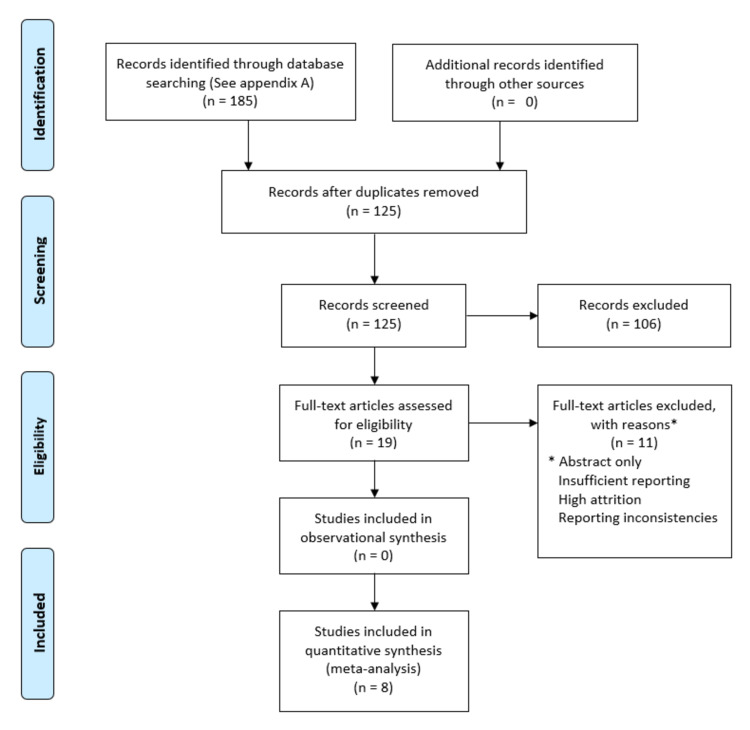
We sought to summarize, in a systematic review, the effectiveness of songs to support learning, performance, and recall of quality characteristics of cardiopulmonary resuscitation (CPR) compression rate, and depth. We systematically reviewed the literature from eight academic indexes from the fields of medicine, nursing, allied health, and education, from 2014 to 2020 to identify studies that evaluated an intervention of song use during CPR training against control and reported outcomes of compression rate and depth. There were 185 studies initially identified for review, eight met criteria for inclusion and analysis. For the critical outcome of compression depth, a pooled song group (n=446) when compared to a non-song group (n=443) demonstrated higher odds of being in the recommended range (OR 3.47). All studies, however, performed an average compression depth shallower than recommended guidelines in each arm. The available literature, we found, utilized heterogenous methodology and was at high risk of bias. When pooled, there were trends towards improved CPR metric performance in groups who were exposed to songs during treatment, though this only reached significance when groups were tested at >30 days from initial exposure. Findings of lower compression rates in the song groups suggest that song selection should favor beats per minute closer to the midpoint of the 100-120 ideal range to allow for variation when used as mental metronomes.
Keywords: bpm; compression; cpr; education; first aid; learning; mental metronome; resuscitation; songs; teaching aids.
Copyright © 2021, Pellegrino et al.
Conflict of interest statement
The authors have declared that no competing interests exist.
Figures


References
-
- Measuring intent to aid of lay responders: survey development and validation. Miller B, Pellegrino JL. Health Educ Behav. 2018;45:730–734. - PubMed
-
- Lay responder post arrest support model: methodology & conceptual design. Snobelen PJ, Pellegrino JL, Nevils GS, Dainty KN. BMJ Open. 2018;8:0–11.
-
- Lay responder post-arrest support model - Methodology & conceptual model. Snobelen PJ, Pellegrino JL, Nevils GS, Dainty KN. Emergency Cardiovascular Care Update Conference. 2017;8:0.
-
- A call for revolution in first aid education. Pellegrino JL, Oliver E, Orkin A, Marentette D, Snobelen PJ. Int J First Aid Educ. 2017;1:6061280.
-
- Empowering first aiders through innovative instructor resources. Logan JV, MacDonald D. https://oaks.kent.edu/ijfae/vol2/iss1/empowering-first-aiders-through-in... Int J First Aid Educ. 2018;2:28.
Publication types
LinkOut - more resources
Full Text Sources
Miscellaneous