


doi: 10.1007/s00415-021-10655-x.
Epub 2021 Jun 18.
Long COVID: cognitive complaints (brain fog) and dysfunction of the cingulate cortex
Affiliations
- PMID: 34143277
- PMCID: PMC8211714
- DOI: 10.1007/s00415-021-10655-x
Item in Clipboard
Long COVID: cognitive complaints (brain fog) and dysfunction of the cingulate cortex
J Neurol.
2022 Jan.
Abstract
Many patients who have suffered from acute COVID infections have long-lasting symptoms affecting several organs including the brain. This long COVID status can include "brain fog" and cognitive deficits that can disturb activities of daily living and can delay complete recovery. Here, we report two cases of neurological long COVID with abnormal FDG PET findings marked by hypometabolic regions of the cingulate cortex.
Keywords: Cingulate cortex; Cognitive involvement; Long COVID.
© 2021. Springer-Verlag GmbH Germany, part of Springer Nature.
Conflict of interest statement
The authors declare no conflict of interests regarding this work.
Figures
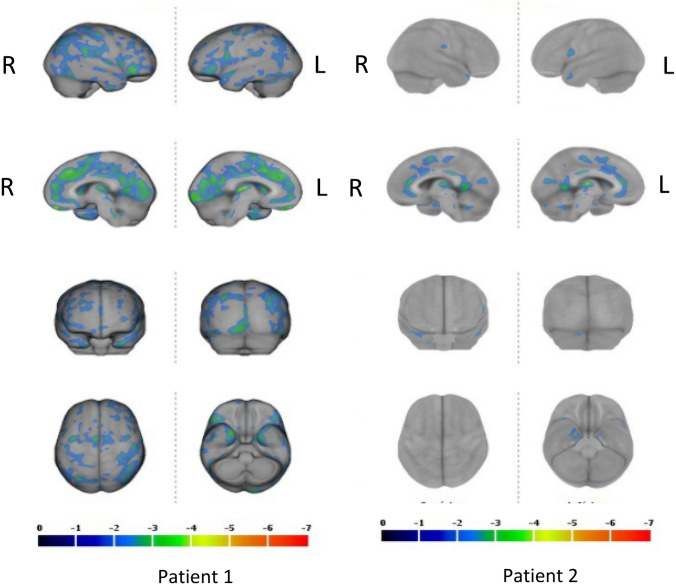
The cerebral Fluorodeoxyglucose (FDG) Positron Emission Tomography (PET) of patients 1 and 2. In patient 1, the posterior cingulate cortex and the precuneus are the most hypometabolic regions. In patient 2, anterior and posterior cingulate cortex are involved (more than 2SD)
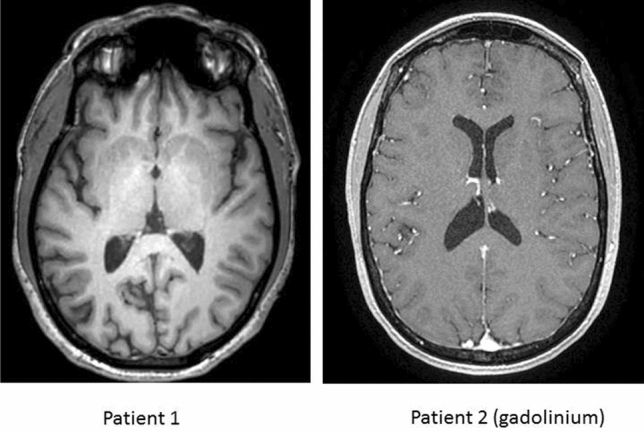
Brain MRI of patient 1 (left panel and patient 2 (right panel). Both MRI were found normal
References
-
- Coutinho AMN, Porto FHG, Zampieri PF, Otaduy MC, Perroco TR, Oliveira MO, Nunes RF, Pinheiro TL, Bottino CMC, Leite CC, Buchpiguel CA. Analysis of the posterior cingulate cortex with [18F]FDG-PET and Naa/mI in mild cognitive impairment and Alzheimer's disease: correlations and differences between the two methods. Dement Neuropsychol. 2015;9:385–393. doi: 10.1590/1980-57642015DN94000385. - DOI - PMC - PubMed
MeSH terms
Substances
LinkOut - more resources
Full Text Sources
Medical
