. 2021 Jun 18;11(1):12871.
doi: 10.1038/s41598-021-92460-0.

Combination of 131I-trastuzumab and lanatoside C enhanced therapeutic efficacy in HER2 positive tumor model

Affiliations

Combination of 131I-trastuzumab and lanatoside C enhanced therapeutic efficacy in HER2 positive tumor model

Nagarajan Vinod et al. Sci Rep. .

Abstract

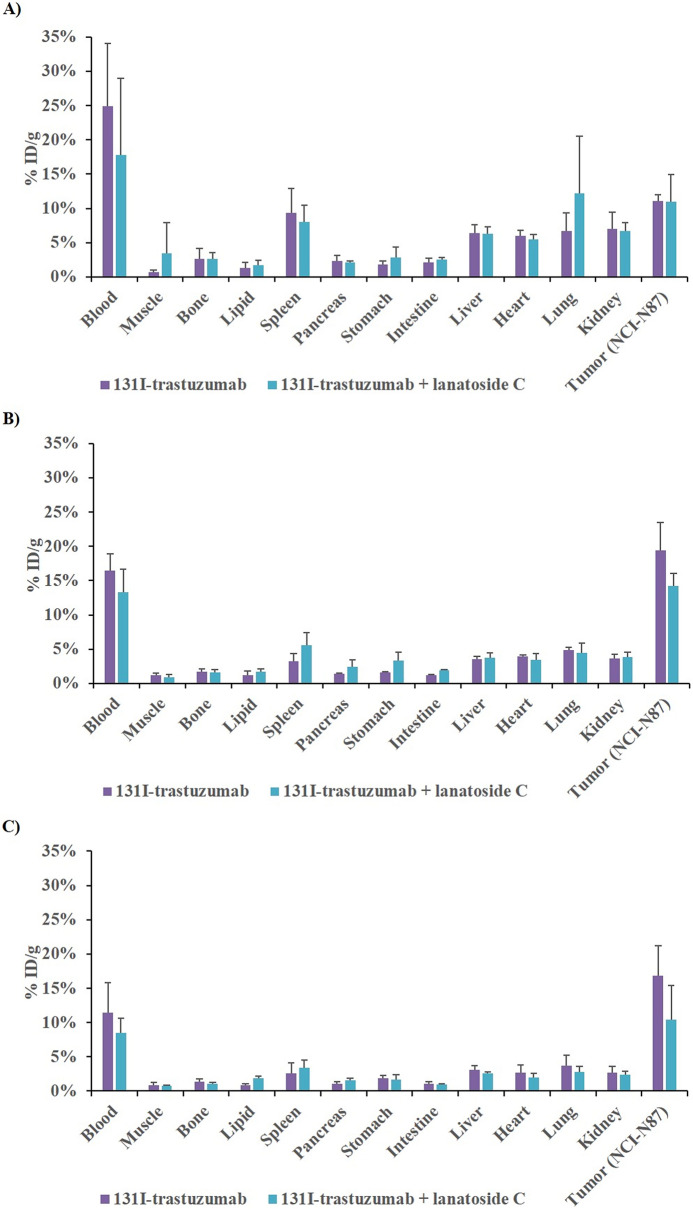
Lanatoside C has a promising anti-tumor activity and is a potential candidate for radiosensitizers. In this study, we have investigated the therapeutic efficacy of the combination of 131I-trastuzumab and lanatoside C for inhibition of human epidermal growth factor receptor 2 (HER2) positive tumor progression in NCI-N87 xenograft model. The combination treatment (131I-trastuzumab and lanatoside C) showed highest cytotoxicity when compared to non-treated control or trastuzumab alone or 131I alone or 131I-trastuzumab alone in vitro. Biodistribution studies using 131I-trastuzumab or combination of 131I-trastuzumab and lanatoside C showed tumor uptake in BALB/c nude mice bearing HER2 positive NCI-N87 tumor xenograft model. The higher tumor uptake was observed in 131I-trastuzumab (19.40 ± 0.04% ID/g) than in the combination of 131I-trastuzumab and lanatoside C (14.02 ± 0.02% ID/g) at 24 h post-injection. Most importantly, an antitumor effect was observed in mice that received the combination of 131I-trastuzumab and lanatoside C (p = 0.009) when compared to control. In addition, mice received lanatoside C alone (p = 0.085) or 131I-trastuzumab alone (p = 0.160) did not significantly inhibit tumor progression compared with control. Taken together, our data suggest that combination of 131I-trastuzumab and lanatoside C might be a potential synergistic treatment for radioimmunotherapy to control the HER2 positive tumor.


Conflict of interest statement

The authors declare no competing interests.

Figures
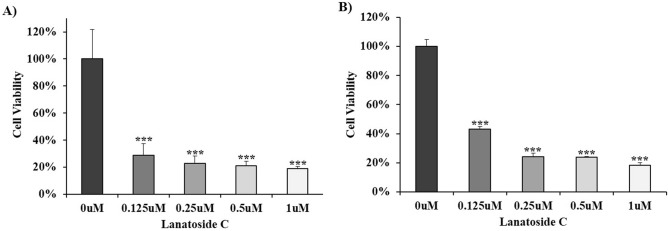
Figure 1
Figure 1
Lanatoside C suppressed growth of cancel cell lines. Inhibitory effect of lanatoside C on cell viability of NCI-N87 (A) and MDA-MB231 (B) cells. Data are presented as percentage of cell viability in which the 0.01% DMSO treated control sample is set 100%. The average of experimental triplicates ± standard deviation is shown. ***p < 0.001.
Figure 2
Figure 2
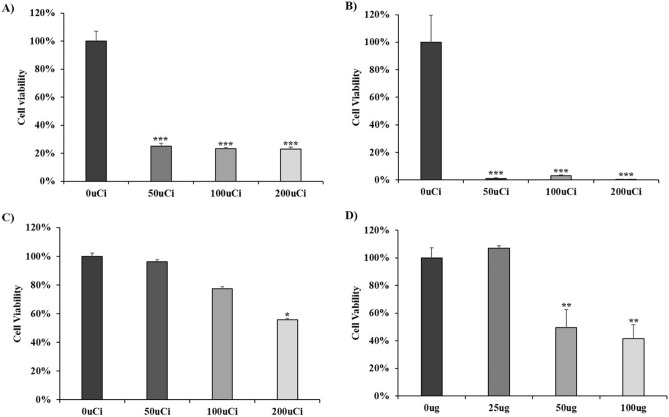
Lanatoside C enhanced 131I-trastuzumab RIT in vitro. NCI-N87 cells were treated with various activity of 131I-trastuzumab RIT (A), 131I-trastuzumab RIT combined with lanatoside C (B), 131I alone (C) and trastuzumab alone (D), and cell viability was determined by Ez-Cytox assay. Data are presented as percentage of cell viability in which the 0.01% DMSO treated control sample is set 100%. The average of experimental triplicates ± standard deviation is shown. ***p < 0.001, **p < 0.01, and *p < 0.05.
Figure 3
Figure 3
Lanatoside C enhanced 131I-trastuzumab RIT in xenograft model. When the NCI-N87 tumor volume reached approximately 150 mm3, the BALB/c nude mice were treated with non-treated control group (untreated control), vehicle control group (0.01% DMSO in saline, 100 μl, the first 3 days), lanatoside C (6 mg/kg body weight, the first 3 days intraperitoneal injection), 131I-trastuzumab group (400 μCi, once tail vein injection), and combination of 131I-trastuzumab and lanatoside C (lanatoside C, 6 mg/kg body weight, the first 3 days intraperitoneal injection, and 131I-trastuzumab, 400 μCi, once tail vein injection). **p < 0.01, and *p < 0.05.
Figure 4
Figure 4
Biodistribution pattern (% ID/g) of 131I-trastuzumab or combination of 131I-trastuzumab and lanatoside C in tumor (tumor xenograft NCI-N87) bearing BALB/c nude mice at 4 h (A), 24 h (B), and 48 h (C).

References

    1. Bethge WA, Sandmaier BM. Targeted cancer therapy using radiolabeled monoclonal antibodies. Technol. Cancer Res. Treat. 2005;4:393–405. doi: 10.1177/153303460500400407. - DOI - PubMed
    1. Larson SM, Carrasquillo JA, Cheung NK, Press OW. Radioimmunotherapy of human tumours. Nat. Rev. Cancer. 2015;15:347–360. doi: 10.1038/nrc3925. - DOI - PMC - PubMed
    1. Navarro-Teulon I, Lozza C, Pelegrin A, Vives E, Pouget JP. General overview of radioimmunotherapy of solid tumors. Immunotherapy. 2013;5:467–487. doi: 10.2217/imt.13.34. - DOI - PubMed
    1. Deshayes E, et al. Tandem myeloablative 131I-rituximab radioimmunotherapy and high-dose chemotherapy in refractory/relapsed non-Hodgkin lymphoma patients. Immunotherapy. 2013;5:1283–1286. doi: 10.2217/imt.13.138. - DOI - PubMed
    1. Frost SH, et al. Comparative efficacy of 177Lu and 90Y for anti-CD20 pretargeted radioimmunotherapy in murine lymphoma xenograft models. PLoS ONE. 2015;10:e0120561. doi: 10.1371/journal.pone.0120561. - DOI - PMC - PubMed

Publication types

MeSH terms