


Ramp lesion of the medial meniscus
- PMID: 34150331
- PMCID: PMC8183152
- DOI: 10.1302/2058-5241.6.200126
Ramp lesion of the medial meniscus
Abstract
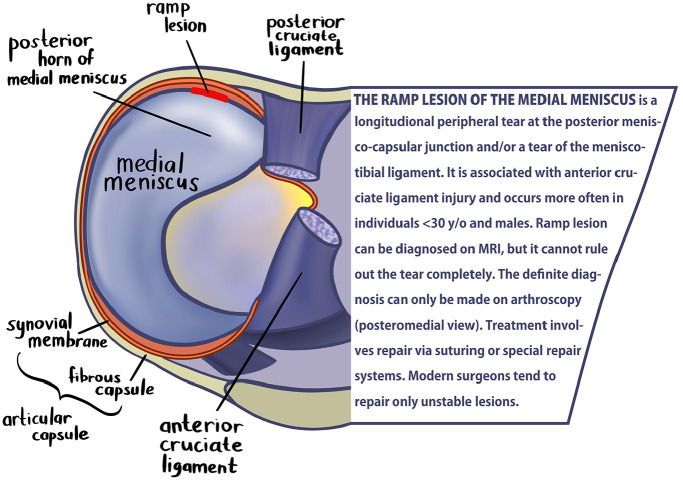
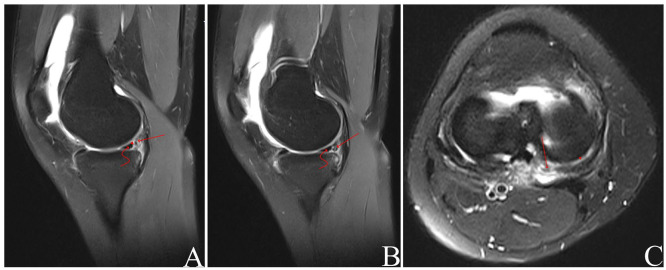
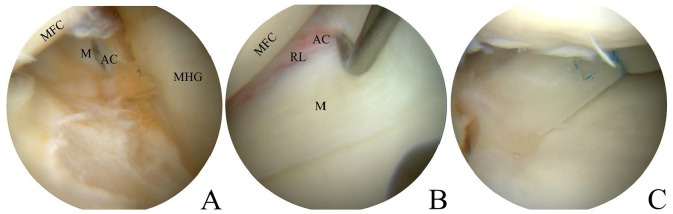
Ramp lesion of the medial meniscus used to be completely disregarded in the past.Ramp lesion has been now put under the spotlight by orthopaedic and sport medicine surgeons and requires attention.It is closely associated with anterior cruciate ligament injury. Major risk factors include chronic laxity, lateral meniscal lesion, anterior cruciate ligament reconstruction revision, anterolateral ligament tear concomitant with anterior cruciate ligament injury, time from injury, pre-operative side-to-side laxity > 6 mm, age < 30 years old, male sex, etc.Radiologists attempt to create diagnostic criteria for ramp lesion using magnetic resonance imaging. However, the only definite method to diagnose ramp lesion is still arthroscopy. Various techniques exist, among which posteromedial approach is the most highly recommended.Various treatment options are available. The success rate of ramp repair is very high. Major complications are uncommon. Cite this article: EFORT Open Rev 2021;6:372-379. DOI: 10.1302/2058-5241.6.200126.
Keywords: literature review; medial meniscus; ramp lesion.
© 2021 The author(s).
Conflict of interest statement
ICMJE Conflict of interest statement: The authors declare no conflict of interest relevant to this work.
Figures
References
-
- Johnson DL, Swenson TM, Livesay GA, Aizawa H, Fu FH, Harner CD. Insertion-site anatomy of the human menisci: gross, arthroscopic, and topographical anatomy as a basis for meniscal transplantation. Arthroscopy 1995;11:386–394. - PubMed
-
- Mouton C, Magosch A, Pape D, Hoffmann A, Nührenbörger C, Seil R. Ramp lesions of the medial meniscus are associated with a higher grade of dynamic rotatory laxity in ACL-injured patients in comparison to patients with an isolated injury. Knee Surg Sports Traumatol Arthrosc 2020;28:1023–1028. - PubMed
-
- Allen CR, Wong EK, Livesay GA, Sakane M, Fu FH, Woo SL-Y. Importance of the medial meniscus in the anterior cruciate ligament-deficient knee. J Orthop Res 2000;18:109–115. - PubMed
-
- Ahn JH, Bae TS, Kang K-S, Kang SY, Lee SH. Longitudinal tear of the medial meniscus posterior horn in the anterior cruciate ligament-deficient knee significantly influences anterior stability. Am J Sports Med 2011;39:2187–2193. - PubMed
-
- Stephen JM, Halewood C, Kittl C, Bollen SR, Williams A, Amis AA. Posteromedial meniscocapsular lesions increase tibiofemoral joint laxity with anterior cruciate ligament deficiency, and their repair reduces laxity. Am J Sports Med 2016;44:400–408. - PubMed
Publication types
LinkOut - more resources
Full Text Sources
Miscellaneous
