


Coronaviruses, cholesterol and statins: Involvement and application for Covid-19
- PMID: 34153377
- PMCID: PMC8213520
- DOI: 10.1016/j.biochi.2021.06.005
Coronaviruses, cholesterol and statins: Involvement and application for Covid-19
Abstract
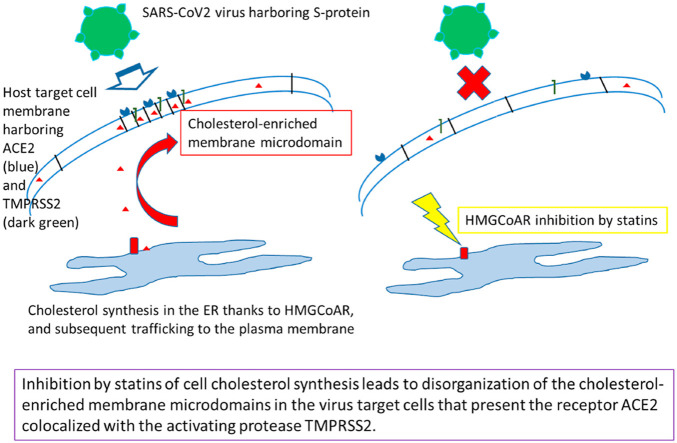
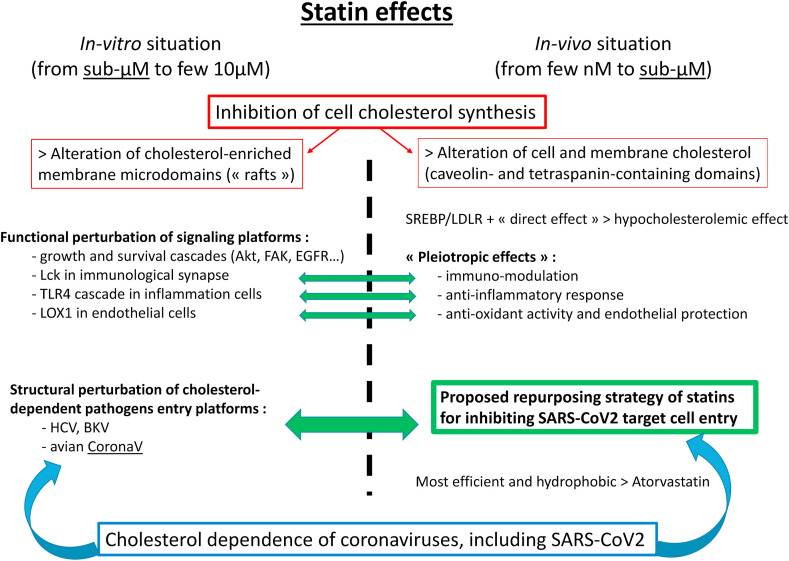
The infectious power of coronaviruses is dependent on cholesterol present in the membranes of their target cells. Indeed, the virus enters the infected cell either by fusion or by endocytosis, in both cases involving cholesterol-enriched membrane microdomains. These membrane domains can be disorganized in-vitro by various cholesterol-altering agents, including statins that inhibit cell cholesterol biosynthesis. As a consequence, numerous cell physiology processes, such as signaling cascades, can be compromised. Also, some examples of anti-bacterial and anti-viral effects of statins have been observed for infectious agents known to be cholesterol dependent. In-vivo, besides their widely-reported hypocholesterolemic effect, statins display various pleiotropic effects mediated, at least partially, by perturbation of membrane microdomains as a consequence of the alteration of endogenous cholesterol synthesis. It should thus be worth considering a high, but clinically well-tolerated, dose of statin to treat Covid-19 patients, in the early phase of infection, to inhibit virus entry into the target cells, in order to control the viral charge and hence avoid severe clinical complications. Based on its efficacy and favorable biodisposition, an option would be considering Atorvastatin, but randomized controlled clinical trials are required to test this hypothesis. This new therapeutic proposal takes benefit from being a drug repurposing, applied to a widely-used drug presenting a high efficiency-to-toxicity ratio. Additionally, this therapeutic strategy avoids any risk of drug resistance by viral mutation since it is host-targeted. Noteworthy, the same pharmacological approach could also be proposed to address different animal coronavirus endemic infections that are responsible for heavy economic losses.
Keywords: Cholesterol; Coronavirus; Covid-19; Drug repurposing; Membrane microdomains; Statins.
Copyright © 2021 The Authors. Published by Elsevier B.V. All rights reserved.
Conflict of interest statement
Declaration of competing interest JJM has consulting activity for Mylan, Servier and Pfizer; AG has received personal fees for public speaking or consultancy support from Akcea Therapeutics, Amgen, MSD, Mylan, Novartis, Sanofi and Regeneron, Unilever; EB declares having received honoraria from Amgen, MSD, Sanofi and Regeneron, Danone, Aegerion, Chiesi, Rottapharm-MEDA, Servier, Ionis-pharmaceuticals, AKCEA, Mylan, GENFIT and Silence Therapeutic; the other author has no competing interests to declare.
Figures
References
-
- Mammette A. Crouan & Roques; Lille, France: 1980. Virologie Médicale.
Publication types
MeSH terms
Substances
LinkOut - more resources
Full Text Sources
Medical
Research Materials
