Time Course of Relapse Following Acute Treatment for Anorexia Nervosa
- PMID: 34154394
- PMCID: PMC8440387
- DOI: 10.1176/appi.ajp.2021.21010026
Time Course of Relapse Following Acute Treatment for Anorexia Nervosa
Abstract
Objective: There is long-standing interest in how best to define stages of illness for anorexia nervosa, including remission and recovery. The authors used data from a previously published study to examine the time course of relapse over the year following full weight restoration.
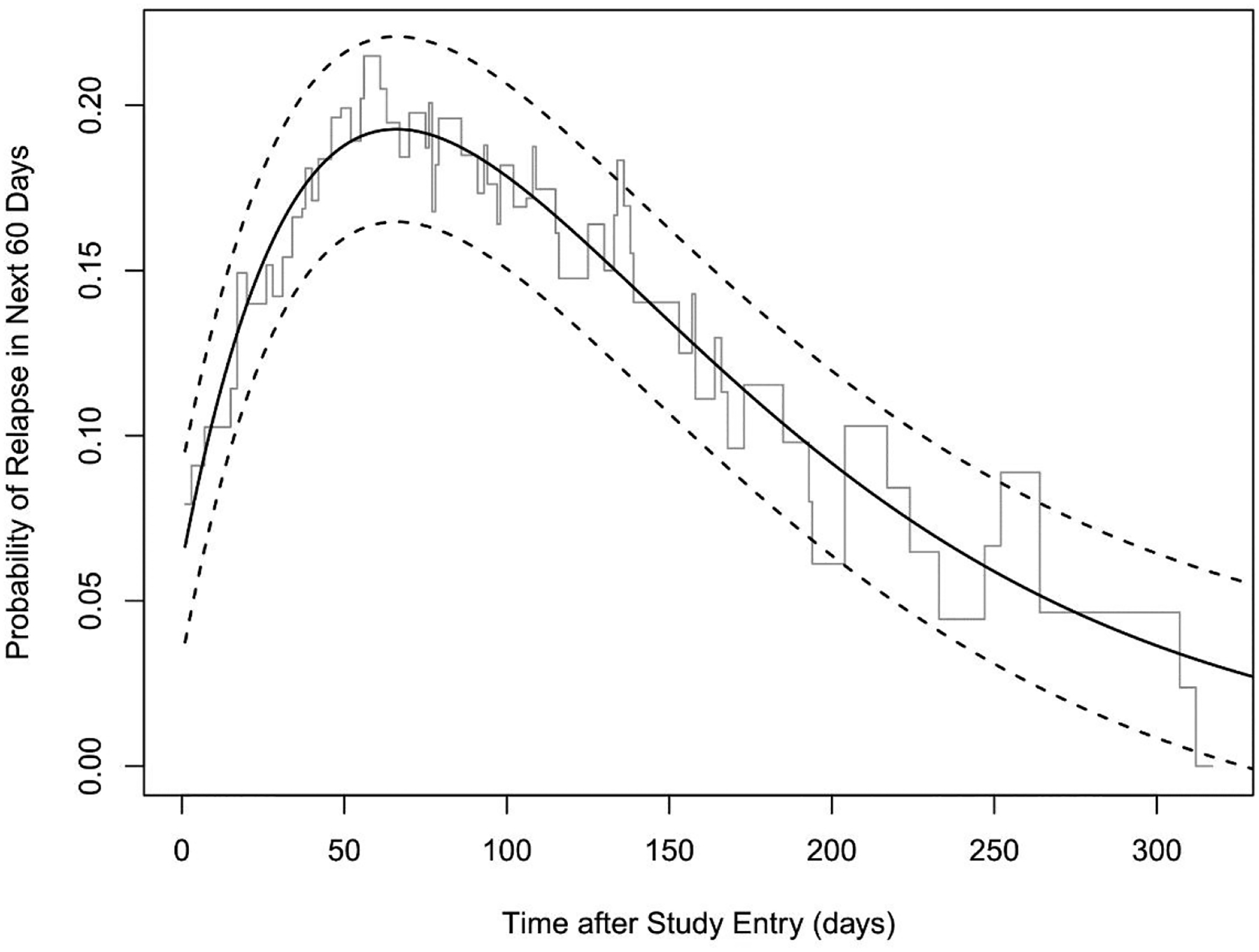
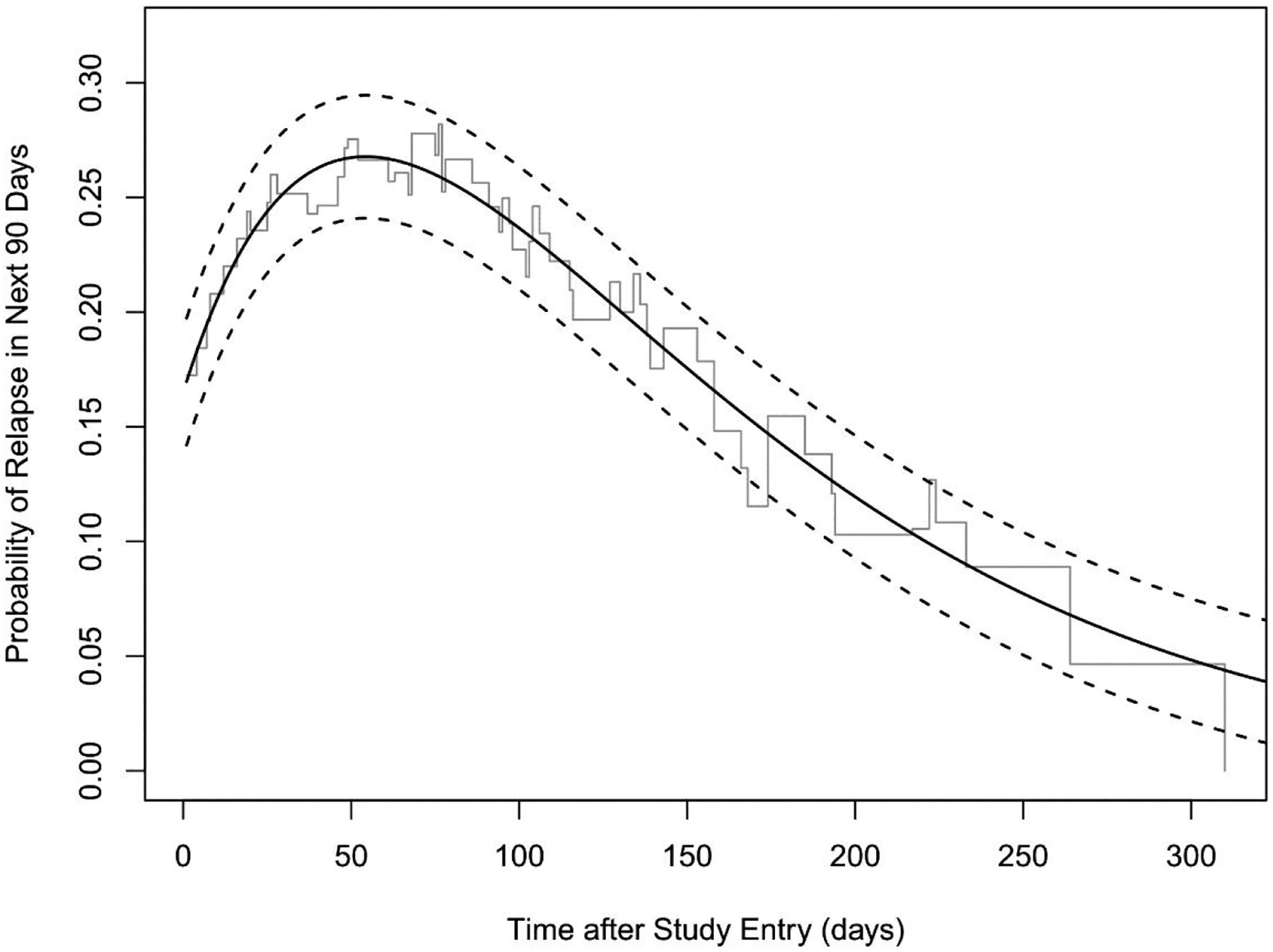
Methods: Following weight restoration in an acute care setting, 93 women with anorexia nervosa were randomly assigned to receive fluoxetine or placebo and were discharged to outpatient care, where they also received cognitive-behavioral therapy for up to 1 year. Relapse was defined on the basis of a priori clinical criteria. Fluoxetine had no impact on the time to relapse. In the present analysis, for each day after entry into the study, the risk of relapse over the following 60 days and the following 90 days was calculated and a parametric function was fitted to approximate the Kaplan-Meier estimator.
Results: The risk of relapse rose immediately after entry into the study, reached a peak after approximately 60 days, and then gradually declined. There was no indication of an inflection point at which the risk of relapse fell precipitously after the initial peak.
Conclusions: This analysis highlights the fact that adult patients with anorexia nervosa are at increased risk of relapse in the first months following discharge from acute care, suggesting a need for frequent follow-up and relapse prevention-focused treatment during this period. After approximately 2 months, the risk of relapse progressively decreases over time.
Keywords: Anorexia Nervosa; Feeding and Eating Disorders; Outcome Studies; Relapse; Remission.
Figures
Comment in
-
From Awareness to Action: An Urgent Call to Address the Inadequacy of Treatment for Anorexia Nervosa.Am J Psychiatry. 2021 Sep 1;178(9):786-788. doi: 10.1176/appi.ajp.2021.21070697. Am J Psychiatry. 2021. PMID: 34516232 No abstract available.
References
-
- Treasure J, Stein D, Maguire S. Has the time come for a staging model to map the course of eating disorders from high risk to severe enduring illness? An examination of the evidence. Early Interv Psychiatry. 2015; 9:173–84. - PubMed
-
- Frank E, Prien RF, Jarrett RB, Keller MB, Kupfer DJ, Lavori PW, et al. Conceptualization and rationale for consensus definitions of terms in major depressive disorder. Remission, recovery, relapse, and recurrence. Archives of general psychiatry. 1991; 48:851–5. - PubMed
-
- Kordy H, Kramer B, Palmer RL, Papezova H, Pellet J, Richard M, et al. Remission, recovery, relapse, and recurrence in eating disorders: conceptualization and illustration of a validation strategy. J Clin Psychol. 2002; 58:833–46. - PubMed
-
- De Young KP, Kambanis PE, Bottera AR, Mancuso C, Thomas JJ, Franko DL, et al. Identifying duration criteria for eating-disorder remission and recovery through intensive modeling of longitudinal data. The International journal of eating disorders. 2020; 53:1224–33. - PubMed
-
- Walsh BT, Kaplan AS, Attia E, Olmsted M, Parides M, Carter JC, et al. Fluoxetine after weight restoration in anorexia nervosa: a randomized controlled trial. Jama. 2006; 295:2605–12. - PubMed
Publication types
MeSH terms
Substances
Grants and funding
LinkOut - more resources
Full Text Sources
Medical