Multicenter Study
. 2021 Jun 21;17(1):222.
doi: 10.1186/s12917-021-02931-9.

The use of ondansetron for the treatment of nausea in dogs with vestibular syndrome

Affiliations
Multicenter Study

The use of ondansetron for the treatment of nausea in dogs with vestibular syndrome

S Foth et al. BMC Vet Res. .

Abstract

Background: Vestibular syndrome is often accompanied by nausea. Drugs currently approved for its treatment have been developed to stop vomiting but not nausea. The efficacy of 5-HT3 receptor antagonists to reduce nausea has been described for chemotherapy, but not for nausea secondary to vestibular disorders.

Methods: Sixteen dogs with vestibular syndrome-associated nausea were included in the open-label, multicentre study. The intensity of nausea-like behaviour was analysed before ondansetron administration (0.5 mg/kg i.v.) and 2 h afterwards, using a validated 5-point-scale. The occurrence and frequency of salivation, lip licking, restlessness, vocalisation, lethargy, and vomiting were assessed.

Results: All dogs initially showed signs of nausea, whereas only 31% showed vomitus. The intensity of nausea was significantly reduced in all dogs (p ≤ 0.0001) 2 h after ondansetron administration, including the clinical signs of nausea analysed in 11 dogs (salivation [p = 0.0078], lip licking [p = 0.0078], restlessness [p = 0.0039], and lethargy [p = 0.0078]) except for vocalisation (p > 0.9999).

Conclusions: The results provide preliminary evidence of the potential benefit of ondansetron in the treatment of nausea, which was present in all examined dogs. Vomiting was only observed in 5 dogs indicating that nausea can occur separately and should not be perceived only as a preceding stimulation of the vomiting centre.

Keywords: Behavioural Assessment; Nausea; Ondansetron; Vestibular syndrome.


Conflict of interest statement

The authors declare no conflicts of interest.

Figures
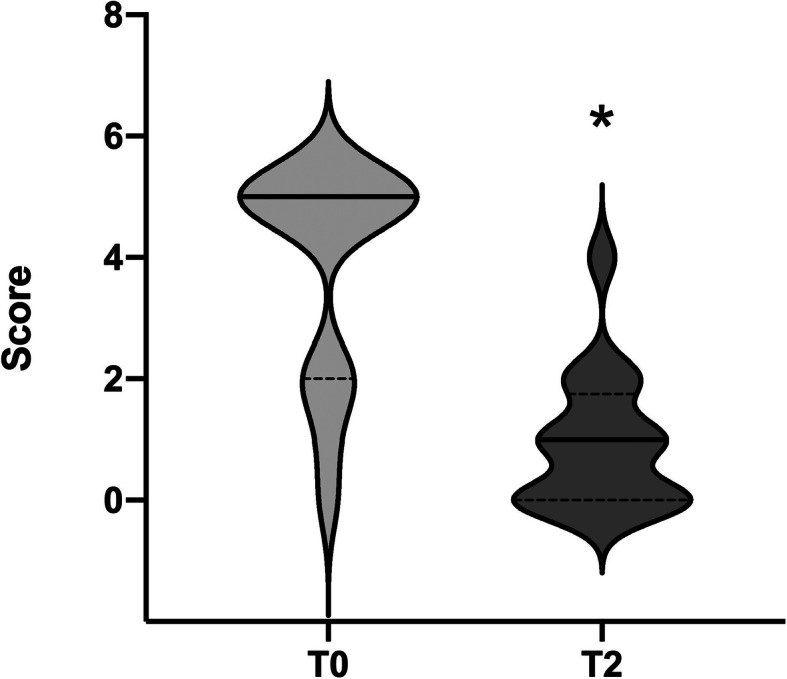
Fig. 1
Fig. 1
Overall nausea severity. Violin plot of NRS assessing the overall nausea severity at timepoints T0 (before ondansetron administration) and T2 (2 h after ondansetron administration) in 16 dogs with vestibular syndrome. Wilcoxon signed-rank test was used for comparison (* p ≤ 0.0001). Scores range from 0 to 5. See Table 2 for further information
Fig. 2
Fig. 2
Signs indicative for nausea in the course of the study period (T0 and T2). Scores (0–5) for the five other signs indicative for nausea are shown in 11 dogs at time points T0 (before ondansetron) and T2 (2 h after ondansetron), respectively. Bars represent the median scores and error bars represent the interquartile ranges. Significant decreases of scores after ondansetron treatment are indicated by asterisks with p = 0.0078 for salivation, p = 0.0078 for lip licking, p = 0.0039 for restlessness, and p = 0.0078 for lethargy. No significant differences were found in terms of vocalisation (p > 0.9999) between both time points. Wilcoxon signed-rank test was used for analysis
Fig. 3
Fig. 3
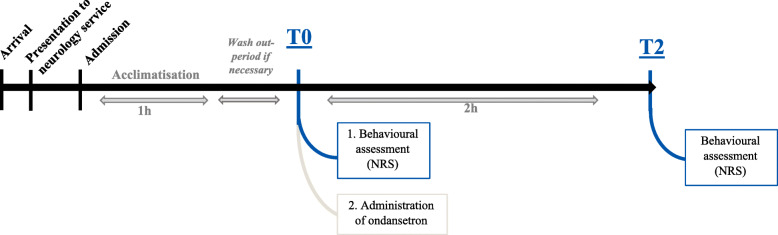
Study Timeline. After arrival at the clinic and presentation to the neurology service, the dogs were hospitalised. An acclimatisation and, if required, a wash-out period were given prior to the study start. Behavioural assessment using a Numerical Rating Scale (NRS) was conducted by a trained observer at T0 and T2. Ondansetron administration was performed straight after behavioural observations at T0

References

    1. Kraeling M. Proposed Treatment for Geriatric Vestibular Disease in Dogs. Top Companion Anim Med. 2014;29(1):6–9. doi: 10.1053/j.tcam.2014.04.004. - DOI - PubMed
    1. Radulescu SM, Humm K, Eramanis LM, Volk HA, Church DB, Brodbelt D, et al. Vestibular disease in dogs under UK primary veterinary care: Epidemiology and clinical management. J Vet Intern Med. 2020;10(5):1993–2004. doi: 10.1111/jvim.15869. - DOI - PMC - PubMed
    1. Rossmeisl JH. Vestibular Disease in Dogs and Cats. Vet Clin North Am Small Anim Pract. 2010;40(1):81–100. doi: 10.1016/j.cvsm.2009.09.007. - DOI - PubMed
    1. Kent M, Platt SR, Schatzberg SJ. The neurology of balance: Function and dysfunction of the vestibular system in dogs and cats. Vet J. 2010;185(3):247–58. doi: 10.1016/j.tvjl.2009.10.029. - DOI - PubMed
    1. Yates BJ, Grelot L, Kerman IA, Balaban CD, Jakus J, Miller AD. Organization of vestibular inputs to nucleus tractus solitarius and adjacent structures in cat brain stem. Am J Physiol Integr Comp Physiol. 1994;267(4):R974–83. doi: 10.1152/ajpregu.1994.267.4.R974. - DOI - PubMed

Publication types

MeSH terms