Review
. 2021 Jul;54(7):344-355.
doi: 10.5483/BMBRep.2021.54.7.064.

Mucin in cancer: a stealth cloak for cancer cells

Affiliations
Review

Mucin in cancer: a stealth cloak for cancer cells

Dong-Han Wi et al. BMB Rep. 2021 Jul.

Abstract

Mucins are high molecular-weight epithelial glycoproteins and are implicated in many physiological processes, including epithelial cell protection, signaling transduction, and tissue homeostasis. Abnormality of mucus expression and structure contributes to biological properties related to human cancer progression. Tumor growth sites induce inhospitable conditions. Many kinds of research suggest that mucins provide a microenvironment to avoid hypoxia, acidic, and other biological conditions that promote cancer progression. Given that the mucus layer captures growth factors or cytokines, we propose that mucin helps to ameliorate inhospitable conditions in tumor-growing sites. Additionally, the composition and structure of mucins enable them to mimic the surface of normal epithelial cells, allowing tumor cells to escape from immune surveillance. Indeed, human cancers such as mucinous carcinoma, show a higher incidence of invasion to adjacent organs and lymph node metastasis than do non-mucinous carcinoma. In this minireview, we discuss how mucin provides a tumor-friendly environment and contributes to increased cancer malignancy in mucinous carcinoma. [BMB Reports 2021; 54(7): 344-355].


Conflict of interest statement

CONFLICTS OF INTEREST

The authors have no conflicting interests.

Figures
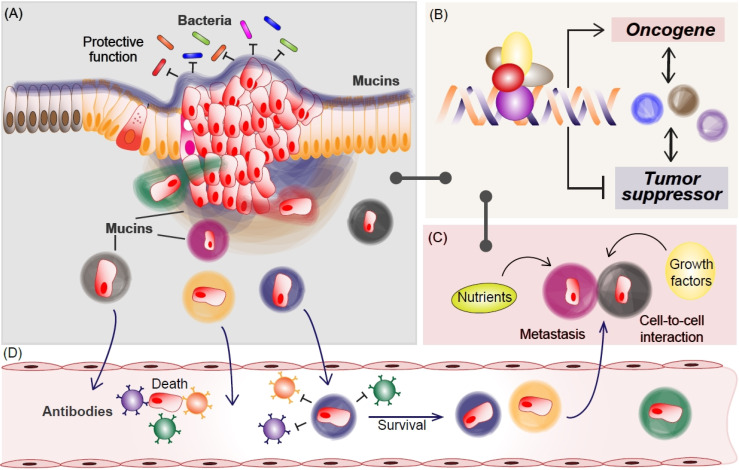
Fig. 1
Fig. 1
The role of mucins in MCC progression. In normal conditions, mucins protect epithelial cells from external environments such as bacteria (A). In MCC, various mucins transcriptionally increase oncogenic factors while inhibiting tumor suppressor (B), which might be mediated by mucin-captured nutrients or growth factors (C). Additionally, mucins protect MCC from immune surveillance via mimic epithelial surface during metastasis (A and D). For the journey to secondary tumor formation, many cancer cells are killed by the immune system in the circulating system (D). Metastasized mucin-cloaked cancer cells take advantage of including transcription, nutrients, and growth factors (C), for secondary MCC development, which would be shared via cell-to-cell interaction.

References

    1. Gum JR, Jr, Hicks JW, Gillespie AM, et al. Goblet cell-specific expression mediated by the MUC2 mucin gene promoter in the intestine of transgenic mice. Am J Physiol. 1999;276:G666–676. doi: 10.1152/ajpgi.1999.276.3.G666. - DOI - PubMed
    1. Johansson ME, Phillipson M, Petersson J, Velcich A, Holm L, Hansson GC. The inner of the two Muc2 mucin-dependent mucus layers in colon is devoid of bacteria. Proc Natl Acad Sci U S A. 2008;105:15064–15069. doi: 10.1073/pnas.0803124105. - DOI - PMC - PubMed
    1. Boland CR, Goel A. Microsatellite instability in colorectal cancer. Gastroenterology. 2010;138:2073–2087. doi: 10.1053/j.gastro.2009.12.064. - DOI - PMC - PubMed
    1. Kufe DW. Mucins in cancer: function, prognosis and therapy. Nat Rev Cancer. 2009;9:874–885. doi: 10.1038/nrc2761. - DOI - PMC - PubMed
    1. Wahrenbrock M, Borsig L, Le D, Varki N, Varki A. Selectin-mucin interactions as a probable molecular explanation for the association of Trousseau syndrome with mucinous adenocarcinomas. J Clin Invest. 2003;112:853–862. doi: 10.1172/JCI200318882. - DOI - PMC - PubMed
