


Evaluating the provision of Further Enabling Care at Home (FECH+) for informal caregivers of older adults discharged home from hospital: protocol for a multicentre randomised controlled trial
- PMID: 34155075
- PMCID: PMC8217916
- DOI: 10.1136/bmjopen-2020-046600
Evaluating the provision of Further Enabling Care at Home (FECH+) for informal caregivers of older adults discharged home from hospital: protocol for a multicentre randomised controlled trial
Abstract
Introduction: There are personal and societal benefits from caregiving; however, caregiving can jeopardise caregivers' health. The Further Enabling Care at Home (FECH+) programme provides structured nurse support, through telephone outreach, to informal caregivers of older adults following discharge from acute hospital care to home. The trial aims to evaluate the efficacy of the FECH+ programme on caregivers' health-related quality of life (HRQOL) after care recipients' hospital discharge.
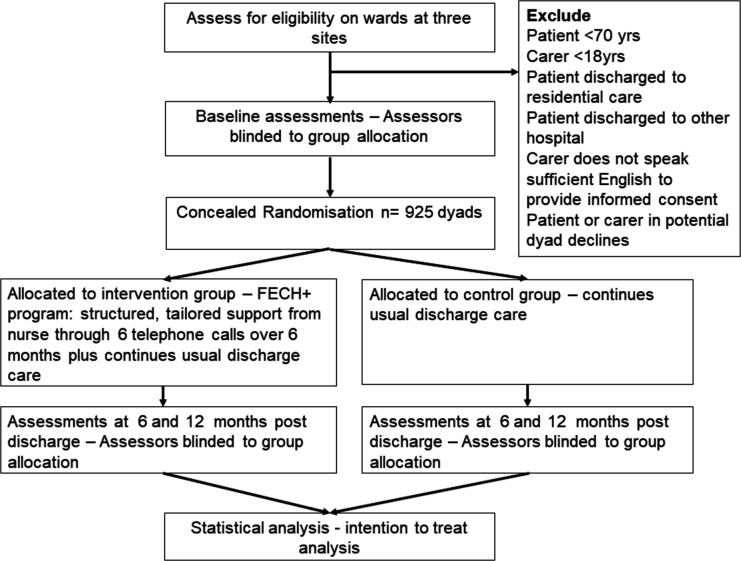
Methods and analysis: A multisite, parallel-group, randomised controlled trial with blinded baseline and outcome assessment and intention-to-treat analysis, adhering to Consolidated Standards of Reporting Trials guidelines will be conducted. Participants (N=925 dyads) comprising informal home caregiver (18 years or older) and care recipient (70 years or older) will be recruited when the care recipient is discharged from hospital. Caregivers of patients discharged from wards in three hospitals in Australia (one in Western Australia and two in Queensland) are eligible for inclusion. Participants will be randomly assigned to one of the two groups. The intervention group receive the FECH+ programme, which provides structured support and problem-solving for the caregiver after the care recipient's discharge, in addition to usual care. The control group receives usual care. The programme is delivered by a registered nurse and comprises six 30-45 min telephone support sessions over 6 months. The primary outcome is caregivers' HRQOL measured using the Assessment of Quality of Life-eight dimensions. Secondary outcomes include caregiver preparedness, strain and distress and use of healthcare services. Changes in HRQOL between groups will be compared using a mixed regression model that accounts for the correlation between repeated measurements.
Ethics and dissemination: Participants will provide written informed consent. Ethics approvals have been obtained from Sir Charles Gairdner and Osborne Park Health Care Group, Curtin University, Griffith University, Gold Coast Health Service and government health data linkage services. Findings will be disseminated through presentations, peer-reviewed journals and conferences.
Trial registration number: ACTRN12620000060943.
Keywords: geriatric medicine; internal medicine; quality in health care.
© Author(s) (or their employer(s)) 2021. Re-use permitted under CC BY-NC. No commercial re-use. See rights and permissions. Published by BMJ.
Conflict of interest statement
Competing interests: None declared.
Figures
References
-
- Australian Bureau of Statistics . Disability, ageing and carers, Australia: summary of findings, 2018. Available: https://www.abs.gov.au/ausstats/abs@.nsf/mf/4430.0
-
- World Health Organisation . Ageing and health, 2018. Available: https://www.who.int/news-room/fact-sheets/detail/ageing-and-health
-
- Carers UK. State of caring. A snapshot of unpaid care in the UK, 2019. Available: https://www.carersuk.org/news-and-campaigns/state-of-caring-survey-2020
-
- Carers NSW Australia . 40 years of carer surveys (1976-2016), 2014. Available: http://www.carersnsw.org.au/research/survey
Publication types
MeSH terms
Associated data
LinkOut - more resources
Full Text Sources
Medical
