


The effect of COVID19 pandemic restrictions on an urban rodent population
- PMID: 34155237
- PMCID: PMC8217515
- DOI: 10.1038/s41598-021-92301-0
The effect of COVID19 pandemic restrictions on an urban rodent population
Abstract
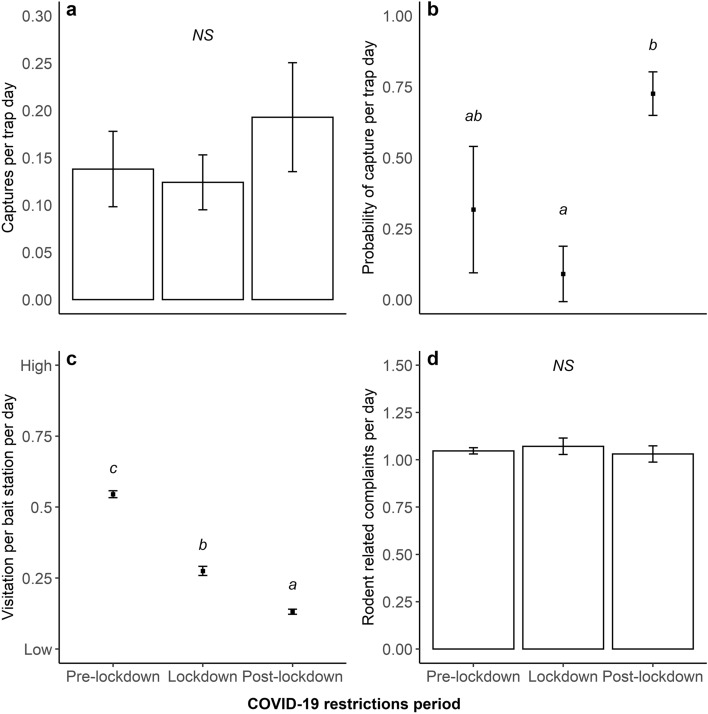
Shortly after the enactment of restrictions aimed at limiting the spread of COVID-19, various local government and public health authorities around the world reported an increased sighting of rats. Such reports have yet to be empirically validated. Here we combined data from multi-catch rodent stations (providing data on rodent captures), rodent bait stations (providing data on rodent activity) and residents' complaints to explore the effects of a six week lockdown period on rodent populations within the City of Sydney, Australia. The sampling interval encompassed October 2019 to July 2020 with lockdown defined as the interval from April 1st to May 15th, 2020. Rodent captures and activity (visits to bait stations) were stable prior to lockdown. Captures showed a rapid increase and then decline during the lockdown, while rodent visits to bait stations declined throughout this period. There were no changes in the frequency of complaints during lockdown relative to before and after lockdown. There was a non-directional change in the geographical distribution of indices of rodent abundance suggesting that rodents redistributed in response to resource scarcity. We hypothesize that lockdown measures initially resulted in increased rodent captures due to sudden shortage of human-derived food resources. Rodent visits to bait stations might not show this pattern due to the nature of the binary data collected, namely the presence or absence of a visit. Relocation of bait stations driven by pest management goals may also have affected the detection of any directional spatial effect. We conclude that the onset of COVID-19 may have disrupted commensal rodent populations, with possible implications for the future management of these ubiquitous urban indicator species.
Conflict of interest statement
The authors declare no competing interests.
Figures

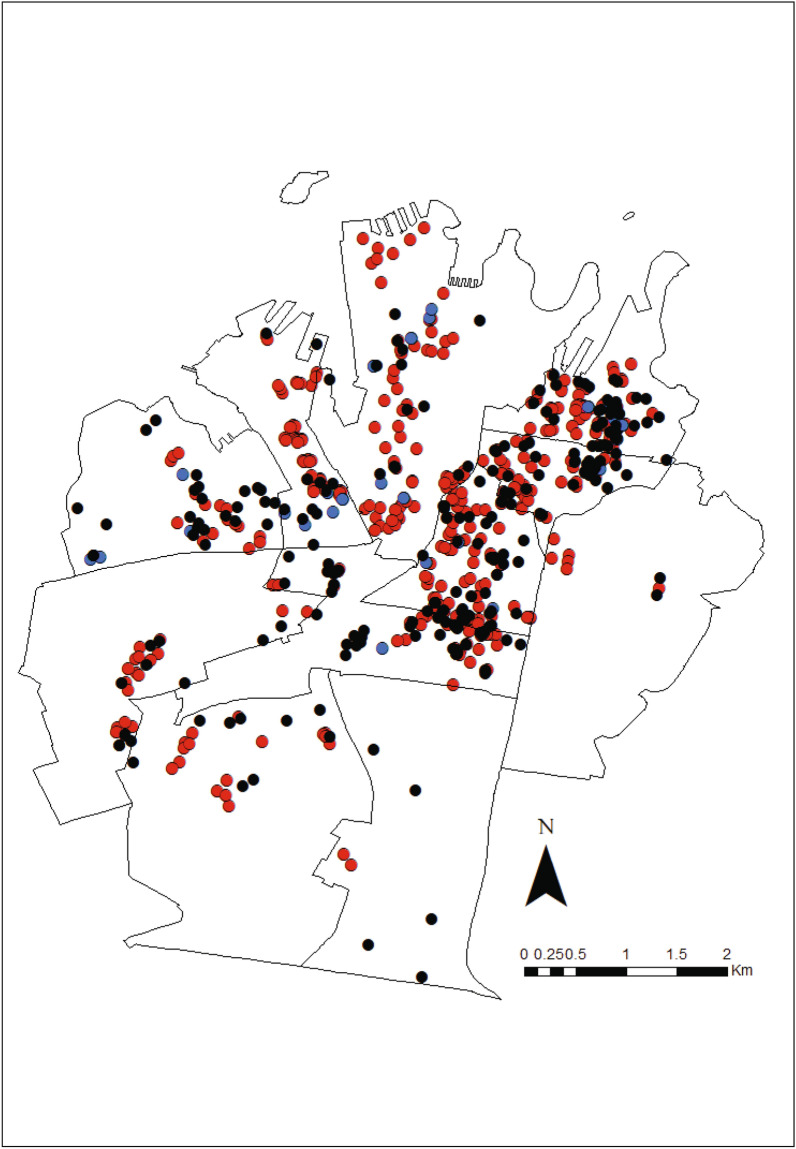
 ), rodent bait stations (
 ) and residents’ rodent complaints (
 ) within the Council of the City of Sydney. The eleven Statistical Area 2 (SA2) which make up the City of Sydney are shown. Map generated using ArcGIS Desktop v10.5.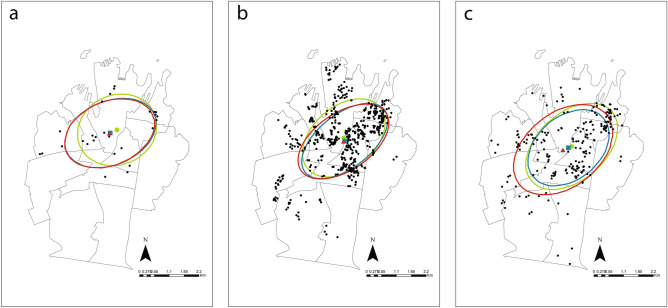
 ), lockdown (
 ) and post-lockdown (
 ) periods. Maps generated using ArcGIS Desktop v10.5.
References
-
- Tobin ME, Fall MW. USDA National Wildlife Research Center-Staff Publications. USDA National Wildlife Research Center-Staff Publications; 2006. pp. 1–21.
-
- Mills, J. N. The role of rodents in emerging human disease: Examples from the hantaviruses and arenaviruses. in Ecologically-Based Rodent Management (eds Grant R. Singleton, Lyn A. Hinds, Herwig Leirs, & Zhibin Zhang) 134–160 (Australian Centre for International Agricultural Research, 1999)
-
- Barnett SA. The Story of Rats: Their Impact on Us, and Our Impact on Them. Allen & Unwin; 2001.
Publication types
MeSH terms
Grants and funding
LinkOut - more resources
Full Text Sources
Medical
Miscellaneous
