


Implementation of new ECMO centers during the COVID-19 pandemic: experience and results from the Middle East and India
- PMID: 34156477
- PMCID: PMC8217786
- DOI: 10.1007/s00134-021-06451-w
Implementation of new ECMO centers during the COVID-19 pandemic: experience and results from the Middle East and India
Abstract
Purpose: Extracorporeal membrane oxygenation (ECMO) use for severe coronavirus disease 2019 (COVID-19) patients has increased during the course of the pandemic. As uncertainty existed regarding patient's outcomes, early guidelines recommended against establishing new ECMO centers. We aimed to explore the epidemiology and outcomes of ECMO for COVID-19 related cardiopulmonary failure in five countries in the Middle East and India and to evaluate the results of ECMO in 5 new centers.
Methods: This is a retrospective, multicenter international, observational study conducted in 19 ECMO centers in five countries in the Middle East and India from March 1, 2020, to September 30, 2020. We included patients with COVID-19 who received ECMO for refractory hypoxemia and severe respiratory acidosis with or without circulatory failure. Data collection included demographic data, ECMO-related specific data, pre-ECMO patient condition, 24 h post-ECMO initiation data, and outcome. The primary outcome was survival to home discharge. Secondary outcomes included mortality during ECMO, survival to decannulation, and outcomes stratified by center type.
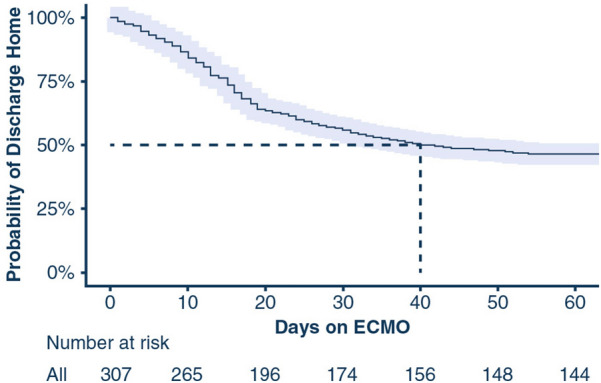
Results: Three hundred and seven COVID-19 patients received ECMO support during the study period, of whom 78 (25%) were treated in the new ECMO centers. The median age was 45 years (interquartile range IQR 37-52), and 81% were men. New center patients were younger, were less frequently male, had received higher PEEP, more frequently inotropes and prone positioning before ECMO and were less frequently retrieved from a peripheral center on ECMO. Survival to home discharge was 45%. In patients treated in new and established centers, survival was 55 and 41% (p = 0.03), respectively. Multivariable analysis retained only a SOFA score < 12 at ECMO initiation as associated with survival (odds ratio, OR 1.93 (95% CI 1.05-3.58), p = 0.034), but not treatment in a new center (OR 1.65 (95% CI 0.75-3.67)).
Conclusions: During pandemics, ECMO may provide favorable outcomes in highly selected patients as resources allow. Newly formed ECMO centers with appropriate supervision of regional experts may have satisfactory results.
Keywords: COVID-19; ECMO; Pandemic; SARS-Cov2; SWAAC-ELSO.
© 2021. Springer-Verlag GmbH Germany, part of Springer Nature.
Conflict of interest statement
KS acknowledges research support from the Metro North Hospital and Health Service and the Prince Charles Hospital Foundation. DB receives research support from ALung Technologies. He has been on the medical advisory boards for Baxter, Abiomed, Xenios, and Hemovent and is the President-Elect of the Extracorporeal Life Support Organization (ELSO). AC reported receiving grants and personal fees from Maquet, Xenios, and Baxter and serving as the recent past president of the EuroELSO organization. Other authors have no conflict of interest.
Figures
References
-
- Peek GJ, Mugford M, Tiruvoipati R, Wilson A, Allen E, Thalanany MM, Hibbert CL, Truesdale A, Clemens F, Cooper N, Firmin RK, Elbourne D. Efficacy and economic assessment of conventional ventilatory support versus extracorporeal membrane oxygenation for severe adult respiratory failure (CESAR): a multicentre randomised controlled trial. Lancet. 2009;374(9698):1351–1363. doi: 10.1016/s0140-6736(09)61069-2. - DOI - PubMed
-
- Combes A, Hajage D, Capellier G, Demoule A, Lavoué S, Guervilly C, Da Silva D, Zafrani L, Tirot P, Veber B, Maury E, Levy B, Cohen Y, Richard C, Kalfon P, Bouadma L, Mehdaoui H, Beduneau G, Lebreton G, Brochard L, Ferguson ND, Fan E, Slutsky AS, Brodie D, Mercat A, EOLIA Trial Group, REVA, ECMONet Extracorporeal membrane oxygenation for severe acute respiratory distress syndrome. N Engl J Med. 2018;378(21):1965–1975. doi: 10.1056/NEJMoa1800385. - DOI - PubMed
-
- Goligher EC, Tomlinson G, Hajage D, et al. Extracorporeal membrane oxygenation for severe acute respiratory distress syndrome and posterior probability of mortality benefit in a post hoc Bayesian analysis of a randomized clinical trial. JAMA. 2018;320(21):2251–2259. doi: 10.1001/jama.2018.14276. - DOI - PubMed
Publication types
MeSH terms
LinkOut - more resources
Full Text Sources
Medical
Miscellaneous
