


Review
doi: 10.1093/af/vfab020.
eCollection 2021 May.
The origins of the domesticate brown rat (Rattus norvegicus) and its pathways to domestication
Affiliations
- PMID: 34158992
- PMCID: PMC8214441
- DOI: 10.1093/af/vfab020
Item in Clipboard
Review
The origins of the domesticate brown rat (Rattus norvegicus) and its pathways to domestication
Anim Front.
.
No abstract available
Figures

Map indicating the assumed native distribution of Rattus norvegicus (in blue) and locations of major rat domestication processes (marked with depictions). From East to West: Hooded rat depiction adapted from an image within the 1700s Japanese rodent breeding guide book, the Chinganso-date-gusa (1787); Rat-baiting dog depiction adapted from Mayhew (1851)London labor and the London poor illustrating blood sport activities from which European domestic rats arose; laboratory rat silhouette representing the postdomestication selective breeding of rats for laboratory inbred strain development at the Wistar Institute of Philadelphia in the early 1900s.
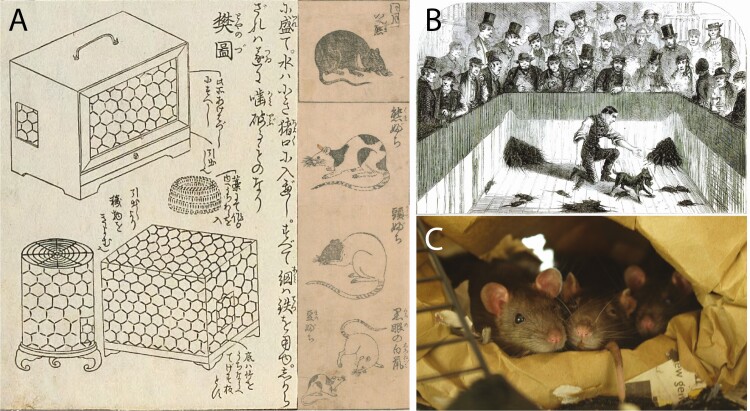
Panel of domestic rats. (A) Composite image of rat and mouse keeping cages from the Yoso-tama-no-kakehashi (1775) and four images of different color morphs of rats from the Chinganso-date-gusa (1787). (B) Rat-baiting event depicted from Mayhew (1851)London labor and the London poor. (C) Three female fancy rats displaying gregarious social behavior (photo credit Robert Lachlan).
References
-
- Aplin, K.P., Brown P.R., Jacob J., Krebs C.J., and Singleton G.R.. . 2003. Field methods for rodent studies in Asia and the Indo-Pacific: review of the major pest species. ACIAR Monograph series no. 100. Canberra (Australia): Australian Centre for International Agricultural Research; p. 397.
-
- Armitage, P.L. 1994. Unwelcome companions: ancient rats reviewed. Antiquity. 68:231–240. Available from: http://www.antiquity.ac.uk/Ant/068/0231/Ant0680231.pdf.
-
- Armitage, P.L., West B., and Steedman K.. . 1984. New evidence of black rat in Roman London. Lond. Archaeol. 4:375–383.
-
- Barnett, S.A. 1960. Social behaviour among tame rats and among wild-white hybrids. Proc. Zool. Soc. Lond. 134(4):611–621.
-
- Barnett, S.A., and Stoddart R.C.. . 1969. Effects of breeding in captivity on conflict among wild rats. J. Mamm. 50:321–325.
Publication types
Grants and funding
LinkOut - more resources
Full Text Sources
Other Literature Sources