. 2021 May;10(5):1988-1999.
doi: 10.21037/tau-21-18.

Eef2k is not required for fertility in male mice

Affiliations

Eef2k is not required for fertility in male mice

Tianhao Feng et al. Transl Androl Urol. 2021 May.

Abstract

Background: Eukaryotic elongation factor-2 kinase (Eef2k) is a protein kinase associated with the calmodulin-induced signaling pathway and an atypical alpha-kinase family member. Eef2k-mediated phosphorylation of eukaryotic translation elongation factor 2 (Eef2) can inhibit the functionality of this protein, altering protein translation. Prior work suggests Eef2k to be overexpressed in breast, pancreatic, brain, and lung cancers wherein it may control key processes associated with apoptosis, autophagy, and cell cycle progression. The functional importance of Eef2k in the testes of male mice, however, has yet to be clarified.

Methods: A CRISPR/Cas9 approach was used to generate male Eef2k-knockout mice, which were evaluated for phenotypic changes in epididymal or testicular tissues through histological and immunofluorescent staining assays. In addition, TUNEL staining was conducted to assess the apoptotic death of cells in the testis. Fertility, sperm counts, and sperm motility were further assessed.

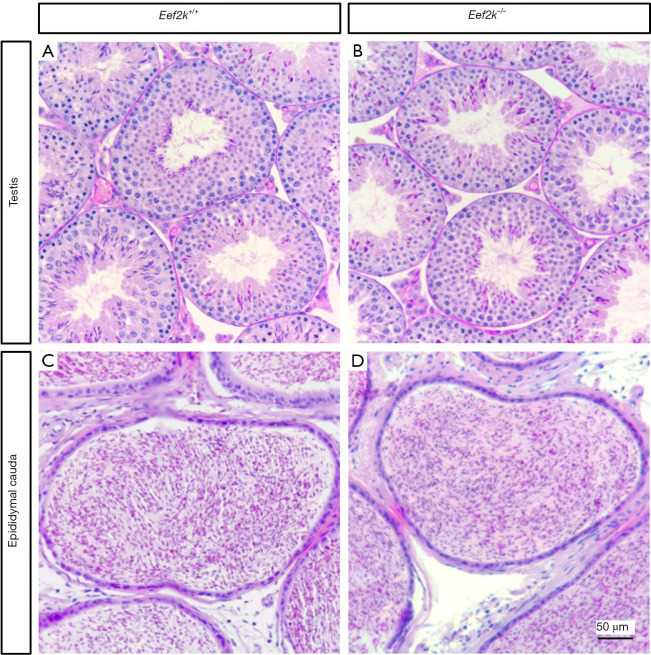
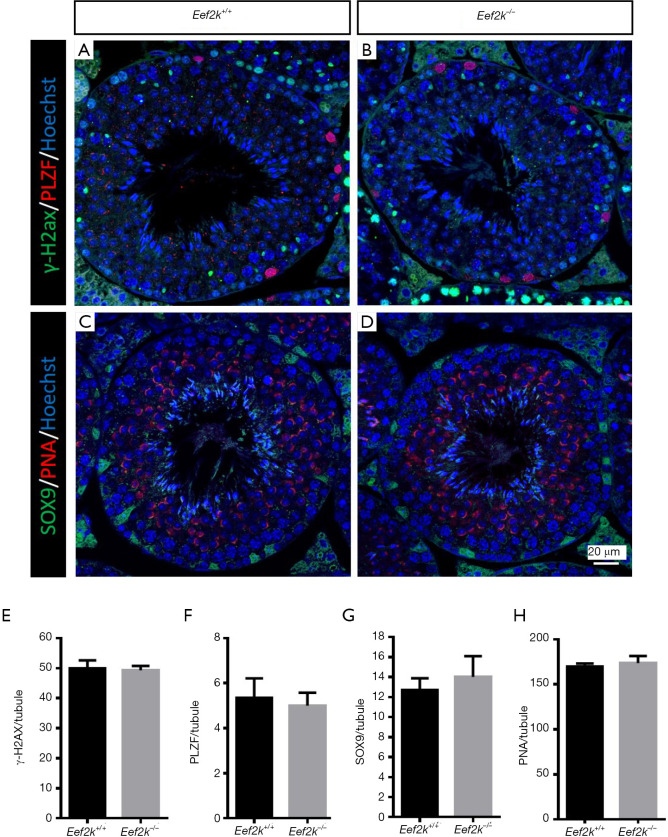
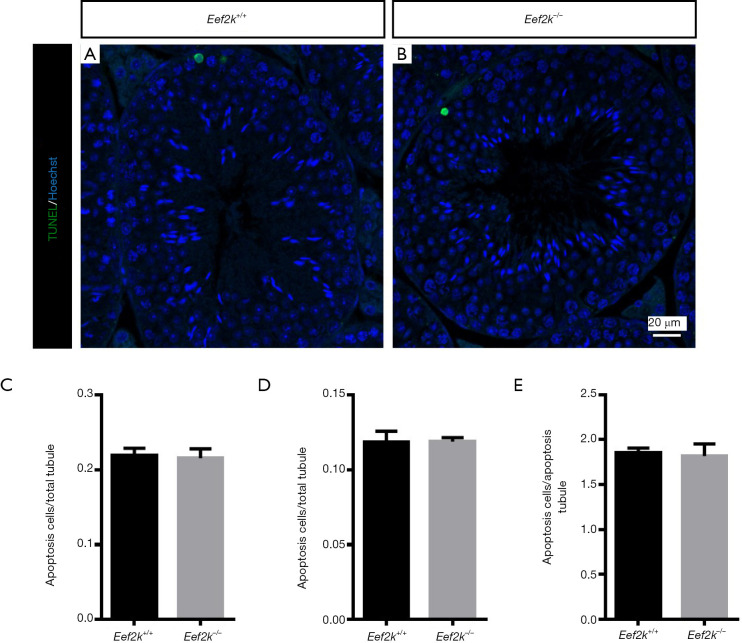
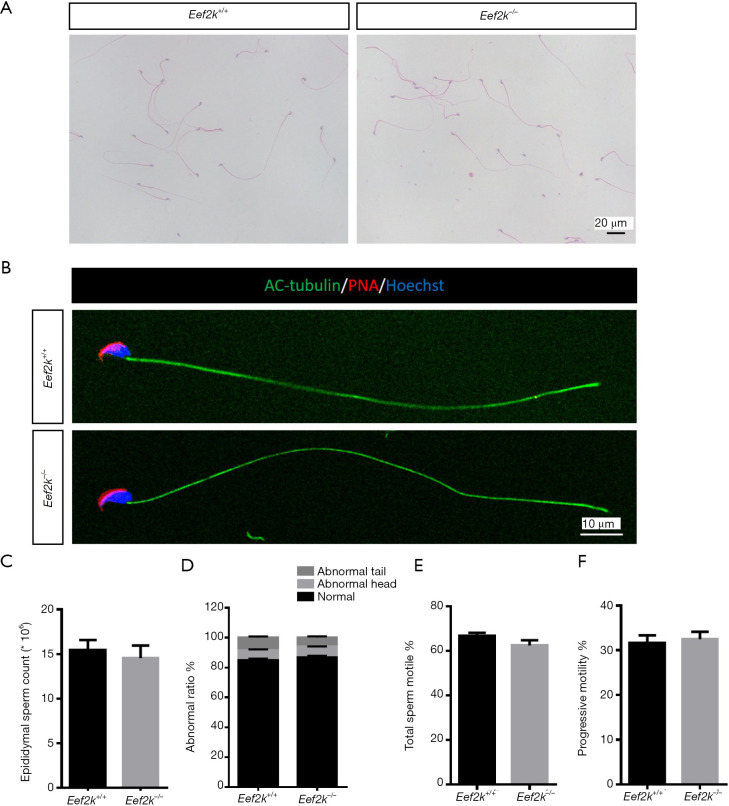
Results: Male Eef2k-knockout mice were successfully generated, and exhibited normal fertility and development. No apparent differences were observed with respect to spermatogenesis, sperm counts, or germ cell apoptosis when comparing male Eef2k -/- and Eef2k +/+ mice.

Conclusions: Male Eef2k-knockout mice remained fertile and were free of any evident developmental or spermatogenic abnormalities, suggesting Eef2k to be dispensable in the context of male fertility.

Keywords: Eukaryotic elongation factor-2 kinase (Eef2k); male fertility; spermatogenesis.


Conflict of interest statement

Conflicts of Interest: All authors have completed the ICMJE uniform disclosure form (available at http://dx.doi.org/10.21037/tau-21-18). The authors have no conflicts of interest to declare.

Figures
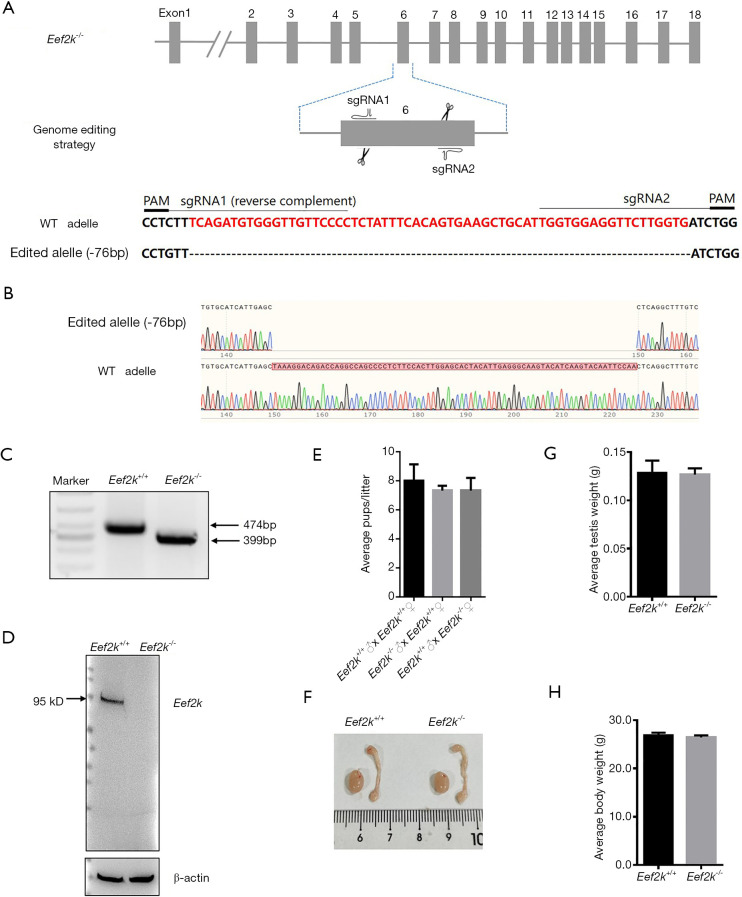
Figure 1
Figure 1
Generation of mutant gene and assessment of Eef2k−/− male mouse fertility. (A) Schematic diagram of CRISPR/Cas9 targeting strategy. The sgRNAs were designed on the basis of exon 6 of Eef2k; (B) A 76-bp deletion from Eef2k exon 6 was detected in Eef2k−/− mice by Sanger sequencing and (C) agarose gel electrophoresis analysis, detected by bio rad chemidoc XRS +; (D) Eef2k was not detected in Eef2k−/− testis on western blot, detected by Tanon 5200; (E) average number of pups per litter from wild-type and Eef2k−/− mice, n=3; (F) testis and epididymis from wild-type and Eef2k−/− adult mice; (G,H) average testis weight and body weight ratio of 8-week-old wild-type and Eef2k−/− mice, n=3. Eef2k, eukaryotic elongation factor-2 kinase.
Figure 2
Figure 2
Histological staining showing normal-appearing spermatogenesis in Eef2k−/− mice. Periodic acid Schiff-stained testis sections from (A) wild-type and (B) Eef2k−/− mice. Hematoxylin- and eosin-stained cauda epididymis sections from (C) wild-type and (D) Eef2k−/− mice. Eef2k, eukaryotic elongation factor-2 kinase.
Figure 3
Figure 3
Immunofluorescent analysis of Eef2k+/+ and Eef2k−/− testes. The spermatogonia (PLZF) and spermatocytes (γ-H2ax) were similar in testis sections of (A) wild-type and (B) Eef2k−/− mice. Spermatids (PNA) and Sertoli cells (Sox9) were comparable in testis sections of (C) wild-type and (D) Eef2k−/− mice. (E,F,G,H) Average number of cells with immune signal in stage VII tubules, n=3. Eef2k, eukaryotic elongation factor-2 kinase.
Figure 4
Figure 4
Analysis of apoptosis in Eef2k+/+ and Eef2k−/− testes. The number of apoptotic cells was not significantly different between Eef2k+/+ and Eef2k−/− mice. Testicular sections from TUNEL assay of (A) Eef2k+/+ and (B) Eef2k−/− mice; (C) Average TUNEL-positive apoptotic cell counts of Eef2k+/+ and Eef2k−/− mice; (D) Average TUNEL positive apoptotic tubule counts of Eef2k+/+ and Eef2k−/− mice, n=3. (E) Average TUNEL-positive apoptotic cell counts in each apoptotic tubule of Eef2k+/+ and Eef2k−/− mice, n=3. Eef2k, eukaryotic elongation factor-2 kinase.
Figure 5
Figure 5
Analysis of spermatozoa in Eef2k−/− mice. (A) Hematoxylin- and eosin-stained spermatozoa from wild-type and Eef2k−/− mice. (B) Fluorescent detection of AC-tubulin (green) and PNA (red) from wild-type and Eef2k−/− spermatozoa. (C) Epididymal sperm count from wild-type and Eef2k−/− mice, n=3. (D) Classification of epididymal sperm morphology from wild-type and Eef2k−/− mice, n=3. (E) Average rate of motile sperm and (F) progressive sperm from wild-type and Eef2k−/− mice, n=3. Eef2k, eukaryotic elongation factor-2 kinase.

References

    1. Agarwal A, Baskaran S, Parekh N, et al. Male infertility. Lancet 2021;397:319-33. 10.1016/S0140-6736(20)32667-2 - DOI - PubMed
    1. Lee JA, Ramasamy R. Indications for the use of human chorionic gonadotropic hormone for the management of infertility in hypogonadal men. Transl Androl Urol 2018;7:S348-52. 10.21037/tau.2018.04.11 - DOI - PMC - PubMed
    1. Durairajanayagam D, Agarwal A, Ong C. Causes, effects and molecular mechanisms of testicular heat stress. Reprod Biomed Online 2015;30:14-27. 10.1016/j.rbmo.2014.09.018 - DOI - PubMed
    1. Sansone A, Di Dato C, de Angelis C, et al. Smoke, alcohol and drug addiction and male fertility. Reprod Biol Endocrinol 2018;16:3. 10.1186/s12958-018-0320-7 - DOI - PMC - PubMed
    1. Krausz C, Riera-Escamilla A. Genetics of male infertility. Nat Rev Urol 2018;15:369-84. 10.1038/s41585-018-0003-3 - DOI - PubMed

LinkOut - more resources