Epidemiologic Analysis of Chilblains Cohorts Before and During the COVID-19 Pandemic
- PMID: 34160569
- PMCID: PMC8223123
- DOI: 10.1001/jamadermatol.2021.2120
Epidemiologic Analysis of Chilblains Cohorts Before and During the COVID-19 Pandemic
Abstract
Importance: Beginning in March 2020, case reports and case series linked the COVID-19 pandemic with an increased occurrence of chilblains, but this association has not been evaluated in an epidemiologic study.
Objective: To assess whether a correlation exists between COVID-19 incidence and chilblains incidence.
Design, setting, and participants: A retrospective cohort study was conducted within the Kaiser Permanente Northern California system from January 1, 2016, to December 31, 2020; health plan members of all ages were included.
Exposure: COVID-19 incidence in 207 location-months, representing 23 geographic locations in northern California across 9 months.
Main outcome and measures: Chilblains incidence was the main outcome. The association of chilblains incidence with COVID-19 incidence across the 207 location-months was measured using the Spearman rank correlation coefficient.
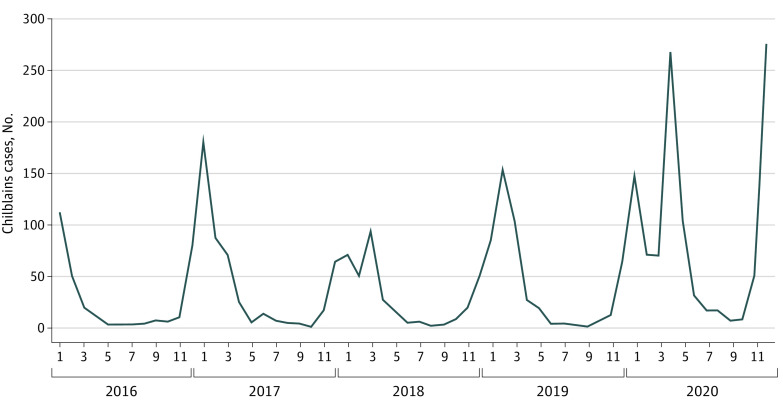
Results: Of 780 patients with chilblains reported during the pandemic, 464 were female (59.5%); mean (SD) age was 36.8 (21.8) years. COVID-19 incidence was correlated with chilblains incidence at 207 location-months (Spearman coefficient 0.18; P = .01). However, only 17 of 456 (3.7%) patients with chilblains tested during the pandemic were positive for SARS-CoV-2, and only 9 of 456 (2.0%) were positive for SARS-CoV-2 within 6 weeks of the chilblains diagnosis. Test results of 1 of 97 (1.0%) patients were positive for SARS-CoV-2 IgG antibodies. Latinx patients were disproportionately affected by COVID-19 but not by chilblains.
Conclusions and relevance: This cohort study found that in northern California, the incidence of chilblains increased during the pandemic but was correlated weakly with the incidence of COVID-19 across 207 location-months. These findings may have resulted from a causal role of COVID-19, increased care-seeking by patients with chilblains during the pandemic, or changes in behavior during shelter in place.
Conflict of interest statement
Figures
Comment in
-
Chilblains and COVID-19-An Update on the Complexities of Interpreting Antibody Test Results, the Role of Interferon α, and COVID-19 Vaccines.JAMA Dermatol. 2022 Feb 1;158(2):217-218. doi: 10.1001/jamadermatol.2021.5172. JAMA Dermatol. 2022. PMID: 34935876 No abstract available.
References
-
- Saenz Aguirre A, De la Torre Gomar FJ, Rosés-Gibert P, Gimeno Castillo J, Martinez de Lagrán Alvarez de Arcaya Z, Gonzalez-Perez R. Novel outbreak of acral lesions in times of COVID-19: a description of 74 cases from a tertiary university hospital in Spain. Clin Exp Dermatol. 2020;45(8):1065-1067. doi: 10.1111/ced.14294 - DOI - PMC - PubMed
-
- de Masson A, Bouaziz JD, Sulimovic L, et al. ; SNDV (French National Union of Dermatologists-Venereologists) . Chilblains is a common cutaneous finding during the COVID-19 pandemic: a retrospective nationwide study from France. J Am Acad Dermatol. 2020;83(2):667-670. doi: 10.1016/j.jaad.2020.04.161 - DOI - PMC - PubMed
-
- Le Cleach L, Dousset L, Assier H, et al. ; French Society of Dermatology . Most chilblains observed during the COVID-19 outbreak occur in patients who are negative for COVID-19 on polymerase chain reaction and serology testing. Br J Dermatol. 2020;183(5):866-874. doi: 10.1111/bjd.19377 - DOI - PMC - PubMed
Publication types
MeSH terms
LinkOut - more resources
Full Text Sources
Medical
Miscellaneous