. 2021 Jun 23;254(1):11.
doi: 10.1007/s00425-021-03651-y.

Introgression of the sesquiterpene biosynthesis from Solanum habrochaites to cultivated tomato offers insights into trichome morphology and arthropod resistance

Affiliations

Introgression of the sesquiterpene biosynthesis from Solanum habrochaites to cultivated tomato offers insights into trichome morphology and arthropod resistance

Rodrigo Therezan et al. Planta. .

Abstract

Cultivated tomatoes harboring the plastid-derived sesquiterpenes from S. habrochaites have altered type-VI trichome morphology and unveil additional genetic components necessary for piercing-sucking pest resistance. Arthropod resistance in the tomato wild relative Solanum habrochaites LA1777 is linked to specific sesquiterpene biosynthesis. The Sesquiterpene synthase 2 (SsT2) gene cluster on LA1777 chromosome 8 controls plastid-derived sesquiterpene synthesis. The main genes at SsT2 are Z-prenyltransferase (zFPS) and Santalene and Bergamotene Synthase (SBS), which produce α-santalene, β-bergamotene, and α-bergamotene in LA1777 round-shaped type-VI glandular trichomes. Cultivated tomatoes have mushroom-shaped type-VI trichomes with much smaller glands that contain low levels of monoterpenes and cytosolic-derived sesquiterpenes, not presenting the same pest resistance as in LA1777. We successfully transferred zFPS and SBS from LA1777 to cultivated tomato (cv. Micro-Tom, MT) by a backcrossing approach. The trichomes of the MT-Sst2 introgressed line produced high levels of the plastid-derived sesquiterpenes. The type-VI trichome internal storage-cavity size increased in MT-Sst2, probably as an effect of the increased amount of sesquiterpenes, although it was not enough to mimic the round-shaped LA1777 trichomes. The presence of high amounts of plastid-derived sesquiterpenes was also not sufficient to confer resistance to various tomato piercing-sucking pests, indicating that the effect of the sesquiterpenes found in the wild S. habrochaites can be insect specific. Our results provide for a better understanding of the morphology of S. habrochaites type-VI trichomes and paves the way to obtain insect-resistant tomatoes.

Keywords: Bergamotene; Glandular trichome; Introgressed line; Piercing-sucking pest; Santalene; Terpenes; Tomato trichome.


Figures
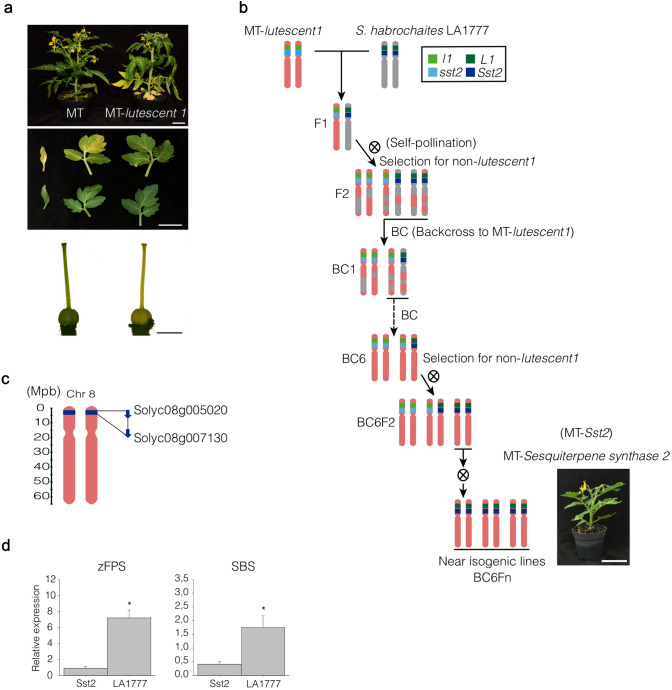
Fig. 1
Fig. 1
a Representative MT and MT near-isogenic line (NIL) harboring the lutescent 1 (l/l) mutation. b Scheme of crossing and backcrossing (BC) to create a Micro-Tom (MT) near-isogenic line (NIL) harboring the Solanum habrochaites LA1777 genes for the “Sesquiterpene Synthase 2” (SsT2) locus. MT NIL bearing the lutescent 1 mutation was used to assist the introgression process as a morphological marker (the absence of the lutescent 1 phenotype was used as an indicator of the presence of the LA1777 genes in the SsT2 locus). The presence of MT (l1 and sst2) or LA1777 (L1 and Sst2) variants is indicated in different colors. c The ID (Solyc) of the genetic markers used to determine the introgression borders are depicted. d Transcript levels of the SsT2 locus-derived genes cis-Farnesyl Diphosphate Synthase (zFPS) and Santalene and Bergamotene Synthase (SBS) in trichomes from MT-Sst2 and S. habrochaites LA1777. The expression of both zFPS and SBS in MT-Sst2 genotype, although lower than that of LA1777, evidences the introgression of the targeted chromosomal segment. Mean values of 4 biological replicates are shown. Transcript levels were normalized for Rubisco conjugating enzyme 1 (RCE1). Asterisks indicate mean significantly different from MT-Sst2, according to Student’s t test (P  ≤  0.05)
Fig. 2
Fig. 2
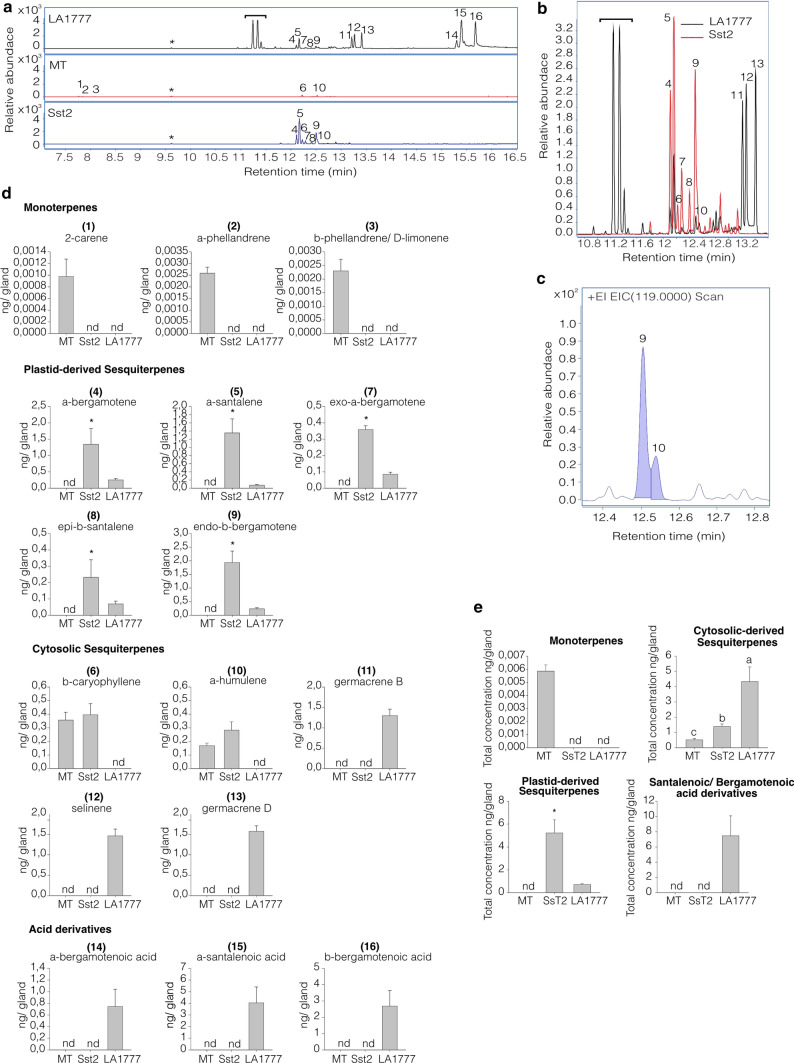
a GC–MS chromatograms showing mono and sesquiterpenes found in type-VI trichomes from Micro-Tom (MT), MT-Sst2, and S. habrochaites LA1777. The indicated peaks correspond to the following compounds: (1) 2-carene, (2) α-phellandrene, (3) β-phellandrene/D-limonene, (4) α-bergamotene, (5) α-santalene, (6) β-caryophyllene, (7) exo-α-bergamotene, (8) epi-β-santalene, (9) endo-β-bergamotene, (10) α-humulene, (11) germacrene B, (12) selinene, (13) germacrene D (14) α-bergamotenoic acid, (15) α-santalenoic acid and (16) β-bergamotenoic acid. The asterisks indicate the peaks related to the internal standard. The bracket indicates peaks related to unidentified putatively lipid-originating compounds. The chromatogram shows the detector response for ion mass 93.069 and 108.056. b Gas chromatogram overlaying sesquiterpenes found in type-VI trichomes from MT-Sst2 and Solanum habrochaites LA1777. c Gas chromatogram showing (9) endo-β-bergamotene and (10) α-humulene peaks from MT-Sst2 plants. Chromatogram shows the detector response for ion mass 119.000. d Amount of compounds presents in type-VI glandular trichomes of each genotype. Concentration of monoterpenes: (1) 2-carene, (2) α-phellandrene and (3) β-phellandrene/D-limonene; Total concentration of cytosolic sesquiterpenes: (6) β-caryophyllene, (10) α-humulene, (11) germacrene B, (12) selinene and (13) germacrene D; Concentration of plastid-derived sesquiterpenes: (4) α-bergamotene, (5) α-santalene, (7) exo-α-bergamotene, (8) epi-β-santalene and (9) endo-β-bergamotene; Concentration of santalenoic/bergamotenoic acid derivative: (14) α-bergamotenoic acid, (15) α-santalenoic acid (16) β-bergamotenoic acid. e Total amount of compounds presents in type-VI glandular trichomes of each genotype. The bars represent the mean  ±  SE of five biological replicates. For each sample, 300 type-VI glandular trichomes were collected with a glass capillary for GC–MS analysis. Bars indicated with an asterisk were significantly different according to t test (P  ≤  0.05). Bars indicated with different letters were significantly different according to Fisher’s LSD test (P  ≤  0.05) after ANOVA. nd not detected
Fig. 3
Fig. 3
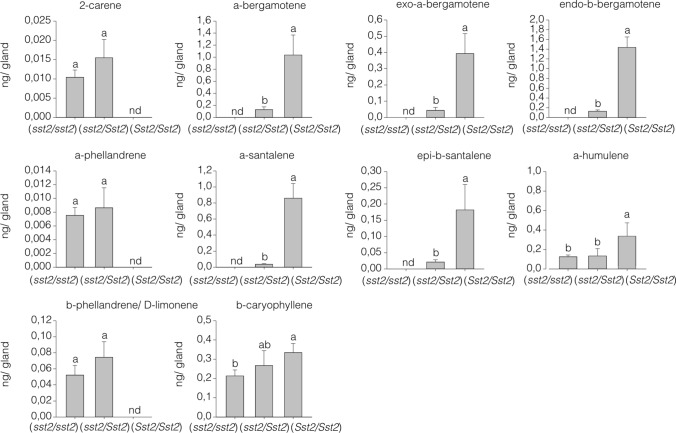
Volatile terpene levels in type-VI glandular trichomes from control Micro-Tom (sst2/sst2) and near-isogenic lines homozygous (Sst2/Sst2) and hemizygous (sst2/Sst2) for S. habrochaites alleles at the SsT2 locus. The data show the amount of each compound present in type-VI glandular trichomes. Each data point represents the mean and SE of five biological replicates. For each sample, 300 type-VI glandular trichomes were collected with a glass capillary before GC–MS. Bars indicated with different letters were significantly different according to Fisher’s LSD test (P  ≤  0.05) after ANOVA. nd not detected
Fig. 4
Fig. 4
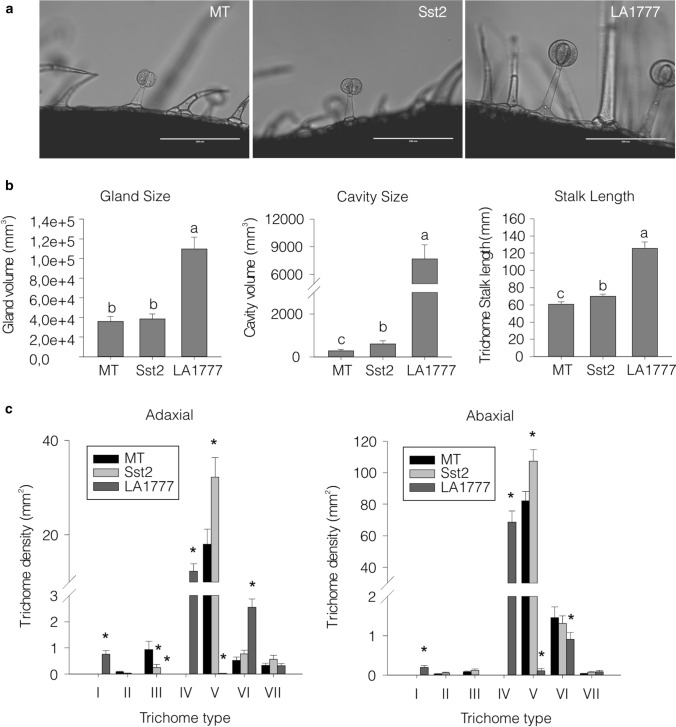
a Bright field microscopy of trichomes on the leaf surface of representative 45-days old plants of Micro-Tom (MT), MT-Sst2, and Solanum habrochaites LA1777. Scale bar  =  200 μm. b Trichome gland size, cavity volume and stalk length of type-VI trichomes. Data are mean (±  SE) of 20 trichomes of two replicate leaves of five plants. Bars indicated with different letters were significantly different according to Fisher’s LSD test (P  ≤  0.05) after ANOVA. c Density (mm2) of trichome types on adaxial and abaxial leaf surfaces. Data are mean (n  =  40) for each surface. Asterisks indicate mean significantly different from the control MT, according to Student’s t test (P  ≤  0.05)
Fig. 5
Fig. 5
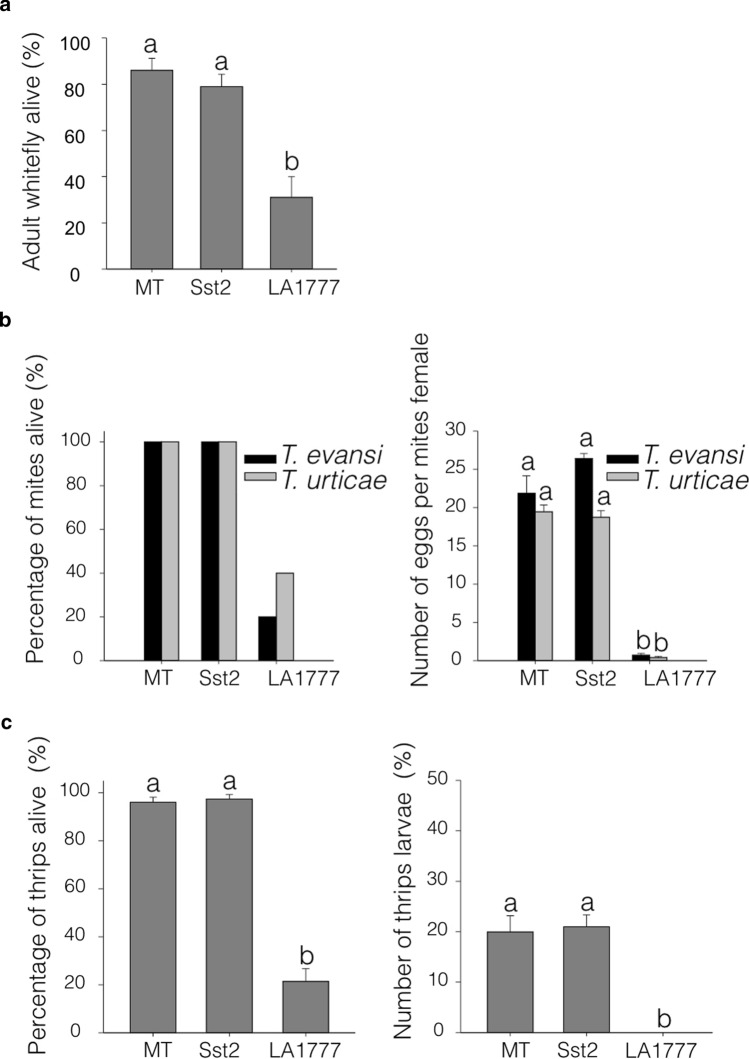
Herbivory tests performed on Micro-Tom (MT), MT-Sst2 and Solanum habrochaites LA1777 genotypes. a Percentage of adult whitefly Bemisia tabaci alive after 5 days of feeding on leaves. Data are means (±  SE) of five plants, each with two cages. b Female spider mite (Tetranychus evansi and Tetranychus urticae) survival and number of eggs after 2 days of feeding on plants. c Percentage of adult thrips alive and number of thrips larvae per female that emerged after 2 days on leaf disks. Bars indicated with different letters were significantly different according to Fisher’s LSD test (P  ≤  0.05) after ANOVA

References

    1. Abbas F, Ke Y, Yu R, et al. Volatile terpenoids: multiple functions, biosynthesis, modulation and manipulation by genetic engineering. Planta. 2017;246:803–816. doi: 10.1007/s00425-017-2749-x. - DOI - PubMed
    1. Aharoni A, Jongsma MA, Bouwmeester HJ. Volatile science? metabolic engineering of terpenoids in plants. Trends Plant Sci. 2005;10:594–602. doi: 10.1016/j.tplants.2005.10.005. - DOI - PubMed
    1. Ataide LMS, Pappas ML, Schimmel BCJ, et al. Induced plant-defenses suppress herbivore reproduction but also constrain predation of their offspring. Plant Sci. 2016;252:300–310. doi: 10.1016/j.plantsci.2016.08.004. - DOI - PubMed
    1. Balcke GU, Bennewitz S, Bergau N, et al. Multi-Omics of tomato glandular trichomes reveals distinct features of central carbon metabolism supporting high productivity of specialized metabolites. Plant Cell. 2017;29:960–983. doi: 10.1105/tpc.17.00060. - DOI - PMC - PubMed
    1. Banerjee A, Wu Y, Banerjee R, et al. Feedback inhibition of deoxy-D-xylulose-5-phosphate synthase regulates the methylerythritol 4-phosphate pathway. J Biol Chem. 2013;288:16926–16936. doi: 10.1074/jbc.M113.464636. - DOI - PMC - PubMed

LinkOut - more resources