


Dinoprostone vaginal insert (DVI) versus adjunctive sweeping of membranes and DVI for term induction of labor
- PMID: 34162016
- PMCID: PMC8453915
- DOI: 10.1111/jog.14907
Dinoprostone vaginal insert (DVI) versus adjunctive sweeping of membranes and DVI for term induction of labor
Abstract
Aim: To compare the efficacy and safety of dinoprostone vaginal insert (DVI) alone versus DVI with adjunctive sweeping of membranes (ASM) for induction of labor (IOL).
Methods: Single-center, prospective, randomized controlled trial; women with singleton term pregnancies, cervical dilation ≥1 and <3 cm, intact membranes allocated to either DVI or DVI with ASM. The primary outcome was vaginal delivery within 24 h of insertion. Secondary outcomes included mean time from insertion to delivery, tachysystole, operative delivery for non-reassuring fetal status (NRFS), tocolytics, fetal outcomes, pain information, and subject satisfaction.
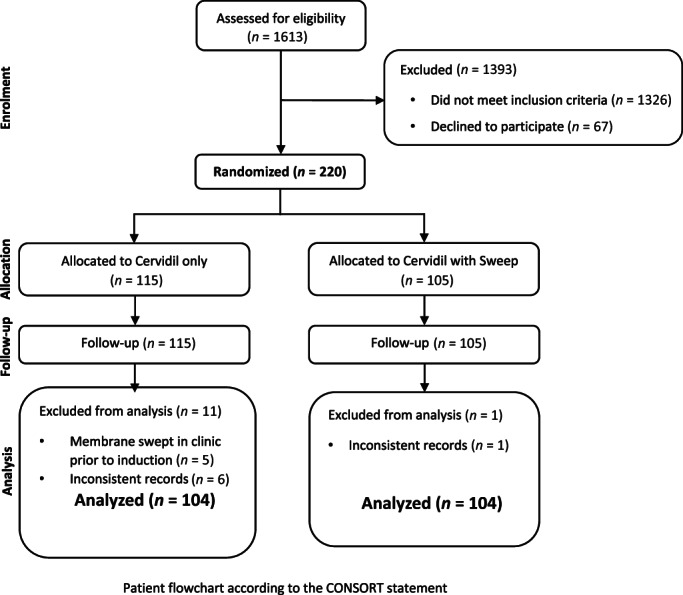
Results: One hundred and four received DVI (Group 1) alone and 104 DVI with ASM (Group 2). The rate of vaginal delivery within 24 h was 53% versus 56%, cesarean rate 8.7% versus 10.6% in Groups 1 and 2 respectively. Although the duration of labor was similar in both groups, about 6% of women required additional ripening with dinoprostone vaginal tablets in Group 2 compared to 11.5% in Group 1 (p-value = 0.2). The frequency of hyperstimulation syndrome, failed induction, analgesic requirements, and fetal outcomes were comparable. The majority (83%-86%) in either cohort were satisfied with their labor experience. Multivariate logistic regression demonstrated a slightly better chance for vaginal delivery within 24 h (odds ratio [OR] 1.22 [95% confidence interval, CI 0.65-2.29]; p-value 0.53] for DVI with ASM, although statistically insignificant. Younger maternal age and multiparity (OR 10.36 [95% CI 4.88-23.67]; p-value <0.0001) contributed to successful IOL.
Conclusion: DVI with ASM is at least as efficacious as DVI for cervical ripening with no increase in morbidity. Although DVI with ASM group less often needed additional dinoprostone tablets to complete the process of IOL (p-value = 0.2), adjunctive sweeping has not been shown to have a significant impact on the duration of labor or mode of delivery.
Keywords: cervical ripening; dinoprostone vaginal insert; hyperstimulation; labor induction; patient comfort; vaginal delivery.
© 2021 The Authors. Journal of Obstetrics and Gynaecology Research published by John Wiley & Sons Australia, Ltd on behalf of Japan Society of Obstetrics and Gynecology.
Conflict of interest statement
This study was funded by a commercial manufacturer of the dinoprostone slow release pessary product used for this study (Cervidil, Ferring, UK).
Figures
References
-
- EURO‐PERISTAT Project, with SCPE EUROCAT EURONEOSTAT . European Perinatal Health Report; data from 2004; 2008.
-
- Martin JA, Hamilton BE, Ventura SJ, Osterman MJK, Kirmeyer S, Mathews TJ, et al. Births: final data for 2009. Natl Vital Stat Rep. 2011;60:1–70. - PubMed
-
- The Health and Social Care Information Centre . NHS Maternity Statistics, England 2007–8; 2010. http://www.ic.nhs.uk/pubs/maternity0910
-
- Tenore JL. Methods for cervical ripening and induction of labor. Am Fam Physician. 2003;67:2123–8. - PubMed
MeSH terms
Substances
Grants and funding
LinkOut - more resources
Full Text Sources
