


Arts engagement supports social connectedness in adulthood: findings from the HEartS Survey
- PMID: 34162360
- PMCID: PMC8221987
- DOI: 10.1186/s12889-021-11233-6
Arts engagement supports social connectedness in adulthood: findings from the HEartS Survey
Abstract
Background: Loneliness is a public health challenge, associated with premature mortality and poorer health outcomes. Social connections can mitigate against loneliness, and there is evidence that the arts can support social connectedness. However, existing research on the arts and social connectedness is limited by focus on particular age groups and arts activities, as well as a reliance on typically small-scale studies.
Methods: This study reports survey data from 5892 adults in the United Kingdom, closely matched to the national profile in terms of sociodemographic and economic characteristics. It investigates the extent to which arts engagement is perceived to be linked with feelings of social connectedness, which forms of arts engagement are reported as most connecting, and how. Data were collected via the HEartS Survey, a newly designed tool to capture arts engagement in the United Kingdom and its associations with social and mental health outcomes. Demographic and quantitative data, pertaining to the extent to which arts engagement is perceived to be linked with social connectedness, were analysed descriptively. Qualitative data pertaining to respondents' perceptions of how arts engagement is linked with feelings of social connectedness were analysed using inductive thematic analysis.
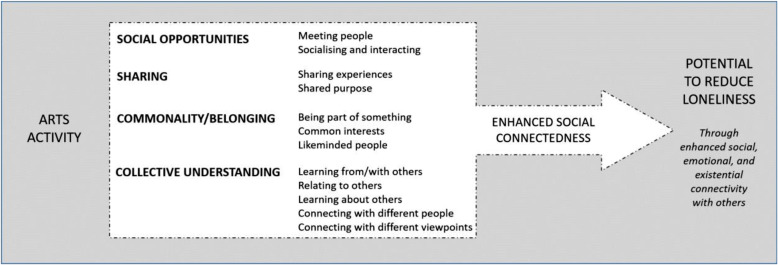
Results: Results demonstrated that the majority of respondents (82%) perceive their arts engagement to be linked with feelings of social connectedness at least some of the time. The forms of arts engagement most linked with feelings of social connectedness were attending a live music performance, watching a live theatre performance, and watching a film or drama at the cinema or other venue. Four overarching themes characterise how arts engagement is perceived to facilitate feelings of social connectedness: social opportunities, sharing, commonality and belonging, and collective understanding.
Conclusions: The findings suggest that arts engagement can support social connectedness among adults in the UK through multiple pathways, providing large-scale evidence of the important role that the arts can play in supporting social public health.
Keywords: Arts; Loneliness; Qualitative; Social connectedness; Social wellbeing; Survey.
Conflict of interest statement
The authors declare that they have no competing interests.
Figures
References
-
- Victor C, et al. An overview of reviews: the effectiveness of interventions to address loneliness at all stages of the life-course. What Works Wellbeing. 2018. p. 1–87.
-
- Weiss R. Loneliness: The experience of emotional and social isolation. Cambridge: MIT Press; 1973.
Publication types
MeSH terms
LinkOut - more resources
Full Text Sources
