Review
. 2022 Jan;27(1):731-743.
doi: 10.1038/s41380-021-01196-w. Epub 2021 Jun 23.

Aberrant maturation and connectivity of prefrontal cortex in schizophrenia-contribution of NMDA receptor development and hypofunction

Affiliations
Review

Aberrant maturation and connectivity of prefrontal cortex in schizophrenia-contribution of NMDA receptor development and hypofunction

Wen-Jun Gao et al. Mol Psychiatry. 2022 Jan.

Abstract

The neurobiology of schizophrenia involves multiple facets of pathophysiology, ranging from its genetic basis over changes in neurochemistry and neurophysiology, to the systemic level of neural circuits. Although the precise mechanisms associated with the neuropathophysiology remain elusive, one essential aspect is the aberrant maturation and connectivity of the prefrontal cortex that leads to complex symptoms in various stages of the disease. Here, we focus on how early developmental dysfunction, especially N-methyl-D-aspartate receptor (NMDAR) development and hypofunction, may lead to the dysfunction of both local circuitry within the prefrontal cortex and its long-range connectivity. More specifically, we will focus on an "all roads lead to Rome" hypothesis, i.e., how NMDAR hypofunction during development acts as a convergence point and leads to local gamma-aminobutyric acid (GABA) deficits and input-output dysconnectivity in the prefrontal cortex, which eventually induce cognitive and social deficits. Many outstanding questions and hypothetical mechanisms are listed for future investigations of this intriguing hypothesis that may lead to a better understanding of the aberrant maturation and connectivity associated with the prefrontal cortex.


Conflict of interest statement

Conflict of Interest

The authors declare no competing financial interests.

Figures
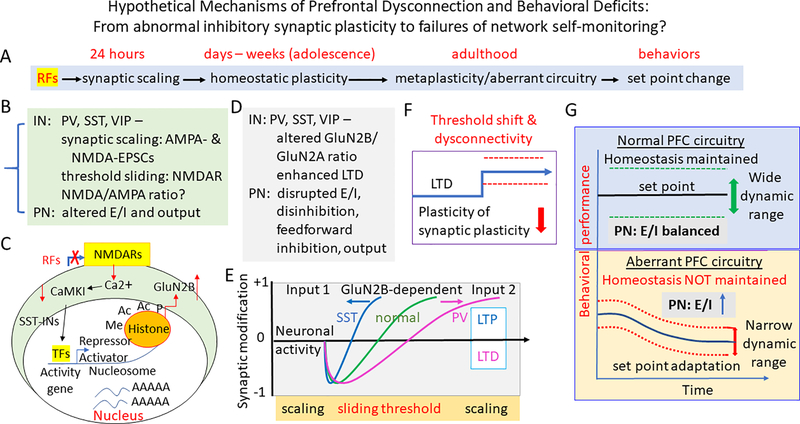
Box 1_Figure 5.
Box 1_Figure 5.
A summary illustration of the perspective mechanisms associated with dysconnectivity and behavioral deficits – from abnormal synaptic function and plasticity to failures of self-monitoring. A, Timeline of synaptic- and circuit-specific alterations and behavioral changes during developmental dysconnectivity. B-G, In response to normal and abnormal stimulation, synapses mediating local and long-range connections between different cell types exhibit sequential alterations through different mechanisms during development. B & C, The immediate responses (within 24 hours) to risk factors (RFs) are associated with both translational and posttranslational modifications such as receptor trafficking (B) related to epigenetic regulation (e.g., epigenetic histone acetylation, methylation, phosphorylation via activator or repressor) (C) , , resulting in changes in excitatory synaptic strength/synaptic scaling of both AMPA- & NMDA-EPSCs , in prefrontal neurons which consequently disrupts E/I balance in the local prefrontal circuit. D & E, Later on, especially during adolescent development, NMDAR subunit-dependent homeostatic plasticity in inhibitory neurons occurs in cell-type and input-specific manner through a sliding threshold mechanism , , such as differential LTP induction in SST vs. LTD PV cells, respectively. NMDAR hypofunction would weaken or disrupt both normal Hebbian plasticity between prefrontal interneurons and long-range afferents, meanwhile reshape the homeostatic plasticity in the mPFC and its connections with downstream targets. F, These homeostatic changes in plasticity (as described in D & E), in turn, induce threshold shift and/or disconnectivity, resulting in a reduced metaplasticity , . G, Consequently, an aberrant local circuit and dysfunctional connections are formed, a new set point with a narrower dynamic range for information is adopted, and abnormal behavioral changes follow under an aberrant connectivity condition , . IN: interneuron; PN: pyramidal neuron; PPF: paired-pulse facilitation; PPD: paired-pulse depression; RFs: regulatory factors; TFs: transcription factors.
Figure 1.
Figure 1.
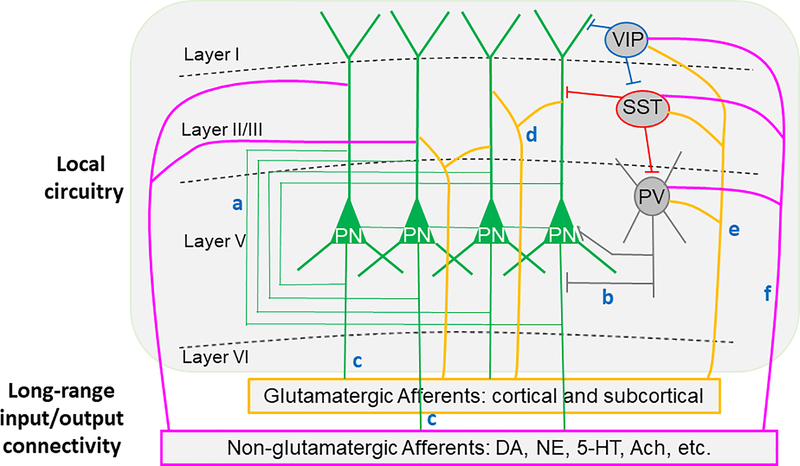
Illustration showing the simplified local prefrontal circuitry and long-range input/output connectivity. The excitatory glutamatergic pyramidal cells connect to each other to form recurrent excitation (a) and innervate GABAergic interneurons to form feedback inhibition (b). The pyramidal neurons project to other cortical and subcortical regions to form corticocortical connections and subcortical regions as descending innervations (c). In turn, local prefrontal circuitry, including both pyramidal neurons and GABAergic cells are also innervated by cortical and subcortical excitatory glutamatergic inputs (green) to form forward excitation (d) and feedforward inhibition (e). Both pyramidal neurons and GABAergic interneurons are also regulated by subcortical non-glutamatergic neuromodulatory afferents (red) from the dopamine (DA), norepinephrine (NE), serotonin (5-HT), and acetylcholine (Ach) cells. Despite these seemingly clear connections, exactly how they interact to affect PFC-associated functions remains to be determined. There are also many unknowns among these connections, and their roles in behavioral deficits associated with SZ symptoms.
Figure 2.
Figure 2.
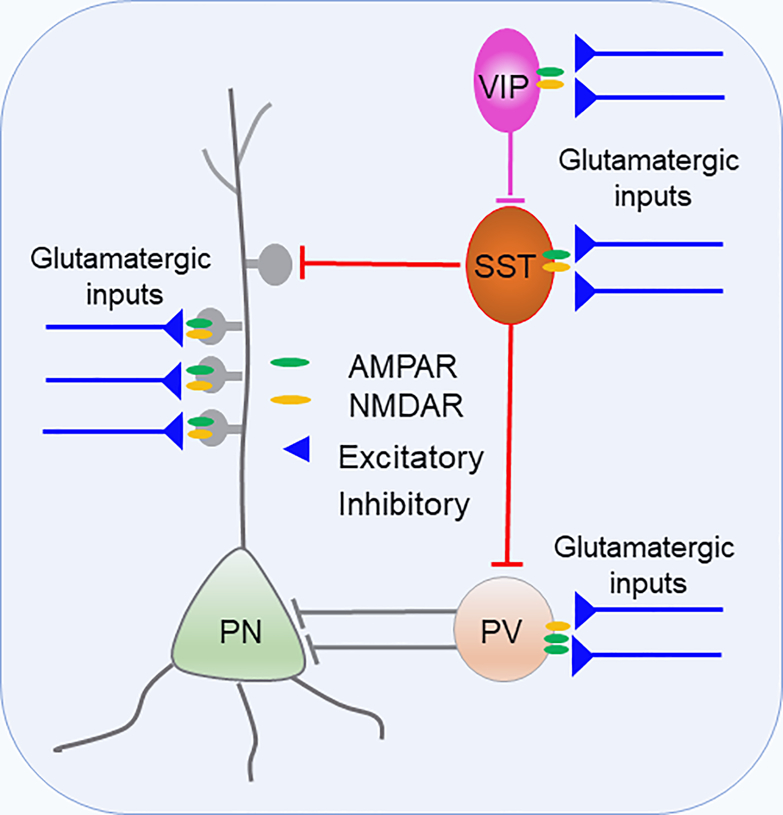
Prefrontal local circuit. Glutamatergic afferents innervate both excitatory pyramidal neurons (PN) and inhibitory GABAergic IN subtypes . These inputs are capable to generate diverse feedforward control on the prefrontal local network through PV-, SST, or VIP-INs. PV-INs express relatively low levels of NMDARs , –, and they are enriched with GluN2A subunit . In contrast, SST- and VIP-INs express relatively more NMDARs and are enriched with GluN2B subunits .
Figure 3.
Figure 3.
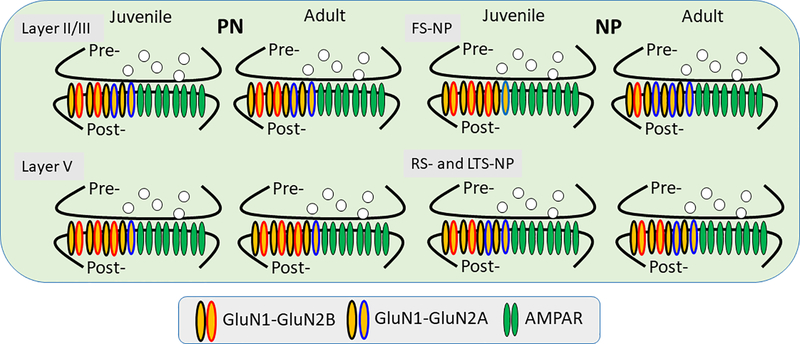
Schematic model showing the development of NMDAR subunits in different types of PFC neurons. Layer II/III pyramidal neurons (PN) exhibit equal amount of GluN2A and GluN2B subunits, whereas layer V pyramidal neurons expresses more GluN2B subunits during the juvenile to adulthood development. In contrast, in the GABAergic interneurons (non-pyramidal neurons (NP), fast-spiking (FS) interneurons exhibits clear GluN2B-to-GluN2A subunit switch whereas regular spiking (RS) and low-threshold spiking (LTS) interneurons exhibit similar NMDAR subunit expression to the layer II/III pyramidal neurons. In summary, except a subset of FS-NPs, which show a sharp increase of GluN2A and decrease of GluN2B, all other cells exhibit no GluN2B-to-GluN2A switch during postnatal development, differing from other brain regions , , , .
Figure 4.
Figure 4.
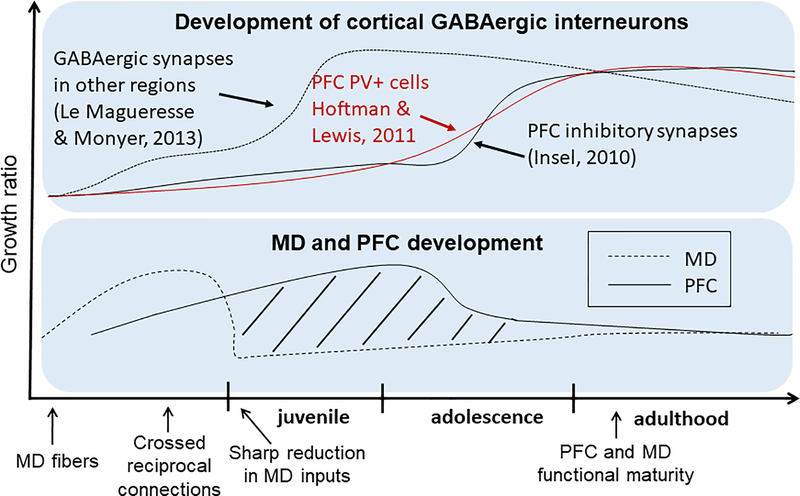
Developmental trajectory of cortical GABAergic interneurons and maturation of MD and PFC. Upper panel: Distinct developmental trajectories of GABAergic inhibitory synapses and PV+ cells in the PFC (red and black lines) vs other brain regions (dashed line) , , . Lower panel: MD afferent density (dashed line) and volume of the PFC (solid line). Dashed lines represent the different developmental window between MD activity and PFC function. Lower panel is modified from , and copyright is permitted for reuse of the figure.

References

    1. Lewis DA, Hashimoto T, Volk DW. Cortical inhibitory neurons and schizophrenia. Nature Rev Neurosci 2005; 6(4): 312–324. - PubMed
    1. Tamminga CA, Thaker GK, Buchanan R, Kirkpatrick B, Alphs LD, Chase TN et al. Limbic System Abnormalities Identified in Schizophrenia Using Positron Emission Tomography With Fluorodeoxyglucose and Neocortical Alterations With Deficit Syndrome. Archives of General Psychiatry 1992; 49(7): 522–530. - PubMed
    1. Anticevic A, Cole MW, Murray JD, Corlett PR, Wang X-J, Krystal JH. The role of default network deactivation in cognition and disease. Trends in cognitive sciences 2012; 16(12): 584–592. - PMC - PubMed
    1. Anticevic A, Corlett PR, Cole MW, Savic A, Gancsos M, Tang Y et al. N-Methyl-D-Aspartate receptor antagonist effects on prefrontal cortical connectivity better model early than chronic schizophrenia. Biological psychiatry 2014; 77(6): 569–580. - PubMed
    1. Anticevic A, Haut K, Murray JD, Repovs G, Yang GJ, Diehl C et al. Association of thalamic dysconnectivity and conversion to psychosis in youth and young adults at elevated clinical risk. JAMA psychiatry 2015; 72(9): 882–891. - PMC - PubMed

Publication types

MeSH terms

Substances