. 2021 May 4;12(21):7533-7546.
doi: 10.1039/d1sc01146d.

Total synthesis, isolation, surfactant properties, and biological evaluation of ananatosides and related macrodilactone-containing rhamnolipids

Affiliations

Total synthesis, isolation, surfactant properties, and biological evaluation of ananatosides and related macrodilactone-containing rhamnolipids

Maude Cloutier et al. Chem Sci. .

Abstract

Rhamnolipids are a specific class of microbial surfactants, which hold great biotechnological and therapeutic potential. However, their exploitation at the industrial level is hampered because they are mainly produced by the opportunistic pathogen Pseudomonas aeruginosa. The non-human pathogenic bacterium Pantoea ananatis is an alternative producer of rhamnolipid-like metabolites containing glucose instead of rhamnose residues. Herein, we present the isolation, structural characterization, and total synthesis of ananatoside A, a 15-membered macrodilactone-containing glucolipid, and ananatoside B, its open-chain congener, from organic extracts of P. ananatis. Ananatoside A was synthesized through three alternative pathways involving either an intramolecular glycosylation, a chemical macrolactonization or a direct enzymatic transformation from ananatoside B. A series of diasteroisomerically pure (1→2), (1→3), and (1→4)-macrolactonized rhamnolipids were also synthesized through intramolecular glycosylation and their anomeric configurations as well as ring conformations were solved using molecular modeling in tandem with NMR studies. We show that ananatoside B is a more potent surfactant than its macrolide counterpart. We present evidence that macrolactonization of rhamnolipids enhances their cytotoxic and hemolytic potential, pointing towards a mechanism involving the formation of pores into the lipidic cell membrane. Lastly, we demonstrate that ananatoside A and ananatoside B as well as synthetic macrolactonized rhamnolipids can be perceived by the plant immune system, and that this sensing is more pronounced for a macrolide featuring a rhamnose moiety in its native 1 C 4 conformation. Altogether our results suggest that macrolactonization of glycolipids can dramatically interfere with their surfactant properties and biological activity.


Conflict of interest statement

There are no conflicts to declare.

Figures
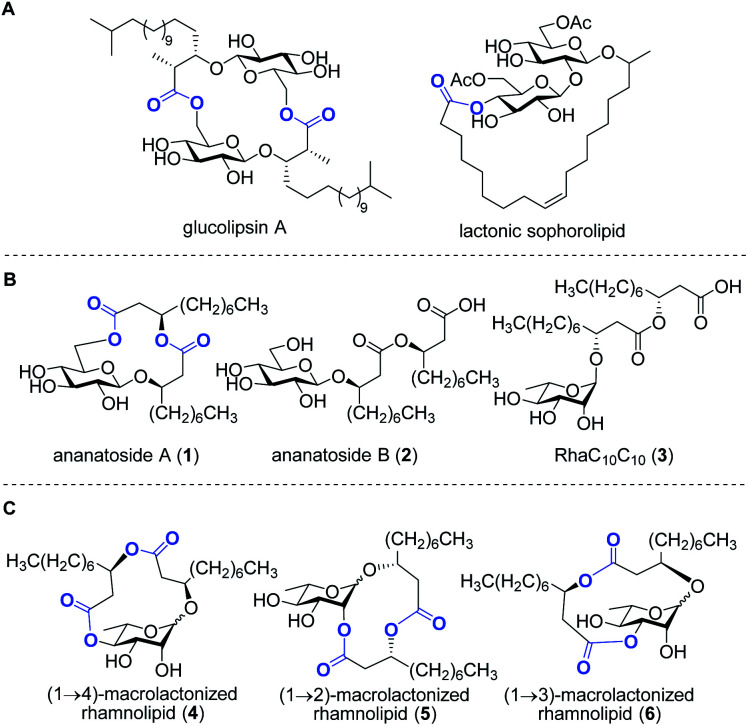
Fig. 1
Fig. 1. Examples of macrolactone-containing glucolipids produced by microbes (A); structures of target ananatoside A (1) and ananatoside B (2) produced by Pantoea ananatis along with the related RhaC10C10 (3) (B); structures of target macrodilactone-containing rhamnolipids 4–6 (C). Lactone functionalities are highlighted in blue.
Fig. 2
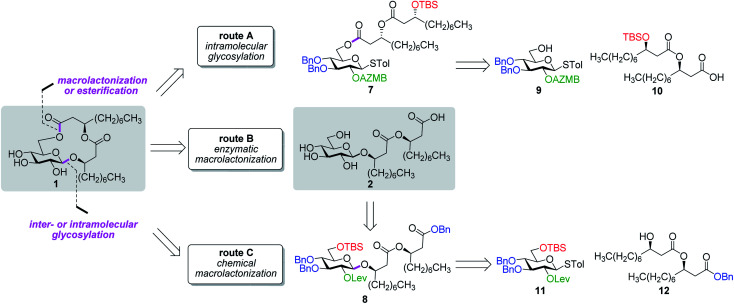
Fig. 2. Retrosynthetic disconnection strategy for the total synthesis of ananatoside A (1) and ananatoside B (2) according to three different pathways: chemical macrolactonization, enzymatic macrolactonization, and inter- or intramolecular glycosylation. AZMB: 2-azidomethylbenzoyl; Bn: benzyl; Lev: levulinoyl; STol: thiotolyl; TBS: tert-butyldimethylsilyl. Blue: permanent protecting groups (Bn); red: temporary protecting groups (TBS); green: esters used as temporary protecting groups enabling neighboring group participation (AZMB and Lev).
Scheme 1
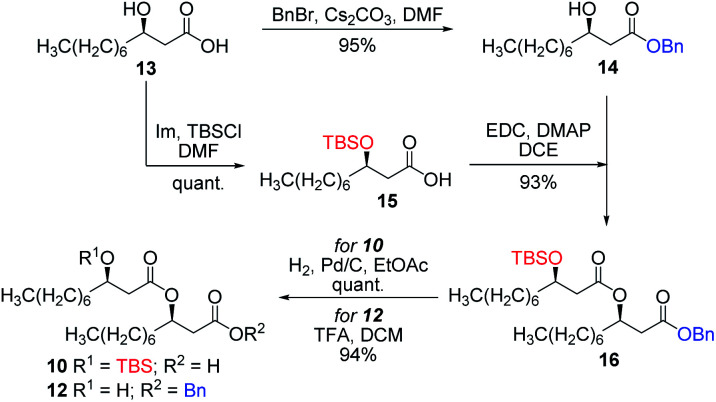
Scheme 1. Synthesis of β-hydroxydecanoic acid derivatives.
Scheme 2
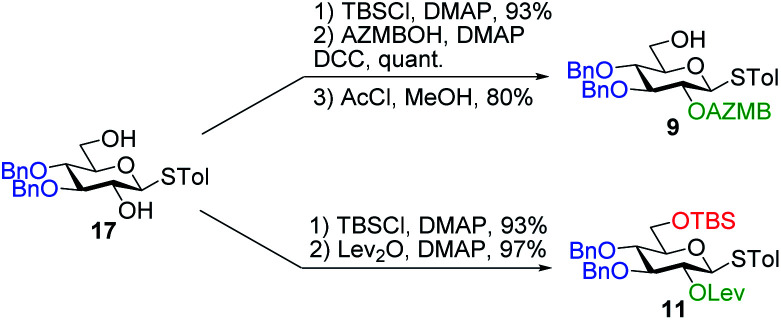
Scheme 2. Synthesis of thioglucoside derivatives 9 and 11.
Scheme 3
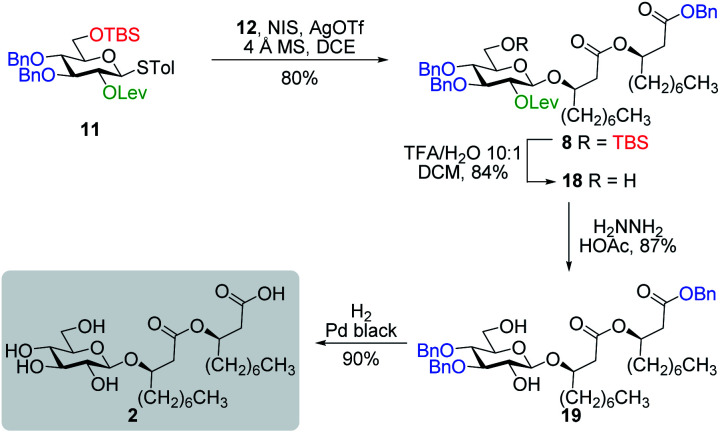
Scheme 3. Total synthesis of ananatoside B.
Scheme 4
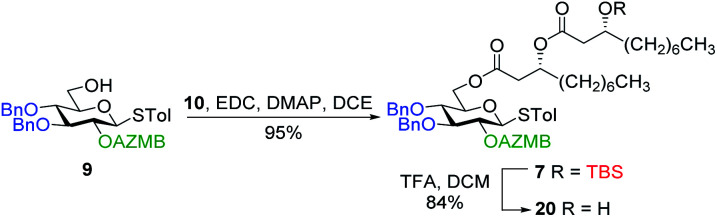
Scheme 4. Synthesis of alcohol 20 ready for intramolecular glycosylation.
Scheme 5
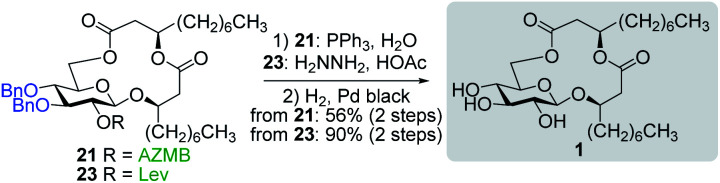
Scheme 5. Deprotection of macrolides 21 and 23 into ananatoside A (1).
Fig. 3
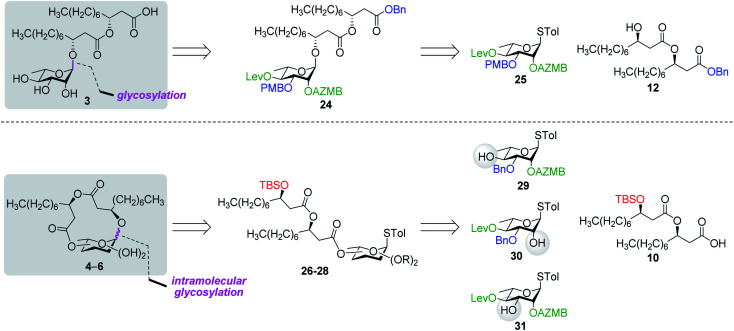
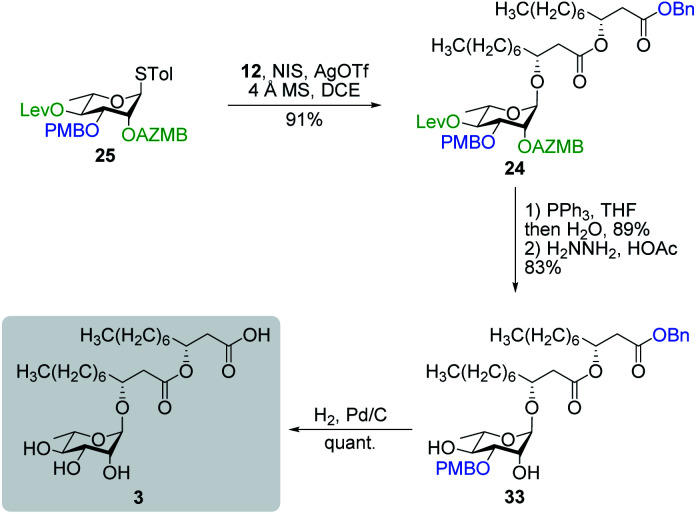
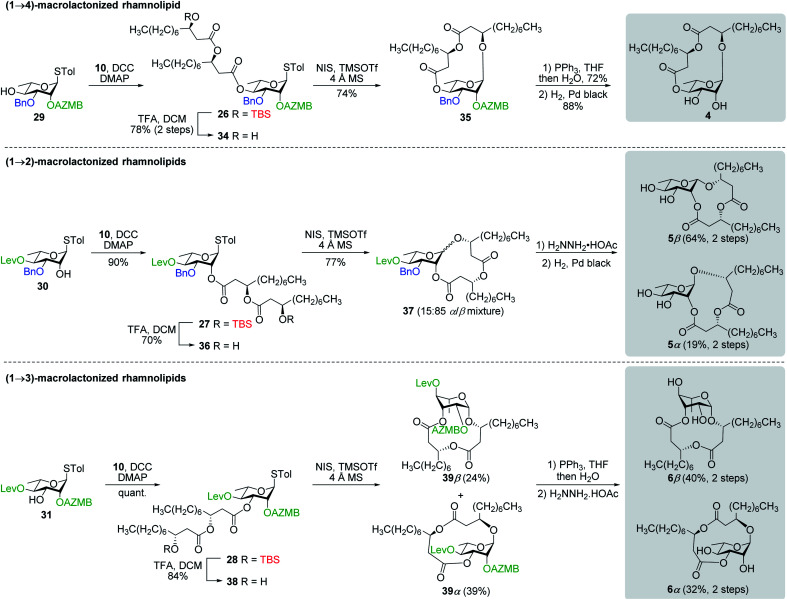
Fig. 3. Retrosynthetic analysis of rhamnolipid 3 and macrodilactone-containing rhamnolipids 4–6. PMB: para-methoxybenzyl. Blue: permanent protecting groups (Bn and PMB); red: temporary protecting groups (TBS); green: esters used as temporary protecting groups enabling neighboring group participation when branched at C2 (AZMB and Lev).
Scheme 6
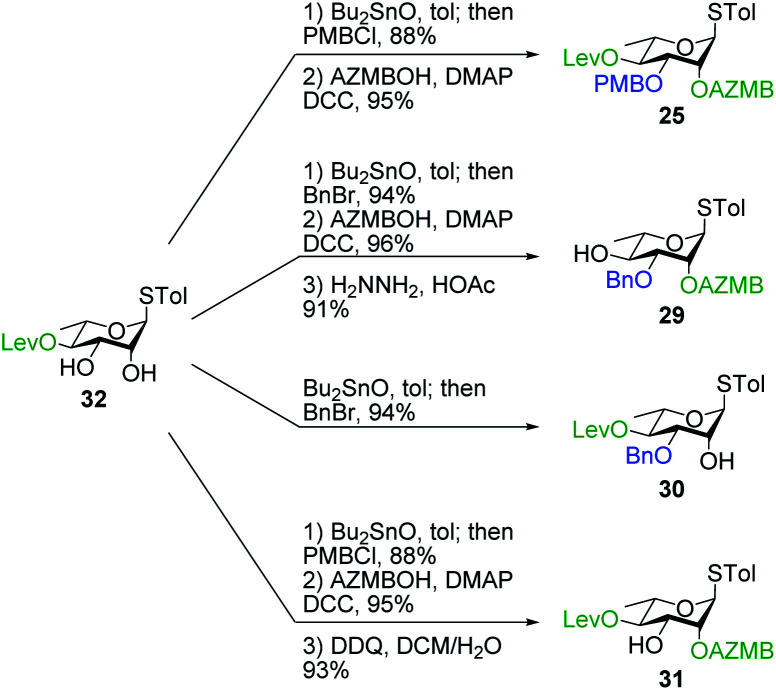
Scheme 6. Synthesis of thiorhamnoside building blocks 25, 29, 30, and 31.
Scheme 7
Scheme 7. Total synthesis of RhaC10C10 (3).
Scheme 8
Scheme 8. Synthesis of (1→4), (1→2), and (1→3)-macrolactonized rhamnolipids 4–6.
Fig. 4
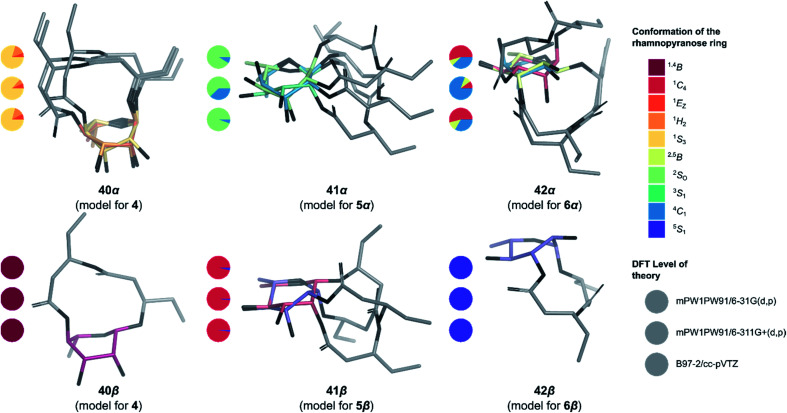
Fig. 4. 3D Structure of the macrolactonized rhamnolipids models 40–42. Only the most stable structure of each conformer is depicted. Pie chart gives Boltzmann population for standard six-membered ring for the three levels of theory used in this study (from top to bottom: mPW1PW91/6-31G(d,p), mPW1PW91/6-311+G(d,p) and B97-2/pVTZ).
Fig. 5
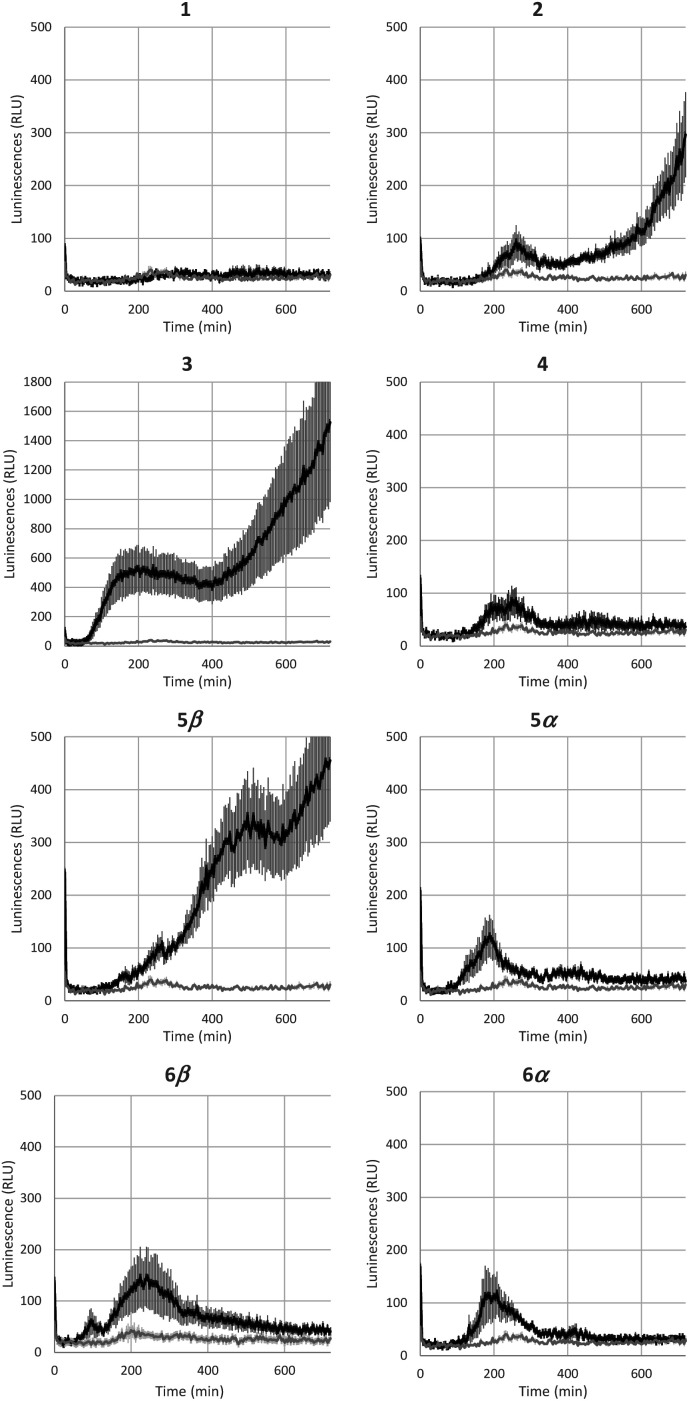
Fig. 5. Extracellular reactive oxygen species (ROS) production following treatment of tomato leaf disks with ananatoside A (1), ananatoside B (2), RhaC10C10 (3), and related macrodilactone-containing rhamnolipids (4–6). Production of ROS was measured in tomato leaf disks following treatment at 100 μM with synthetic glycolipids (1–6). MeOH (0.5%) was used as a control. ROS production was measured using the chemiluminescence of luminol and photon counts were expressed as relative luminescence units (RLUs). Data are mean ± SEM (n = 6). Experiments were independently realized three times with similar results.

References

    1. Bérces A. Whitfield D. M. Nukada T. Tetrahedron. 2001;57:477–491.
    1. Elshahawi S. I. Shaaban K. A. Kharel M. K. Thorson J. S. Chem. Soc. Rev. 2015;44:7591–7697. - PMC - PubMed
    1. Mnif I. Ghribi D. J. Sci. Food Agric. 2016;96:4310–4320. - PubMed
    1. Inès M. Dhouha G. Carbohydr. Res. 2015;416:59–69. - PubMed
    1. Saravanakumari P. Mani K. Bioresour. Technol. 2010;101:8851–8854. - PubMed