. 2021 Jan 4;12(6):2146-2155.
doi: 10.1039/d0sc06327d.

Unraveling the surface glycoprotein interaction network by integrating chemical crosslinking with MS-based proteomics

Affiliations

Unraveling the surface glycoprotein interaction network by integrating chemical crosslinking with MS-based proteomics

Fangxu Sun et al. Chem Sci. .

Abstract

The cell plasma membrane provides a highly interactive platform for the information transfer between the inside and outside of cells. The surface glycoprotein interaction network is extremely important in many extracellular events, and aberrant protein interactions are closely correlated with various diseases including cancer. Comprehensive analysis of cell surface protein interactions will deepen our understanding of the collaborations among surface proteins to regulate cellular activity. In this work, we developed a method integrating chemical crosslinking, an enzymatic reaction, and MS-based proteomics to systematically characterize proteins interacting with surface glycoproteins, and then constructed the surfaceome interaction network. Glycans covalently bound to proteins were employed as "baits", and proteins that interact with surface glycoproteins were connected using chemical crosslinking. Glycans on surface glycoproteins were oxidized with galactose oxidase (GAO) and sequentially surface glycoproteins together with their interactors ("prey") were enriched through hydrazide chemistry. In combination with quantitative proteomics, over 300 proteins interacting with surface glycoproteins were identified. Many important domains related to extracellular events were found on these proteins. Based on the protein-protein interaction database, we constructed the interaction network among the identified proteins, in which the hub proteins play more important roles in the interactome. Through analysis of crosslinked peptides, specific interactors were identified for glycoproteins on the cell surface. The newly developed method can be extensively applied to study glycoprotein interactions on the cell surface, including the dynamics of the surfaceome interactions in cells with external stimuli.


Conflict of interest statement

The authors declare no competing interests.

Figures
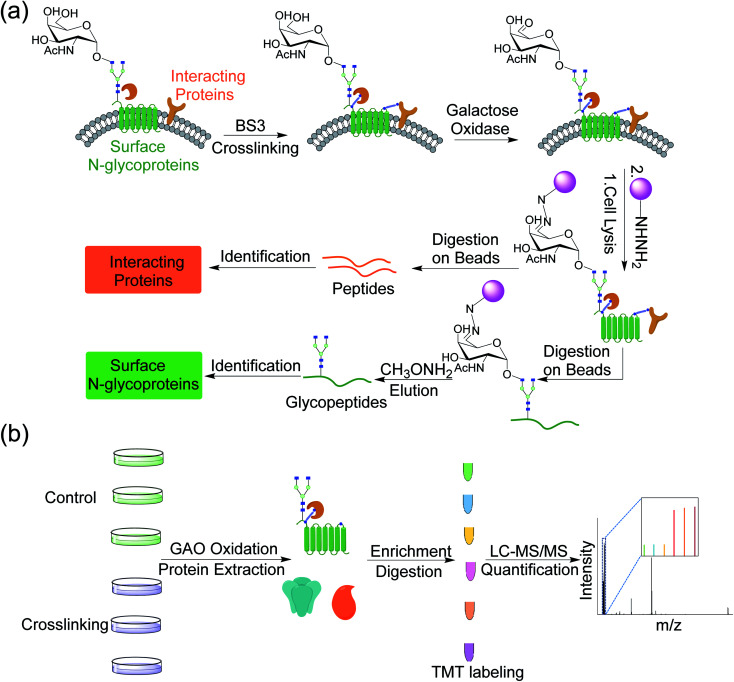
Fig. 1
Fig. 1. (a) Experimental procedure for investigating the cell surface glycoprotein interactions by integrating chemical crosslinking, an enzymatic reaction, and MS-based proteomics. (b) Detailed procedure for identification and quantification of proteins interacting with surface glycoproteins using multiplexed MS-based proteomics.
Fig. 2
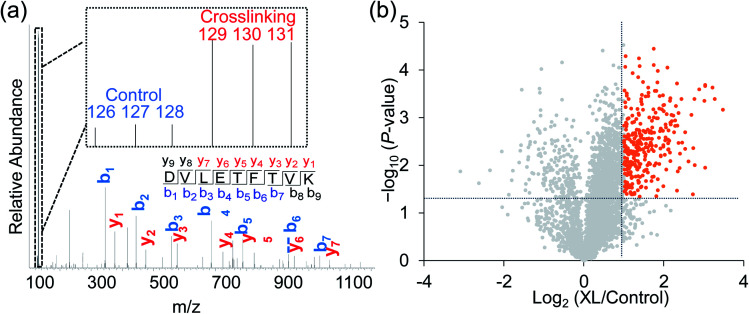
Fig. 2. (a) Identification and quantification of an example peptide. The inset shows the TMT reporter ion intensities, which are used for the quantification. (b) Volcano plot illustrating proteins with statistically significant abundance differences between the crosslinking and control samples. Significant differences are defined with the abundance change >2 fold and the P value <0.05.
Fig. 3
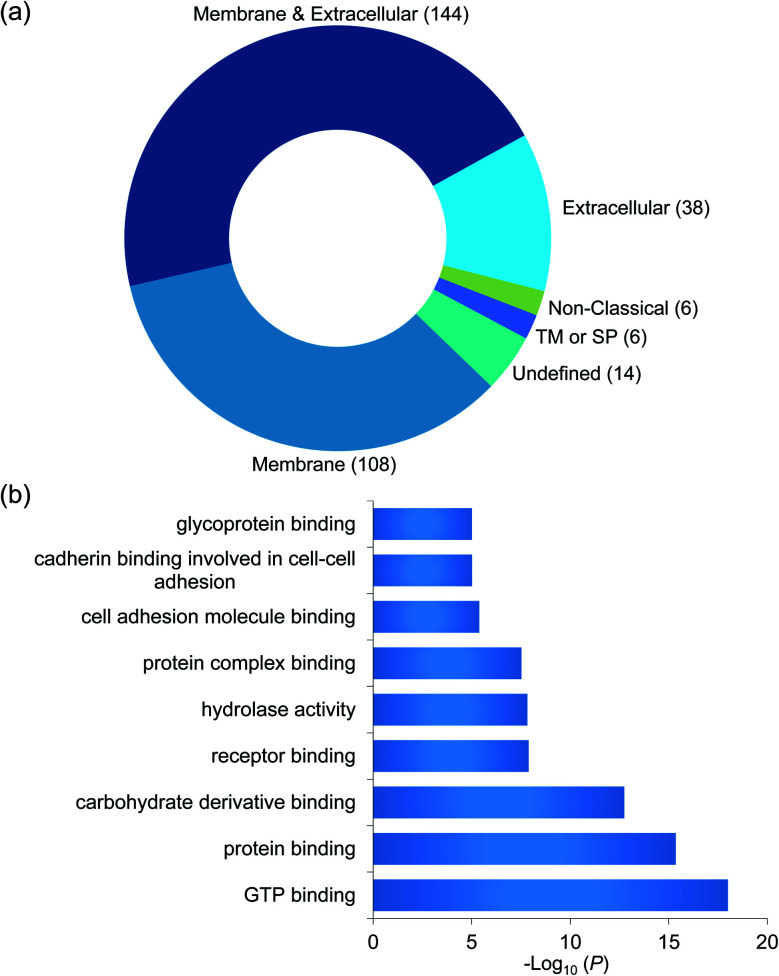
Fig. 3. (a) Classification of the identified proteins interacting with surface glycoproteins based on cellular component. (b) Clustering of the identified proteins based on molecular function.
Fig. 4
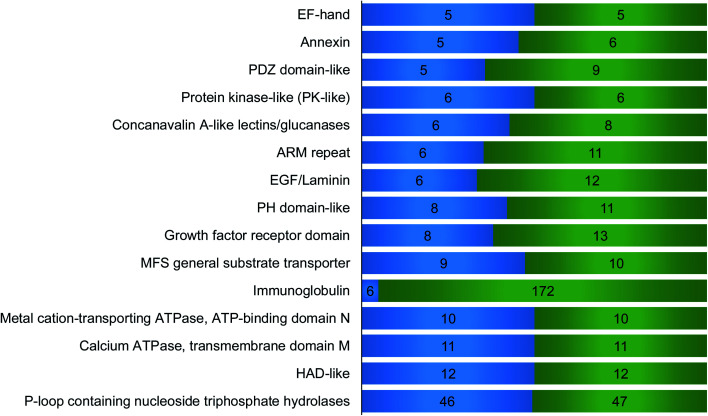
Fig. 4. Domain analysis for the identified proteins that interacted with surface glycoproteins. The number of proteins containing each domain is on the left side and the total hit number of each domain is on the right. For example, 6 proteins contain immunoglobulin (Ig) domain, and in total, these proteins have 172 Ig domains. The domains appeared in at least five proteins are shown here.
Fig. 5
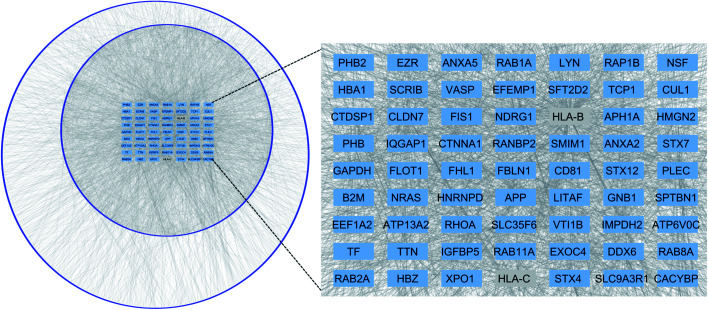
Fig. 5. Interaction network of the identified proteins that interacted with surface glycoproteins. All the interactions were downloaded from the IntAct database and visualized by Cytoscape. The proteins with ≥20 interactions were enlarged. The proteins that overlap with those interacting with surface glycoproteins identified in this work are shown in blue and the rest are in gray.
Fig. 6
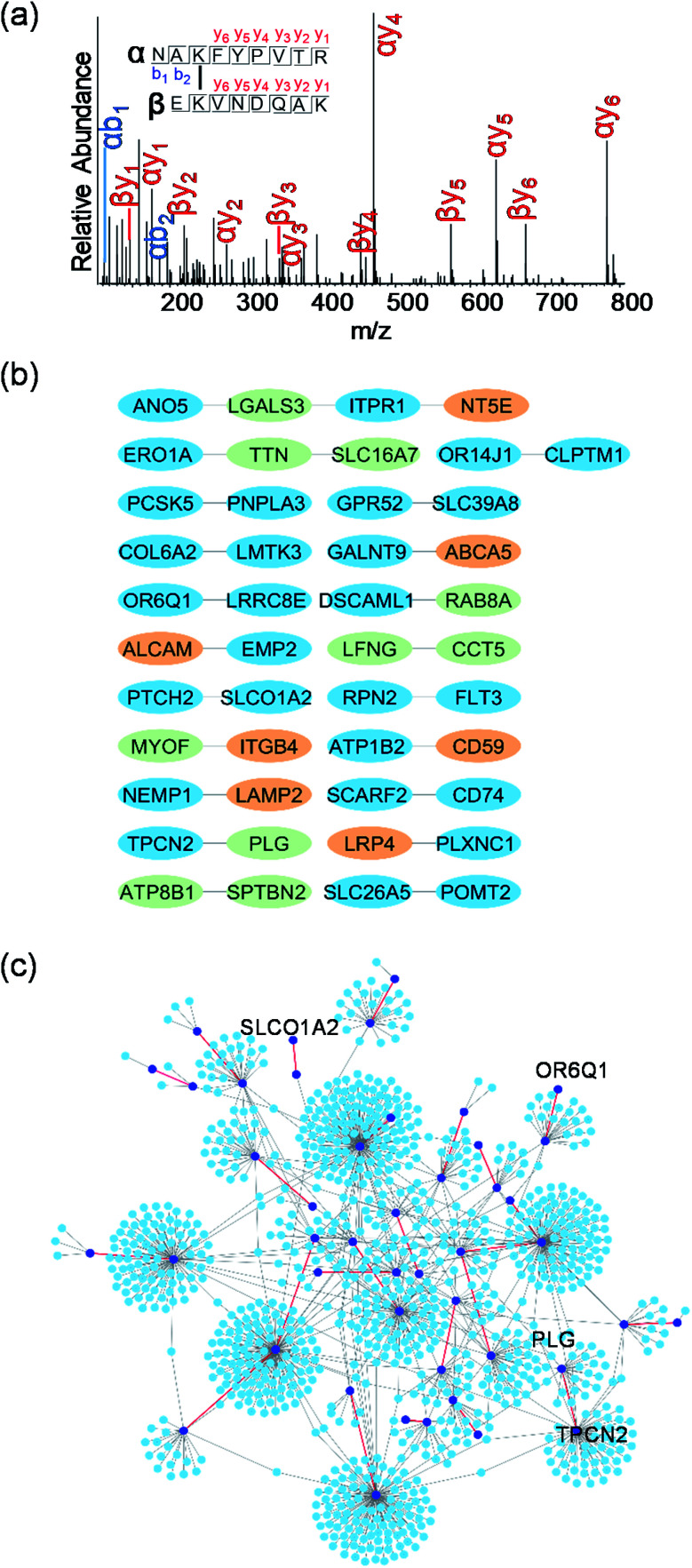
Fig. 6. (a) An example tandem MS of the crosslinked peptide, NAKFYPVTR(3)-EKVNDQAK(2). (b) Some protein–protein interactions based on the identified crosslinked peptides. The proteins also found in the data set of the surface glycoprotein interactors from quantitative proteomics were colored in light green and proteins from the data set of surface glycoproteins identified in this work were in orange. (c) Protein–protein interaction network constructed from the IntAct database. Proteins identified based on the crosslinked peptides were in dark blue and the remaining proteins from IntAct were in light blue. The identified interactions were colored in red and the known interactions from IntAct were in gray.

References

    1. Uings I. J. Farrow S. N. Mol. Pathol. 2000;53:295–299. doi: 10.1136/mp.53.6.295. - DOI - PMC - PubMed
    1. Venkatakrishnan V. Packer N. H. Thaysen-Andersen M. Expert Rev. Respir. Med. 2013;7:553–576. doi: 10.1586/17476348.2013.837752. - DOI - PubMed
    1. Martinez-Martin N. Ramani S. R. Hackney J. A. Tom I. Wranik B. J. Chan M. Wu J. Paluch M. T. Takeda K. Hass P. E. Clark H. Gonzalez L. C. Nat. Commun. 2016;7:11473. doi: 10.1038/ncomms11473. - DOI - PMC - PubMed
    1. Maurel D. Comps-Agrar L. Brock C. Rives M.-L. Bourrier E. Ayoub M. A. Bazin H. Tinel N. Durroux T. Prézeau L. Trinquet E. Pin J.-P. Nat. Methods. 2008;5:561–567. doi: 10.1038/nmeth.1213. - DOI - PMC - PubMed
    1. Papin J. A. Hunter T. Palsson B. O. Subramaniam S. Nat. Rev. Mol. Cell Biol. 2005;6:99–111. doi: 10.1038/nrm1570. - DOI - PubMed