Review
. 2021 Jun 18;11(6):161-179.
doi: 10.5500/wjt.v11.i6.161.

Pediatric metabolic liver diseases: Evolving role of liver transplantation

Affiliations
Review

Pediatric metabolic liver diseases: Evolving role of liver transplantation

Jagadeesh Menon et al. World J Transplant. .

Abstract

Metabolic liver diseases (MLD) are the second most common indication for liver transplantation (LT) in children. This is based on the fact that the majority of enzymes involved in various metabolic pathways are present within the liver and LT can cure or at least control the disease manifestation. LT is also performed in metabolic disorders for end-stage liver disease, its sequelae including hepatocellular cancer. It is also performed for preventing metabolic crisis', arresting progression of neurological dysfunction with a potential to reverse symptoms in some cases and for preventing damage to end organs like kidneys as in the case of primary hyperoxalosis and methyl malonic acidemia. Pathological findings in explant liver with patients with metabolic disease include unremarkable liver to steatosis, cholestasis, inflammation, variable amount of fibrosis, and cirrhosis. The outcome of LT in metabolic disorders is excellent except for patients with mitochondrial disorders where significant extrahepatic involvement leads to poor outcomes and hence considered a contraindication for LT. A major advantage of LT is that in the post-operative period most patients can discontinue the special formula which they were having prior to the transplant and this increases their well-being and improves growth parameters. Auxiliary partial orthotopic LT has been described for patients with noncirrhotic MLD where a segmental graft is implanted in an orthotopic position after partial resection of the native liver. The retained native liver can be the potential target for future gene therapy when it becomes a clinical reality.

Keywords: Auxiliary liver transplant; Glycogen storage diseases; Liver transplantation; Metabolic liver disease; Pathology; Tyrosinemia; Urea cycle disorders; Wilson disease.


Conflict of interest statement

Conflict-of-interest statement: The author(s) declared no potential conflicts of interest with respect to the research, authorship, and/or publication of this article.

Figures
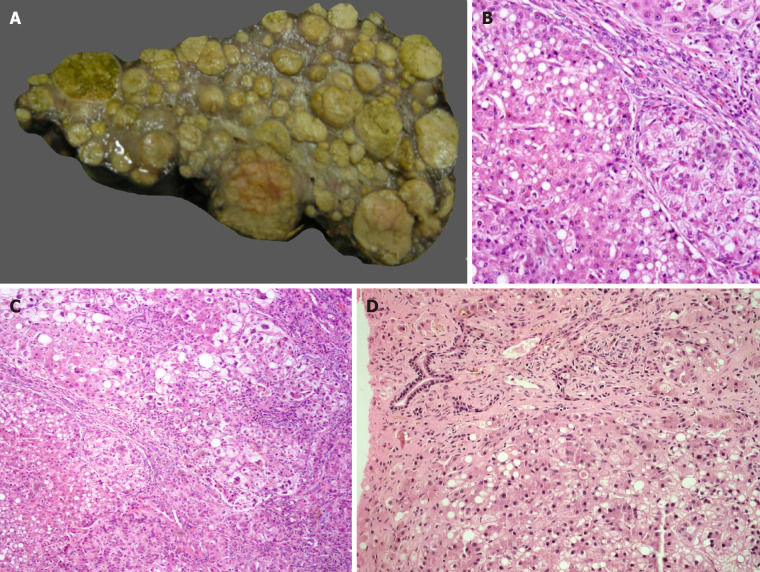
Figure 1
Figure 1
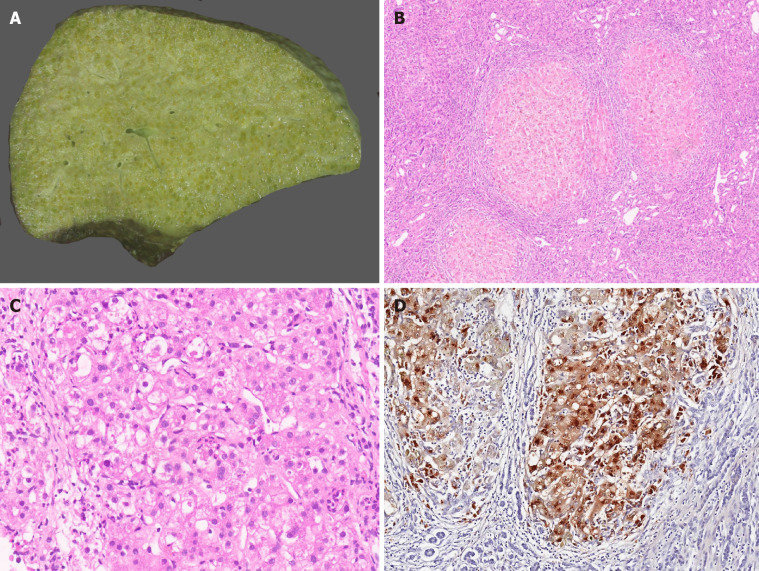
Metabolic liver disease. A: Explant liver specimen of a case of tyrosinemia with nodules of varying sizes; B: Tyrosinemia liver with steatosis [hematoxylin and eosin (HE staining)]; C: Tyrosinemia liver with cirrhosis, hepatocellular ballooning, and fatty change (HE staining); D: Galactosemia with bridging fibrosis, bile ductular reaction, fatty change and rosetting (HE staining).
Figure 2
Figure 2
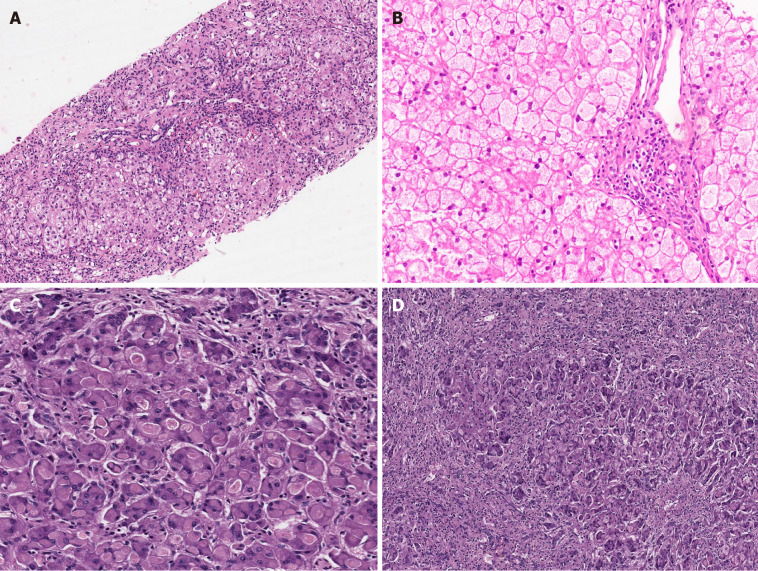
Wilson disease. A: Explant hepatectomy specimen in a case of Wilson disease (WD) with marked cholestasis; B: Micronodular cirrhosis in a case of WD [hematoxylin and eosin (HE staining)]; C: WD with hepatocellular ballooning, Mallory Denk bodies, fatty change and neutrophilic satellitosis (HE staining); and D: WD with marked copper deposition in hepatocytes and macrophages (Rhodanine staining).
Figure 3
Figure 3
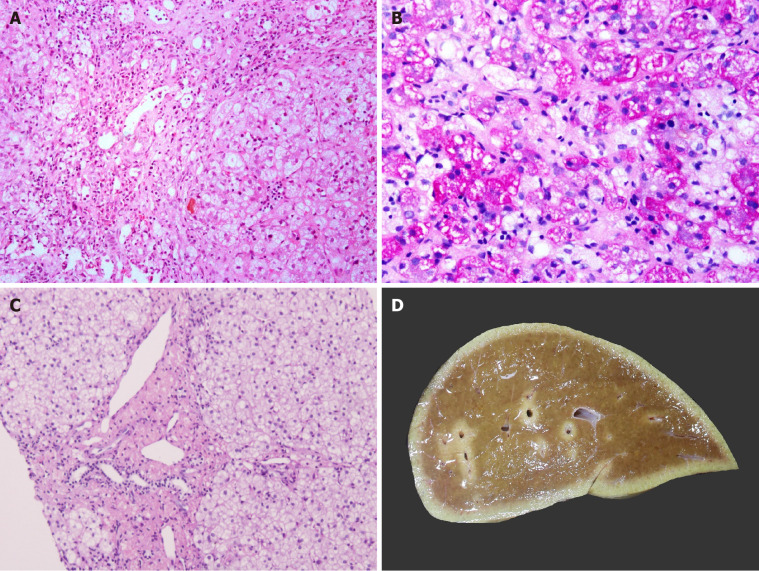
Metabolic liver disease. A: Hereditary Fructosemia with bridging fibrosis [hematoxylin and eosin (HE staining)]; B: Glycogen storage disorder (GSD) type III displaying pale enlarged hepatocytes with thickened borders and portal fibrosis (HE); C: GSD type IV liver eosinophilic ground glass cytoplasmic inclusions (HE); D: Explant liver in case of GSD type IV with extensive fibrosis (HE).
Figure 4
Figure 4
Metabolic liver disease. A: Niemann Pick disease with marked fibrosis [hematoxylin and eosin (HE staining)]; B: Pale-staining storage cell clusters as compared to deeply stained glycogen containing hepatocytes [Periodic acid Schiff (PAS) staining]; C: Cholesteryl ester storage disease liver with granular microphages in portal tract and finely vacuolated hepatocytes (HE staining); and D: Largely unremarkable explant liver in a patient with urea cycle defect.
Figure 5
Figure 5
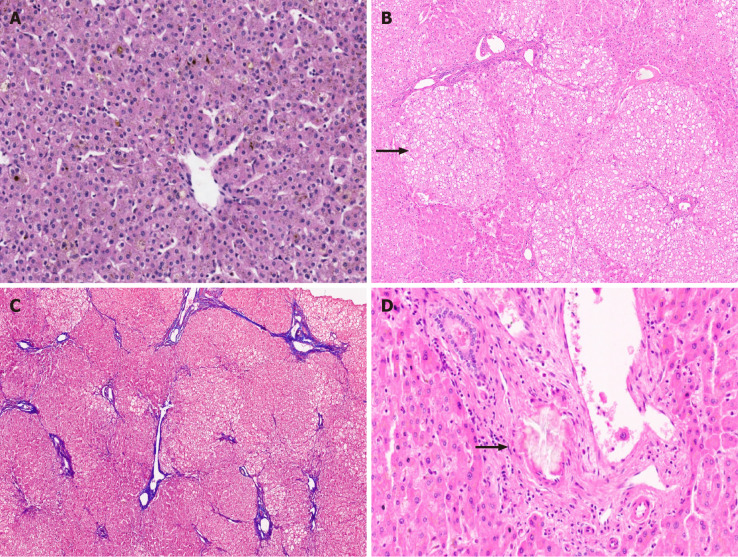
Metabolic liver disease. A: Canalicular bilirubinostasis in case with urea cycle defect [hematoxylin and eosin (HE staining)]; B: Explanted liver in Arginase-1 (ARG-1) deficiency displaying nodules of pale enlarged hepatocytes (arrow, HE staining, B); C: Focal bridging fibrosis in a case of ARG-1 deficiency [Masson trichrome staining]; D: Portal vessel with oxalate crystals in primary hyperoxaluria type 1 (arrow, HE staining).
Figure 6
Figure 6
Metabolic liver disease. A: Crigler Najjar explant liver with no significant morphological findings [Hematoxylin and eosin (HE) staining]; B: Mitochondrial hepatopathy with mixed steatosis and bilirubinostasis HE staining).

References

    1. Kim JS, Kim KM, Oh SH, Kim HJ, Cho JM, Yoo HW, Namgoong JM, Kim DY, Kim KH, Hwang S, Lee SG. Liver transplantation for metabolic liver disease: experience at a living donor dominant liver transplantation center. Pediatr Gastroenterol Hepatol Nutr. 2015;18:48–54. - PMC - PubMed
    1. Alam S, Sood V. Metabolic Liver Disease: When to Suspect and How to Diagnose? Indian J Pediatr. 2016;83:1321–1333. - PubMed
    1. Ferreira CR, Cassiman D, Blau N. Clinical and biochemical footprints of inherited metabolic diseases. II. Metabolic liver diseases. Mol Genet Metab. 2019;127:117–121. - PMC - PubMed
    1. Pham YH, Miloh T. Liver Transplantation in Children. Clin Liver Dis. 2018;22:807–821. - PubMed
    1. Shanmugam NP, Valamparampil JJ, Reddy MS, Al Said KJ, Al-Thihli K, Al-Hashmi N, Al-Jishi E, Isa HMA, Jalan AB, Rela M. Auxiliary Partial Orthotopic Liver Transplantation for Monogenic Metabolic Liver Diseases: Single-Centre Experience. JIMD Rep. 2019;45:29–36. - PMC - PubMed