. 2021 Aug 1;17(8):1695-1705.
doi: 10.5664/jcsm.9308.

Mandibular advancement device use in obstructive sleep apnea: ORCADES study 5-year follow-up data

Affiliations

Mandibular advancement device use in obstructive sleep apnea: ORCADES study 5-year follow-up data

Marie-Françoise Vecchierini et al. J Clin Sleep Med. .

Abstract

Study objectives: Mandibular advancement devices (MADs) are an alternative to continuous positive airway pressure for the management of obstructive sleep apnea (OSA). The ORthèse d'avanCée mAndibulaire dans le traitement en DEuxième intention du SAHOS sévère (ORCADES) study is investigating the long-term effectiveness of MAD therapy in patients with OSA who refused or were intolerant of continuous positive airway pressure. Five-year follow-up data are presented.

Methods: Data were available in 172 of 331 patients treated with a custom-made computer-aided design/computer-aided manufacturing biblock MAD (Narval CC; ResMed, Saint-Priest, France). The primary end point was treatment success (≥50% decrease in apnea-hypopnea index from baseline).

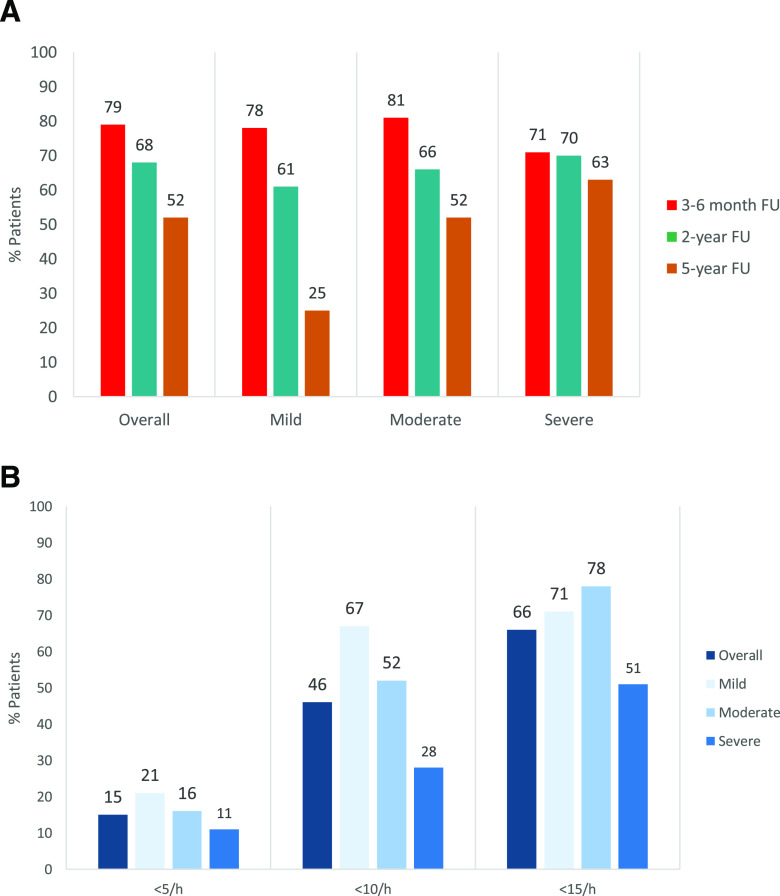
Results: Five-year treatment success rates were 52% overall and 25%, 52%, and 63%, respectively, in patients with mild, moderate, or severe OSA. This reflects a decline over time vs 3-6 months (79% overall) and 2 years (68%). Rates declined in all patient subgroups but to the greatest extent in patients with mild OSA. The slight worsening of respiratory parameters over time was not associated with any relevant changes in sleepiness and symptoms. Moderate or severe OSA at baseline, treatment success at 3-6 months, and no previous continuous positive airway pressure use were significant independent predictors of 5-year treatment success on multivariate analysis. No new safety signals emerged during long-term follow-up. The proportion of patients using their MAD for ≥4 h/night on ≥4 days/wk was 93.3%; 91.3% of patients reported device use of ≥6 h/night at 5 years. At 5-year follow-up, 96.5% of patients reported that they wanted to continue MAD therapy.

Conclusions: Long-term MAD therapy remained effective after 5 years in >50% of patients, with good levels of patient satisfaction and adherence.

Citation: Vecchierini MF, Attali V, Collet JM, et al. Mandibular advancement device use in obstructive sleep apnea: ORCADES study 5-year follow-up data. J Clin Sleep Med. 2021;17(8):1695-1705.

Keywords: adherence; apnea-hypopnea index; mandibular advancement device; obstructive sleep apnea.


Figures

Figure 1
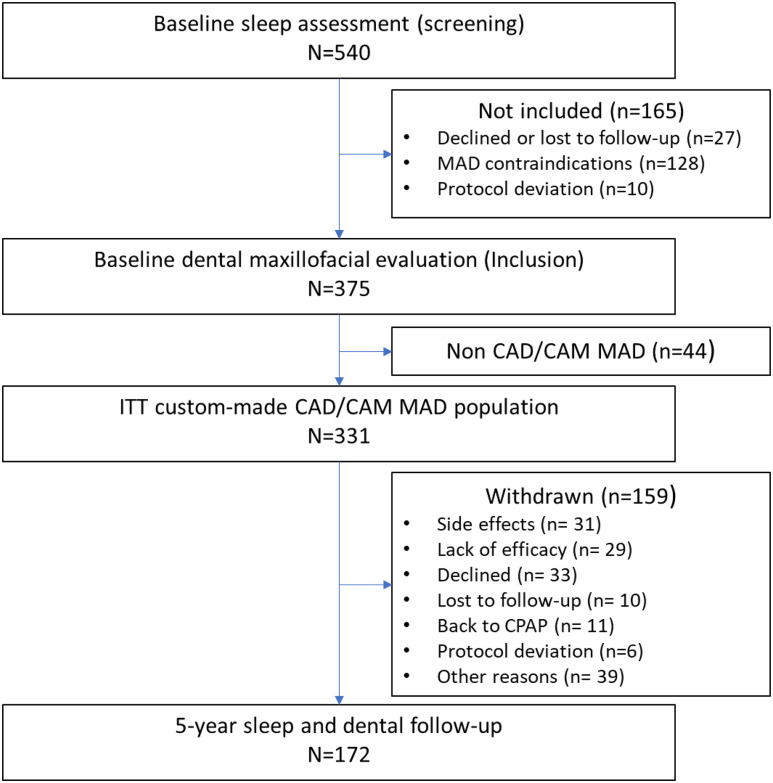
Figure 1. Study flowchart.
*Other reasons for withdrawal from the study were as follows: patients who did not decline the therapy or withdraw their consent but declined to return to follow-up visits at the hospital (these patients could not be considered as lost to follow-up because they answered phone calls; n = 19); MAD-treated patients who did not withdraw their consent but moved out of the area during the follow-up period (n = 7); patients effectively treated with an MAD but who preferred surgery or other therapy to treat their OSA during follow-up (n = 6); patients who stopped MAD because of another pathology (eg, cancer, depression; n = 3); patients who stopped MAD therapy because of weight loss that resolved their OSA (n = 1); death (n = 1); patient with dental treatment not linked to MAD therapy who did not want to resume study treatment (n = 1); and patient file lost by center (n = 1). CAD/CAM = computer-aided design/computer-aided manufacturing, CPAP = continuous positive airway pressure, ITT = intention-to-treat, MAD = mandibular advancement device.
Figure 2
Figure 2. Treatment success rate and 5-year efficacy of mandibular advancement device therapy.
(A) Treatment success rate (percentage of patients with a ≥50% reduction in the AHI from baseline) during mandibular advancement device therapy in patients with OSA, overall and in patient subgroups based on baseline OSA severity (mild: AHI 5–≤15 events/h; moderate: AHI 15–≤30 events/h; severe: AHI >30 events/h). Overall: P = .0159 for the difference between 3- to 6-month FU and 2-year FU; P < .001 for the difference between 3- to 6-month FU and 5-year FU; and P = .034 for the difference between 2-year FU and 5-year FU. (B) Five-year efficacy of mandibular advancement device therapy, defined as the proportion of patients achieving an AHI of <5, <10, or < 15 events/h at 5-year follow-up, in the overall population and in patient subgroups based on baseline OSA severity (mild: AHI 5–≤15 events/h; moderate: AHI 15–≤30 events/h; severe: AHI > 30 events/h). AHI < 5 events/h: no statistically significant difference between patient subgroups; AHI < 10 events/h: P = .0015 for the difference between the mild and severe OSA subgroups and P = .0087 for the difference between the moderate and severe OSA subgroups. AHI < 15 events/h: P = .0025 for the difference between the moderate and severe OSA subgroups. AHI = apnea-hypopnea index, FU = follow-up, OSA = obstructive sleep apnea.
Figure 3
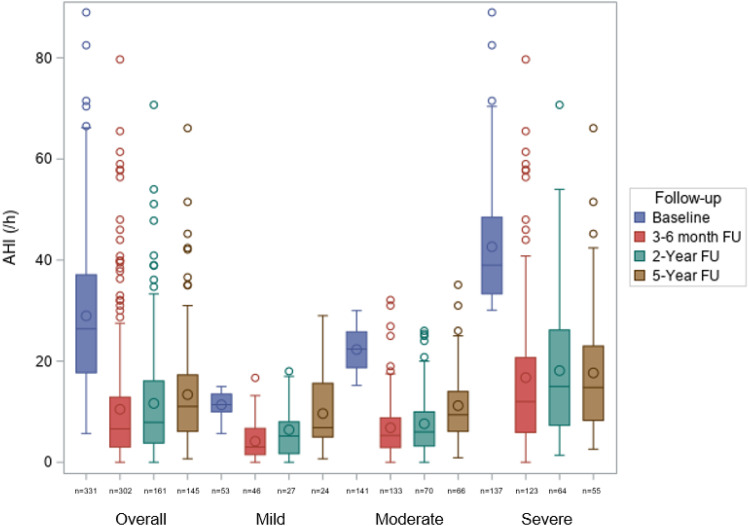
Figure 3. Change in the AHI over time in the overall population and in patient subgroups based on baseline OSA severity (mild: AHI 5–≤15 events/h; moderate: AHI 15–≤30 events/h; severe: AHI > 30 events/h).
Overall: P < .0001 for the difference between baseline and each FU visit; P = .0187 for the difference between 3- and 6-month FU and 2-year FU and P < .0001 for the difference between 3- and 6-month FU and 5-year FU. Mild OSA: P < .0001 for the difference between baseline and 3- to 6-month FU; P = .0002 for the difference between baseline and 2-year FU; and P < .0001 for the difference between 3- to 6-month FU and 5-year FU. Moderate OSA: P < .0001 for the difference between baseline and each FU visit; P < .0001 for the difference between 3- to 6-month FU and 5-year FU; and P = .0004 for the difference between 2-year FU and 5-year FU. Severe OSA: P < .0001 for the difference between baseline and each FU visit. AHI = apnea-hypopnea index, FU = follow-up, OSA = obstructive sleep apnea.
Figure 4
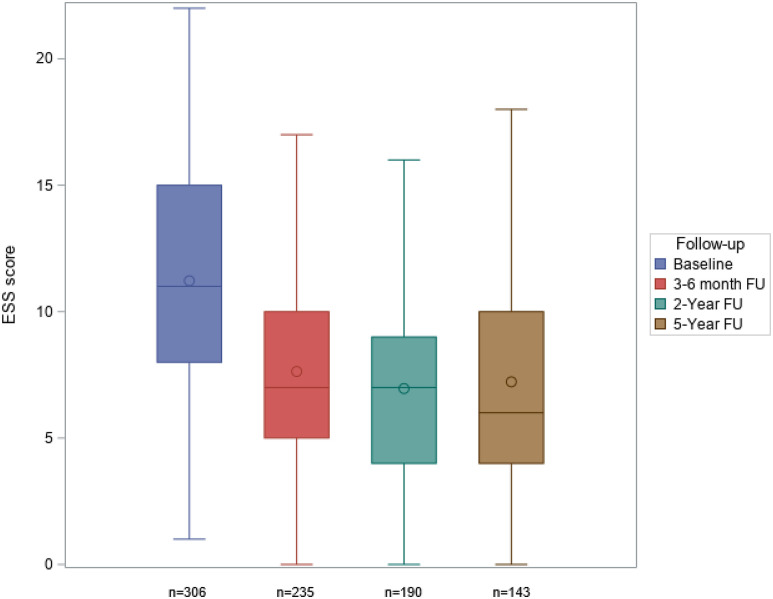
Figure 4. Change in ESS score during 5 years of mandibular advancement device therapy (P < .0001 for comparison with baseline at each FU visit).
ESS = Epworth Sleepiness Scale, FU = follow-up.
Figure 5
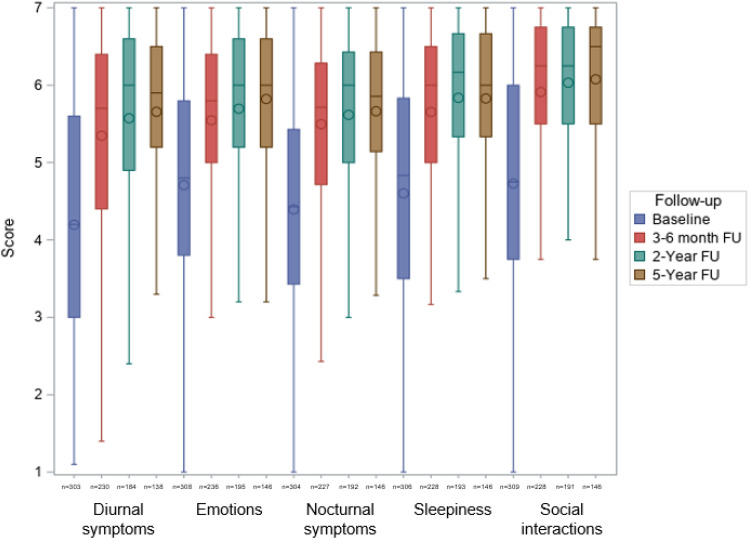
Figure 5. Change in Quebec Sleep Questionnaire scores during 5 years of mandibular advancement device therapy (P < .0001 for comparison with baseline at each FU visit).
FU = follow-up.

Comment in

References

    1. Benjafield AV , Ayas NT , Eastwood PR , et al. . Estimation of the global prevalence and burden of obstructive sleep apnoea: a literature-based analysis . Lancet Respir Med . 2019. ; 7 ( 8 ): 687 – 698 . - PMC - PubMed
    1. Askland K , Wright L , Wozniak DR , Emmanuel T , Caston J , Smith I . Educational, supportive and behavioural interventions to improve usage of continuous positive airway pressure machines in adults with obstructive sleep apnoea . Cochrane Database Syst Rev . 2020. ; 4 : CD007736 . - PMC - PubMed
    1. Patil SP , Ayappa IA , Caples SM , Kimoff RJ , Patel SR , Harrod CG . Treatment of adult obstructive sleep apnea with positive airway pressure: an American Academy of Sleep Medicine Clinical Practice Guideline . J Clin Sleep Med . 2019. ; 15 ( 2 ): 335 – 343 . - PMC - PubMed
    1. Chan AS , Sutherland K , Schwab RJ , et al. . The effect of mandibular advancement on upper airway structure in obstructive sleep apnoea . Thorax . 2010. ; 65 ( 8 ): 726 – 732 . - PubMed
    1. Kato J , Isono S , Tanaka A , et al. . Dose-dependent effects of mandibular advancement on pharyngeal mechanics and nocturnal oxygenation in patients with sleep-disordered breathing . Chest . 2000. ; 117 ( 4 ): 1065 – 1072 . - PubMed

Publication types