Review
. 2021 Nov:160:42-55.
doi: 10.1016/j.yjmcc.2021.04.010. Epub 2021 Jun 22.

Matters of the heart: Cellular sex differences

Affiliations
Review

Matters of the heart: Cellular sex differences

Cierra J Walker et al. J Mol Cell Cardiol. 2021 Nov.

Abstract

Nearly all cardiovascular diseases show sexual dimorphisms in prevalence, presentation, and outcomes. Until recently, most clinical trials were carried out in males, and many animal studies either failed to identify the sex of the animals or combined data obtained from males and females. Cellular sex in the heart is relatively understudied and many studies fail to report the sex of the cells used for in vitro experiments. Moreover, in the small number of studies in which sex is reported, most of those studies use male cells. The observation that cells from males and females are inherently different is becoming increasingly clear - either due to acquired differences from hormones and other factors or due to intrinsic differences in genotype (XX or XY). Because of the likely contribution of cellular sex differences in cardiac health and disease, here, we explore differences in mammalian male and female cells in the heart, including the less-studied non-myocyte cell populations. We discuss how the heart's microenvironment impacts male and female cellular phenotypes and vice versa, including how secretory profiles are dependent on cellular sex, and how hormones contribute to sexually dimorphic phenotypes and cellular functions. Intracellular mechanisms that contribute to sex differences, including gene expression and epigenetic remodeling, are also described. Recent single-cell sequencing studies have revealed unexpected sex differences in the composition of cell types in the heart which we discuss. Finally, future recommendations for considering cellular sex differences in the design of bioengineered in vitro disease models of the heart are provided.

Keywords: Cardiovascular disease; Cellular sex; Heart biology; Sex differences.


Conflict of interest statement

Declaration of Competing Interest

The authors declare that they have no conflict of interest.

Figures
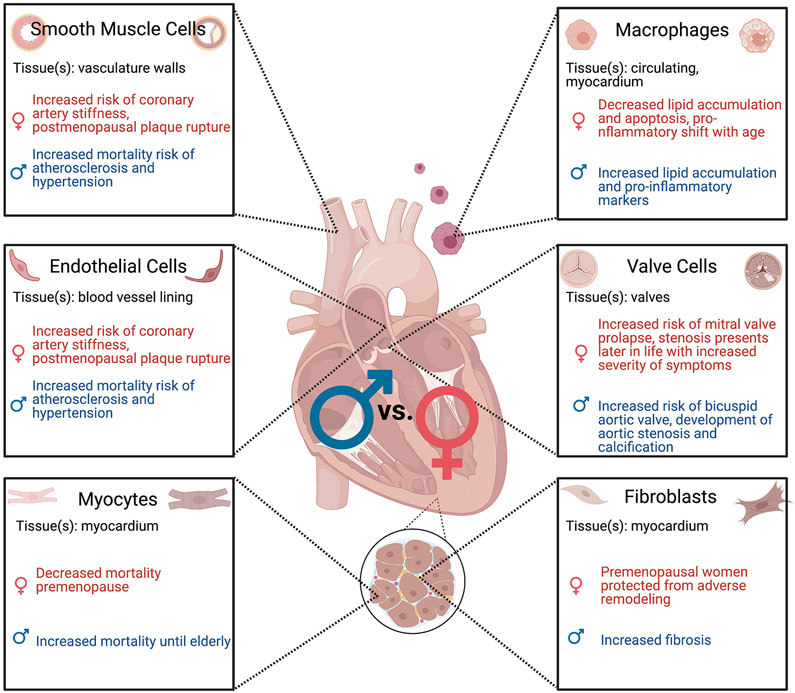
Figure 1.
Figure 1.
Pathophysiology of cardiac diseases can be linked to differences in cellular sex of myocytes [2], endothelial cells [3-7], fibroblasts [8-10], macrophages [11-13], smooth muscle cells [3-7], and valve cells [14-19]. Figure created with BioRender.com.
Figure 2.
Figure 2.
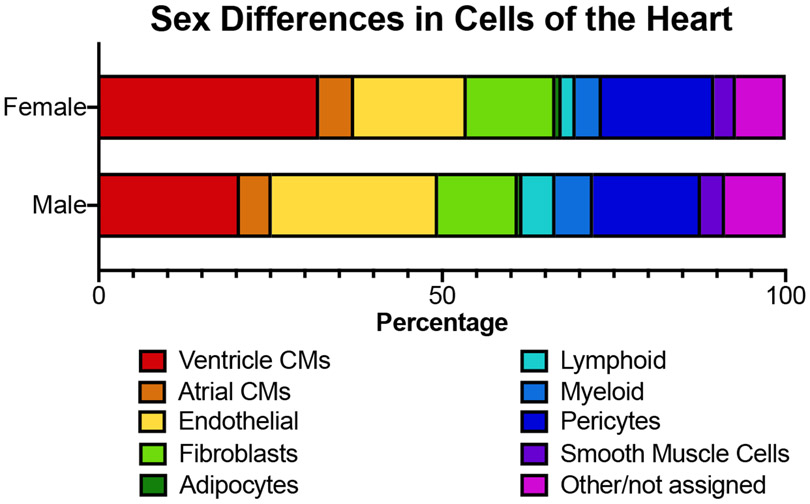
Cell distribution in male and female human hearts based on single cell sequencing datasets from the heartcellatlas.org [26]. Healthy hearts from seven males and seven females with an age range of 40-75 years and collected from North America and the United Kingdom.
Figure 3:
Figure 3:
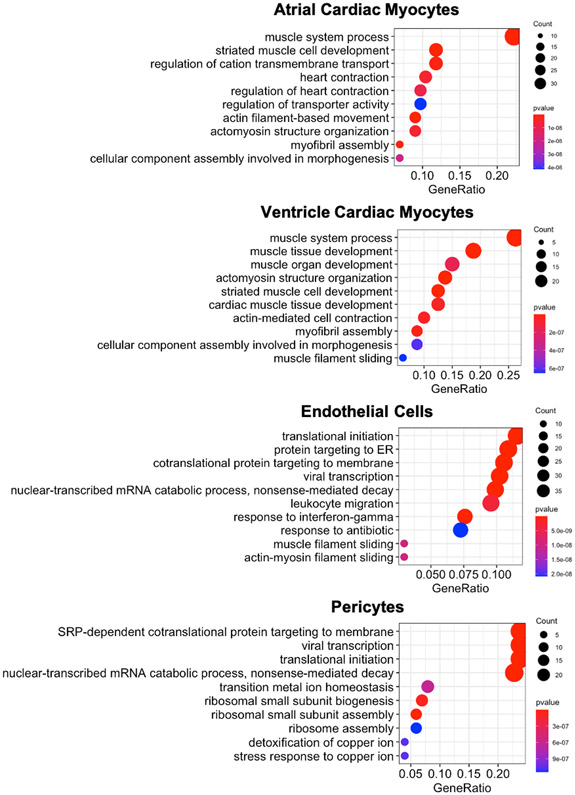
Gene ontology – biological processes term analysis of differentially expressed genes between male and female CMs, ECs, and pericytes. Lists of the differentially expressed genes between males and females from all cell types in the heart can be found in Supplemental Table 1. The gene ratio refers to the number of significantly different genes identified between male and female cells that fit within a specific GO term over the total number of significantly different genes identified. Essentially, the gene ratio signifies the enrichment of the GO term within the significantly differentially expressed gene set.
Figure 4:
Figure 4:
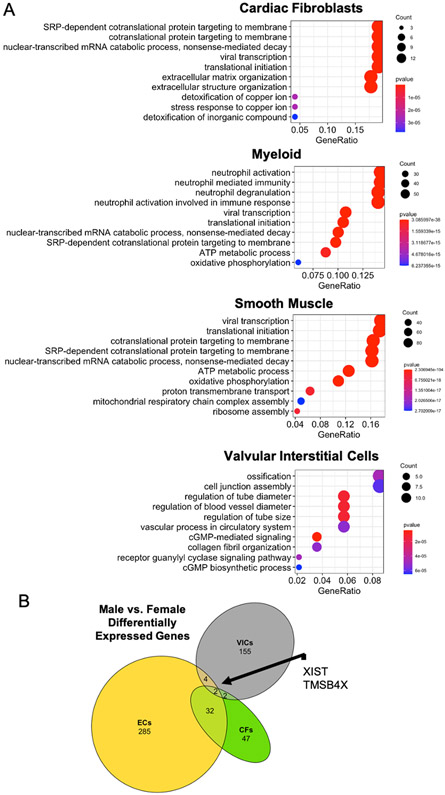
A) Gene ontology – biological processes term analysis of differentially expressed genes between male and female cardiac fibroblasts, myeloid, smooth muscle, and valvular interstitial cells. Lists of the differentially expressed genes between males and females from all cell types in the heart can be found in Supplemental Table 1. The gene ratio refers to the number of significantly different genes identified between male and female cells that fit within a specific GO term over the total number of significantly different genes identified. Essentially, the gene ratio signifies the enrichment of the GO term within the significantly differentially expressed gene set. B) Comparisons of differentially expressed genes between male and female cells. ECs = endothelial cells, CFs = cardiac fibroblasts, VICs = valvular interstitial cells. Data for ECs and CFs from heartcellatlas.org. Data for VICs from microarray of porcine VICs [174].

References

    1. Squiers GT, McLellan MA, Ilinykh A, Branca J, Rosenthal NA, Pinto AR, Cardiac cellularity is dependent upon biological sex and is regulated by gonadal hormones, Cardiovasc. Res (2020). 10.1093/cvr/cvaa265. - DOI - PMC - PubMed
    1. Leinwand LA, Sex is a potent modifier of the cardiovascular system, J. Clin. Invest 112 (2003) 302–307. 10.1172/jci19429. - DOI - PMC - PubMed
    1. Ishii Y, Langberg J, Rosborough K, Mikawa T, Endothelial cell lineages of the heart, Cell Tissue Res. 335 (2009) 67–73. 10.1007/s00441-008-0663-z. - DOI - PMC - PubMed
    1. Brutsaert DL, Cardiac endothelial-myocardial signaling: Its role in cardiac growth, contractile performance, and rhythmicity, Physiol. Rev 83 (2003) 59–115. 10.1152/physrev.00017.2002. - DOI - PubMed
    1. Cattaneo MG, Banfi C, Brioschi M, Lattuada D, Vicentini LM, Sex-dependent differences in the secretome of human endothelial cells, Biol. Sex Differ 12 (2021) 7. 10.1186/s13293-020-00350-3. - DOI - PMC - PubMed

Publication types

Substances