. 2021 Jun 24;11(6):e044463.
doi: 10.1136/bmjopen-2020-044463.

Queensland Family Cohort: a study protocol

Collaborators, Affiliations

Queensland Family Cohort: a study protocol

Danielle Borg et al. BMJ Open. .

Abstract

Introduction: The perinatal-postnatal family environment is associated with childhood outcomes including impacts on physical and mental health and educational attainment. Family longitudinal cohort studies collect in-depth data that can capture the influence of an era on family lifestyle, mental health, chronic disease, education and financial stability to enable identification of gaps in society and provide the evidence for changes in government in policy and practice.

Methods and analysis: The Queensland Family Cohort (QFC) is a prospective, observational, longitudinal study that will recruit 12 500 pregnant families across the state of Queensland (QLD), Australia and intends to follow-up families and children for three decades. To identify the immediate and future health requirements of the QLD population; pregnant participants and their partners will be enrolled by 24 weeks of gestation and followed up at 24, 28 and 36 weeks of gestation, during delivery, on-ward, 6 weeks postpartum and then every 12 months where questionnaires, biological samples and physical measures will be collected from parents and children. To examine the impact of environmental exposures on families, data related to environmental pollution, household pollution and employment exposures will be linked to pregnancy and health outcomes. Where feasible, data linkage of state and federal government databases will be used to follow the participants long term. Biological samples will be stored long term for future discoveries of biomarkers of health and disease.

Ethics and dissemination: Ethical approval has been obtained from the Mater Research Ethics (HREC/16/MHS/113). Findings will be reported to (1) QFC participating families; (2) funding bodies, institutes and hospitals supporting the QFC; (3) federal, state and local governments to inform policy; (4) presented at local, national and international conferences and (5) disseminated by peer-review publications.

Keywords: cell biology; epidemiology; obstetrics; physiology.


Conflict of interest statement

Competing interests: None declared.

Figures
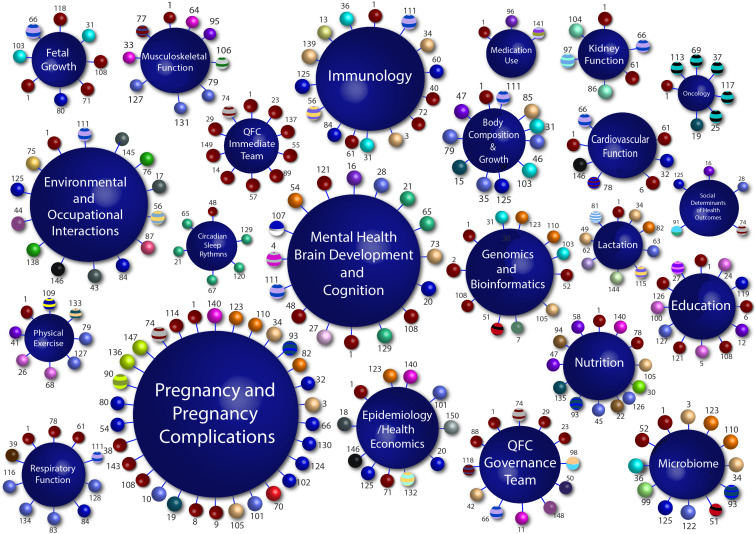
Figure 1
Figure 1
The QFC research collaborative. Each large sphere (navy blue) represents one of the 21 research themes that compromise the QFC research collaborative. Each number represents an individual researcher (150 researchers to date). Each small sphere represents the affiliation of that particular researcher (51 collaborating institutes/universities). These affiliation areas follows: ACU (Faculty of Health Sciences); ACU (Institute for Learning Science and Teacher Education); ACU/UQ (Faculty of Health and Behavioural Sciences); Child Health Research Centre; Griffith University; James Cook University (Australian Institute of Tropical Health & Medicine); James Cook University (Department of Medicine); Mater Health; Mater Health Pathology(consultant microbiologist); Mater Health/Princess Alexander Hospital; MaterHealth/ Queensland Children's Hospital; Mater Research—UQ/Mater Health; Mater Research/Carbal MedicalServices; Mater Research—UQ; Menzies Health Institute Queensland/Griffith University (Griffith Health); Metro South Health/QUT (Faculty of Health); Metro South Health/Princess Alexander Hospital; Monash University (Faculty of Medicine, Nursing and Health Sciences); NSW Department of Planning, Industry and Environment; Pathology Queensland; QIMR Berghofer; QUT (Faculty of Health); QUT (Faculty of Health)/Child Health Research Centre; QUT (Faculty of Science and Engineering);QUT (Faculty of Science and Engineering)/Child Health Research Centre; QUT (Faculty of Health)/UQ (Centre of Clinical Research); QUT/University ofGeorgia; South Australian Health and Medical Research Institute; Sun Yat-SenUniversity; University of Newcastle; University of Southampton; UQ (Institute for Social Science Research; Faculty of Humanities and Social Sciences); UQ(Centre of Clinical Research); UQ (Diamantina Institute); UQ (Diamantina Institute)/Dermatology Research Centre; UQ (Discipline of General Practice;Primary Care Clinical Unit); UQ (Faculty of Business, Economics & Law); UQ (Faculty of Engineering, Architecture & Information Technology); UQ (Faculty of Health and Behavioural Sciences); UQ (Faculty of Health and Behavioural Sciences)/Bond University (Faculty of Health Sciences &Medicine)/Mater Health; UQ (Faculty of Medicine); UQ (Faculty of Medicine)/Child Health Research Centre; UQ (Faculty of Medicine)/Centre for Health Services Research; UQ (Faculty of Medicine)/Mater Research-UQ; UQ (Faculty of Medicine)/Perinatal Research Centre; UQ (Faculty of Science)/UQ (Centre of Clinical Research); UQ (Institute for Molecular Bioscience); UQ (Institute forSocial Science Research); UQ (Queensland Brain Institute); Wesley Hospital Monash IVF and Wesley Hospital Monash IVF/University of Melbourne.

References

    1. Barker DJP. Developmental origins of adult health and disease. J Epidemiol Community Health 2004;58:114–5. 10.1136/jech.58.2.114 - DOI - PMC - PubMed
    1. Gluckman PD, Hanson MA, Cooper C, et al. . Effect of in utero and early-life conditions on adult health and disease. N Engl J Med 2008;359:61–73. 10.1056/NEJMra0708473 - DOI - PMC - PubMed
    1. Gluckman PD, Hanson MA, Pinal C. The developmental origins of adult disease. Matern Child Nutr 2005;1:130–41. 10.1111/j.1740-8709.2005.00020.x - DOI - PMC - PubMed
    1. Braun JM, Messerlian C, Hauser R. Fathers matter: why it's time to consider the impact of paternal environmental exposures on children's health. Curr Epidemiol Rep 2017;4:46–55. 10.1007/s40471-017-0098-8 - DOI - PMC - PubMed
    1. Western M, Foelz C. The case for a new Australian birth cohort study. Brisbane: Institute for Social Science Research, University of Queensland, 2014.

Publication types

LinkOut - more resources
