. 2021 Jun 24;13(12):15770-15784.
doi: 10.18632/aging.203159. Epub 2021 Jun 24.

In silico analysis identifies neuropilin-1 as a potential therapeutic target for SARS-Cov-2 infected lung cancer patients

Affiliations

In silico analysis identifies neuropilin-1 as a potential therapeutic target for SARS-Cov-2 infected lung cancer patients

Song Hu et al. Aging (Albany NY). .

Abstract

The severe acute respiratory syndrome coronavirus 2 (SARS-CoV-2) causes coronavirus disease 2019 (COVID-19), and is highly contagious and pathogenic. TMPRSS2 and Neuropilin-1, the key components that facilitate SARS-CoV-2 infection, are potential targets for treatment of COVID-19. Here we performed a comprehensive analysis on NRP1 and TMPRSS2 in lung to provide information for treating comorbidity of COVID-19 with lung cancer. NRP1 is widely expressed across all the human tissues while TMPRSS2 is expressed in a restricted pattern. High level of NRP1 associates with worse prognosis in multiple cancers, while high level of TMPRSS2 is associated with better survival of Lung Adenocarcinoma (LUAD). Moreover, NRP1 positively correlates with the oncogenic Cancer Associated Fibroblast (CAF), macrophage and endothelial cells infiltration, negatively correlates with infiltration of CD8+ T cell, the tumor killer cell in Lung Squamous cell carcinoma (LUSC). TMPRSS2 shows negative correlation with the oncogenic events in LUAD. RNA-seq data show that NRP1 level is slightly decreased in peripheral blood of ICU admitted COVID-19 patients, unaltered in lung, while TMPRSS2 level is significantly decreased in lung of COVID-19 patients. Our analysis suggests NRP1 as a potential therapeutic target, while sets an alert on targeting TMPRSS2 for treating comorbidity of COVID-19 and lung cancers.

Keywords: COVID-19; NRP1; SARS-CoV-2; TMPRSS2; immune infiltration; miRNA.


Conflict of interest statement

CONFLICTS OF INTEREST: The authors declare that they have no conflicts of interest.

Figures

Figure 1
Figure 1
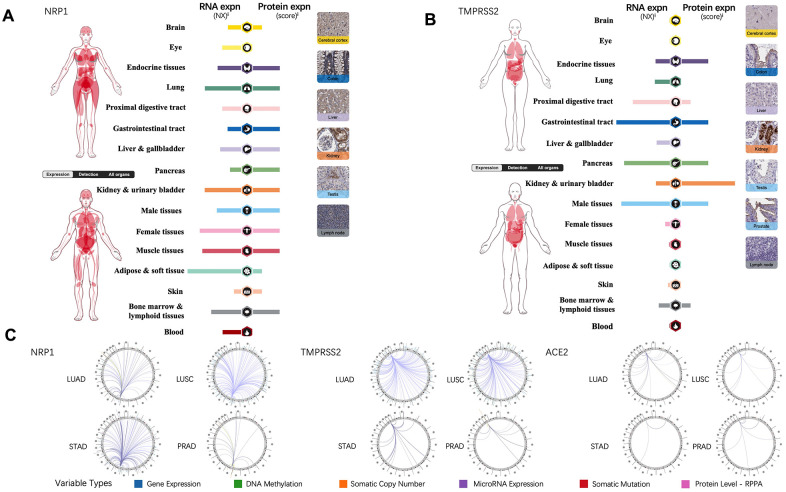
NRP1, TMPRSS2 and ACE2 expression in human normal tissue and their interrelation with other genes. (A) The expression levels of NRP1 in human tissues. (B) The expression levels of TMPRSS2 in human tissues. (C) The correlation between certain genes and NRP1, TMPRSS2, ACE2 in LUAD, LUSC, STAD and PRAD.
Figure 2
Figure 2
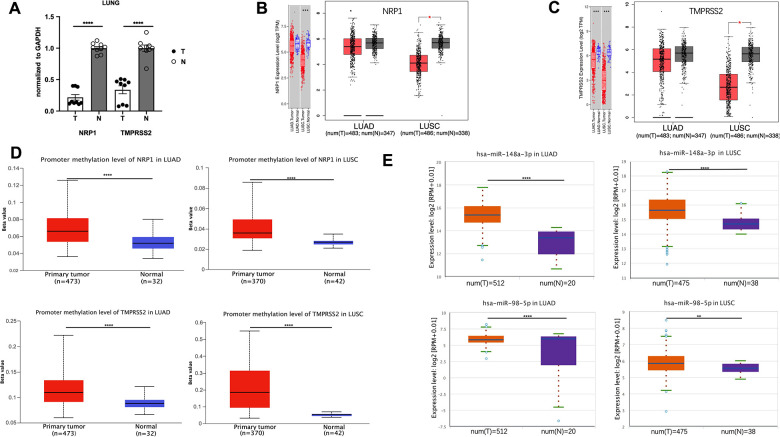
The promoter methylation level of NRP1(TMPRESS2) and miRNA expression level in lung tumors. (A) qPCR analysis of the expression of NRP1 and TMPRSS2 in LUAD tissues and paired normal tissues. n=3, **** P<0.0001. (B) The expression of NRP1 analyzed with TIMER and GEPIA. (C) The expression of TMPRSS2 analyzed with TIMER and GEPIA. (D)The promoter methylation level of NRP1 and TMPRSS2 in LUAD or LUSC analyzed with UALCAN. (E) The hsa-mir-148a and hsa-mir-98-5p expression level in LUAD and LUSC analyzed with ENCORI.
Figure 3
Figure 3
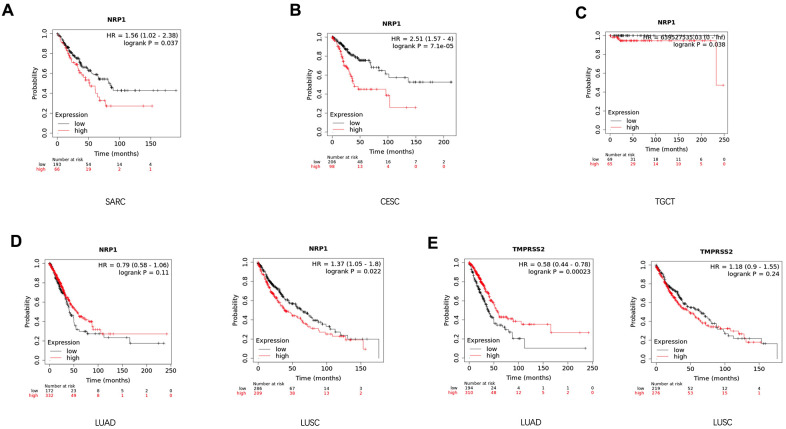
Survival analysis of cancer patients with differential gene expression level. (AD) Survival curve of SARC (n=259), CESC (n=304), TGCT (n=134), LUSC (n=501) and LUAD (n=513) patients with differential level of NRP1 expression. (E) Survival curve of LUSC and LUAD patients with differential level of TMPRSS2 expression. Analysis was done with Kaplan-Meier Plotter.
Figure 4
Figure 4
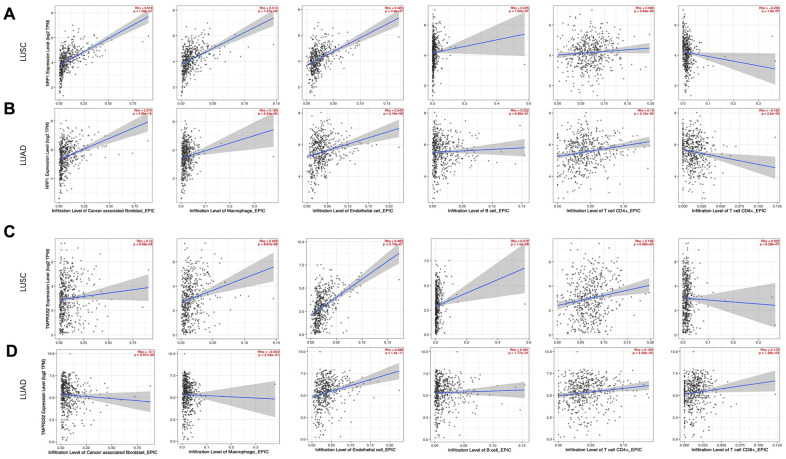
Correlation analysis between NRP1/TMPRSS2 expression and tumor immune infiltration. (A, B) Correlation analysis between NRP1 expression and tumor immune infiltration in LUSC (n=501) and LUAD (n=515). (C, D) Correlation analysis between TMPRESS2 expression and tumor immune infiltration in LUSC and LUAD. None purity-adjusted for all the panels.
Figure 5
Figure 5
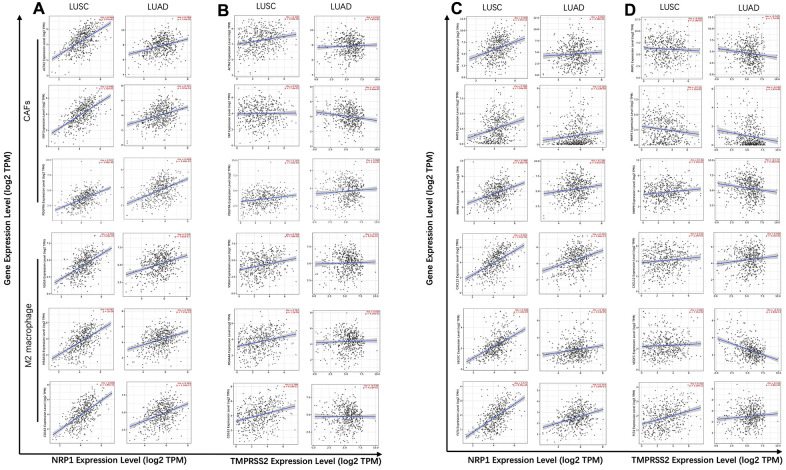
Correlation analysis between NRP1/TMPRSS2 and pro-tumorigenic factors. (A) Correlation analysis between NRP1 and markers for CAFs and M2 macrophage in LUSC (n=501) and LUAD (n=515). (B) Correlation analysis between TMPRSS2 and markers for CAFs and M2 macrophage in LUSC and LUAD. (C) Correlation analysis between NRP1 and MMP1, MMP3, MMP9, VEGFC, FLT4 and CXCL12 in LUSC and LUAD. (D) Correlation analysis between TMPRSS2 and MMP1, MMP3, MMP9, VEGFC, FLT4 and CXCL12 in LUSC and LUAD. None purity-adjusted for all the panels.
Figure 6
Figure 6
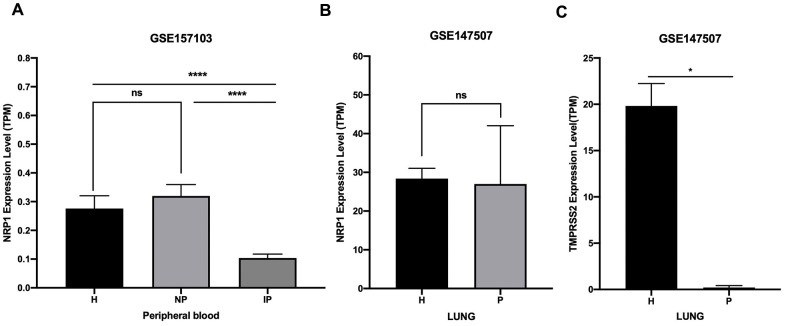
Expression analysis of NRP1 and TMPRSS2 after SARS-CoV-2 infection. (A) TPM of NRP1 in peripheral blood RNA seq data. H: healthy control. NP: Non-ICU patients with COVID-19. IP: ICU patients with COVID-19. (B) TPM of NRP1 in lung RNA seq data. H: healthy control. P: COVID-19 patients. (C) TPM of TMPRSS2 in lung RNA seq data. H: healthy control. P: COVID-19 patients. ****, P<0.0001. *, P<0.05. ns, not significant.

References

    1. Feng RM, Zong YN, Cao SM, Xu RH. Current cancer situation in China: good or bad news from the 2018 Global Cancer Statistics? Cancer Commun (Lond). 2019; 39:22. 10.1186/s40880-019-0368-6 - DOI - PMC - PubMed
    1. Astuti I, Ysrafil. Severe Acute Respiratory Syndrome Coronavirus 2 (SARS-CoV-2): An overview of viral structure and host response. Diabetes Metab Syndr. 2020; 14:407–12. 10.1016/j.dsx.2020.04.020 - DOI - PMC - PubMed
    1. Rogado J, Pangua C, Serrano-Montero G, Obispo B, Marino AM, Pérez-Pérez M, López-Alfonso A, Gullón P, Lara MÁ. Covid-19 and lung cancer: A greater fatality rate? Lung Cancer. 2020; 146:19–22. 10.1016/j.lungcan.2020.05.034 - DOI - PMC - PubMed
    1. Luo J, Rizvi H, Preeshagul IR, Egger JV, Hoyos D, Bandlamudi C, McCarthy CG, Falcon CJ, Schoenfeld AJ, Arbour KC, Chaft JE, Daly RM, Drilon A, et al. COVID-19 in patients with lung cancer. Ann Oncol. 2020; 31:1386–96. 10.1016/j.annonc.2020.06.007 - DOI - PMC - PubMed
    1. Rizzolio S, Tamagnone L. Multifaceted role of neuropilins in cancer. Curr Med Chem. 2011; 18:3563–75. 10.2174/092986711796642544 - DOI - PubMed

Publication types

MeSH terms