


Near-Ambient-Temperature Dehydrogenative Synthesis of the Amide Bond: Mechanistic Insight and Applications
- PMID: 34168903
- PMCID: PMC8218306
- DOI: 10.1021/acscatal.1c00728
Near-Ambient-Temperature Dehydrogenative Synthesis of the Amide Bond: Mechanistic Insight and Applications
Abstract
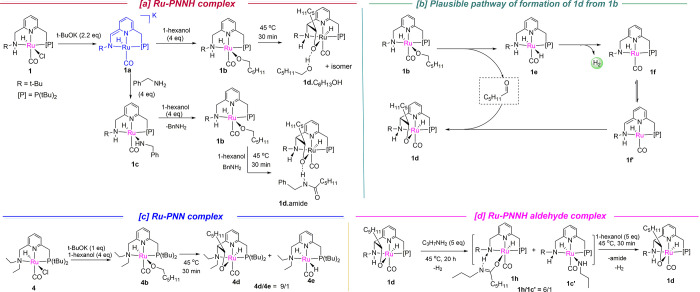
The current existing methods for the amide bond synthesis via acceptorless dehydrogenative coupling of amines and alcohols all require high reaction temperatures for effective catalysis, typically involving reflux in toluene, limiting their potential practical applications. Herein, we report a system for this reaction that proceeds under mild conditions (reflux in diethyl ether, boiling point 34.6 °C) using ruthenium PNNH complexes. The low-temperature activity stems from the ability of Ru-PNNH complexes to activate alcohol and hemiaminals at near-ambient temperatures through the assistance of the terminal N-H proton. Mechanistic studies reveal the presence of an unexpected aldehyde-bound ruthenium species during the reaction, which is also the catalytic resting state. We further utilize the low-temperature activity to synthesize several simple amide bond-containing commercially available pharmaceutical drugs from the corresponding amines and alcohols via the dehydrogenative coupling method.
© 2021 The Authors. Published by American Chemical Society.
Conflict of interest statement
The authors declare no competing financial interest.
Figures




References
-
- Cupido T.; Tulla-Puche J.; Spengler J.; Albericio F. The synthesis of naturally occurring peptides and their analogs. Curr. Opin. Drug Discovery Dev. 2007, 10, 768–783. - PubMed
- Hu P.; Ben-David Y.; Milstein D. Rechargeable Hydrogen Storage System Based on the Dehydrogenative Coupling of Ethylenediamine with Ethanol. Angew. Chem., Int. Ed. 2016, 55, 1061–1064. 10.1002/anie.201505704. - DOI - PubMed
- Hu P.; Fogler E.; Diskin-Posner Y.; Iron M. A.; Milstein D. A novel liquid organic hydrogen carrier system based on catalytic peptide formation and hydrogenation. Nat. Commun. 2015, 6, 6859. 10.1038/ncomms7859. - DOI - PMC - PubMed
- Xie Y.; Hu P.; Ben-David Y.; Milstein D. A Reversible Liquid Organic Hydrogen Carrier System Based on Methanol-Ethylenediamine and Ethylene Urea. Angew. Chem., Int. Ed. 2019, 58, 5105–5109. 10.1002/anie.201901695. - DOI - PubMed
-
- Carey J. S.; Laffan D.; Thomson C.; Williams M. T. Analysis of the reactions used for the preparation of drug candidate molecules. Org. Biomol. Chem. 2006, 4, 2337–2347. 10.1039/b602413k. - DOI - PubMed
- Dunetz J. R.; Magano J.; Weisenburger G. A. Large-Scale Applications of Amide Coupling Reagents for the Synthesis of Pharmaceuticals. Org. Process Res. Dev. 2016, 20, 140–177. 10.1021/op500305s. - DOI
-
- Han S.-Y.; Kim Y.-A. Recent development of peptide coupling reagents in organic synthesis. Tetrahedron 2004, 60, 2447–2467. 10.1016/j.tet.2004.01.020. - DOI
- Valeur E.; Bradley M. Amide bond formation: beyond the myth of coupling reagents. Chem. Soc. Rev. 2009, 38, 606–631. 10.1039/b701677h. - DOI - PubMed
- de Figueiredo R. M.; Suppo J.-S.; Campagne J.-M. Nonclassical Routes for Amide Bond Formation. Chem. Rev. 2016, 116, 12029–12122. 10.1021/acs.chemrev.6b00237. - DOI - PubMed
- Montalbetti C. A. G. N.; Falque V. Amide bond formation and peptide coupling. Tetrahedron 2005, 61, 10827–10852. 10.1016/j.tet.2005.08.031. - DOI
- Sabatini M. T.; Boulton L. T.; Sneddon H. F.; Sheppard T. D. A green chemistry perspective on catalytic amide bond formation. Nat. Catal. 2019, 2, 10–17. 10.1038/s41929-018-0211-5. - DOI
-
- Constable D. J. C.; Dunn P. J.; Hayler J. D.; Humphrey G. R.; Leazer J. L.; Linderman R. J.; Lorenz K.; Manley J.; Pearlman B. A.; Wells A.; Zaks A.; Zhang T. Y. Key green chemistry research areas—a perspective from pharmaceutical manufacturers. Green Chem. 2007, 9, 411–420. 10.1039/b703488c. - DOI
- Bandichhor R.; Bhattacharya A.; Diorazio L.; Dunn P.; Fraunhoffer K.; Gallou F.; Hayler J.; Hickey M.; Hinkley B.; Hughes D.; Humphreys L.; Kaptein B.; Mathew S.; Oh L.; Richardson P.; White T.; Wuyts S. Green Chemistry Articles of Interest to the Pharmaceutical Industry. Org. Process Res. Dev. 2013, 17, 1394–1405. 10.1021/op400263a. - DOI
LinkOut - more resources
Full Text Sources
Other Literature Sources